fetching data ... 
Background: MEFV gene variants, which are responsible for familial Mediterranean fever (FMF), have been studied in various inflammatory disorders. Although some studies suggest an association of M694V with some rheumatic diseases, all studies suffer from small sample sizes. The aim of this study was to conduct a meta-analysis of these studies to asses whether any of the four common MEFV variants (E148Q, M694V, M680I, and V726A) showed an association with rheumatic diseases other than FMF in Turkish population.
Methods: We performed a systematic search of the literature using major health science databases and proceedings of relevant international meetings. We used keywords ``MEFV and (Turkey OR Turkish)''. We also made hand searches of bibliographiesof the found articles. StatsDirect software was used for meta-analysis.
Results: Eight controlled studies out of 33 studies identified, were evaluated in this meta-analysis. Three studies assessed MEFV variants in patients with ankylosing spondylitis (AS), 4 studies in patients with Behcet's disease (BD) and 2 studies in patients with rheumatoid arthritis (RA), one study examined both AS and RA. In total, the genotypes of 335 patients with AS, 479 patients with BD, 149 patients with RA and 793 healthy controls (HCs) were analyzed. Allele frequency of M694V, compared to HCs (2.3%), was significantly increased in AS (6.5%) (Figure 1a) and in BD (5.8%) (Figure 1b), but not in RA (1.0%). The carriage rate of M694V in patients with AS (12.5%) and in patients with BD (10.9%) were also significantly higher than in HCs (4.5%) (p<0.001 for both comparisons). Frequency of the other analyzed MEFV variants in any patient group was not different than the HCs. Merged data from two uncontrolled studies in AS (n=207), which were not included in the meta-analysis, also indicated an increased allelic frequency of M694V of 9.4% when compared to that of a previous study from the same center/city conducted in HCs (n=100) (p=0,0003, 0R: 6.8 (95% CI 2.1-22.4). In an uncontrolled study of RA (n=20) M694V was not detected in any patient. It was also of great interest to identify 5 patients with AS (n=542) and 4 patients with BD (n=479) who were homozygous for M694V in the assessed studies.
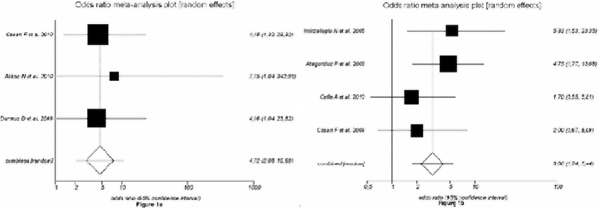
Conclusions: These results suggest that M694V may be the genetic explanation for the reported cases in the literature which suggest an association of AS and BD with FMF.
Disclosure of Interest: None Declared