fetching data ... 
Background: Sarilumab is the first fully human monoclonal antibody directed against IL-6Rα.
Objectives: Part A of the MOBILITY phase 2/3 seamless study evaluated the efficacy and safety of 5 dose regimens of subcutaneous sarilumab on top of methotrexate (MTX) versus placebo plus MTX, for the treatment of rheumatoid arthritis (RA).
Methods: Adults with active, moderate-to-severe RA who had an inadequate response to treatment with MTX were randomized to 6 groups: sarilumab 100 mg every other week (q2w), 150 mg q2w, 100 mg weekly (qw), 200 mg q2w, 150 mg qw, or placebo. All patients were on background MTX. The primary endpoint was the proportion of patients achieving ACR20 response at Week 12.
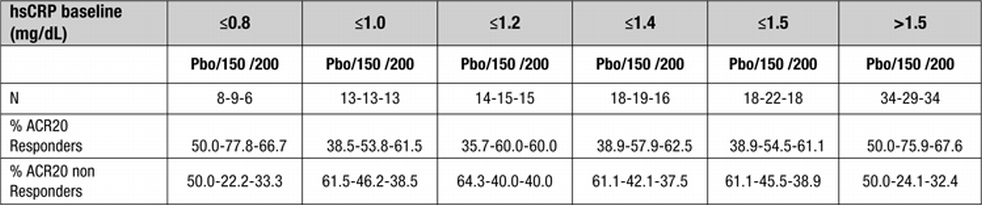
Results: Baseline demographic and disease characteristics of the 306 patients enrolled in the study were similar across groups: 79% female; mean age 52 yrs; disease duration 8 yrs; RF+ 79.7%; tender joint count 27; swollen joint count 17; hsCRP 2.8 mg/dL; and HAQ-DI 1.6. ACR20 response at Week 12 was higher in 4 sarilumab dose groups but statistically significantly greater in the 150 mg qw arm only (72.0%, P=0.02) when compared to placebo (46.2%). At week 12, the 2 sarilumab doses (150 and 200 mg q2w) selected for the subsequent phase 3 (MOBILITY part B), showed statistically significant improvement of at least 3 of the seven ACR core components and marginal significance (p value range >0.01 to <0.02) in a fourth compared to the placebo arm. A post hoc analysis of the ACR20 response based on hsCRP value was performed comparing placebo to that of sarilumab 150 and 200 mg q2w. Results indicated that ACR response to Sarilumab was not correlated to changes in hsCRP. The percentage of patients with ≥1 treatment emergent adverse event (AE) ranged from 43% to 72% for the sarilumab groups versus 47% for placebo. The most common treatment emergent AEs reported in the active treatment arms were infections (non-serious) 12-26%, neutropenia 0-20%, and ALT increase 0-6%. Eight patients (3 receiving sarilumab 100 mg q2w, 3 receiving 100 mg qw, and 2 receiving placebo) experienced at least 1 treatment emergent serious AE. One death (stroke/acute respiratory distress syndrome) occurred in a patient treated with sarilumab. Increases in total cholesterol, LDL and HDL were seen with sarilumab, consistent with those previously observed with the approved IL-6 inhibitor.
Conclusions: In this phase 2 study, sarilumab 150 mg qw, in combination with methotrexate, demonstrated efficacy in patients with active, moderate-to-severe rheumatoid arthritis, who had inadequate response to MTX. Moreover, for the doses that were selected for phase 3 (150 and 200 mg q2w), sarilumab resulted in an improvement in some ACR core components compared to placebo. The types and incidence of adverse events were consistent with those previously reported with IL-6 inhibition. MOBILITY Part B (SARIL-RA-MOBILITY) the phase 3 portion of the seamless study will assess long-term efficacy of sarilumab in rheumatoid arthritis.
Clinical trial identifier: NTC01061736
Disclosure of Interest: T. Huizinga Consultant for: Sanofi, A. Kivitz: None Declared, M. Rell-Bakalarska: None Declared, R. Fleischmann Grant/Research support from: Sanofi, Regeneron Pharmaceuticals, Inc., Consultant for: Sanofi, Regeneron Pharmeceuticals, Inc., M. Jasson Shareholder of: Sanofi, Employee of: Sanofi, A. Radin Shareholder of: Regeneron Pharmaceuticals, Inc., Employee of: Regeneron Pharmaceuticals, Inc., M. Genovese Grant/Research support from: Sanofi, Regeneron Pharmaceuticals, Inc., Consultant for: Sanofi, Regeneron Pharmaceuticals, Inc.