fetching data ... 
Background: Few studies and small series have addressed the characteristics of pure membranous lupus nephritis (MLN).
Objectives: To establish the clinical characteristics, treatment and prognosis of MLN and to make international and intersocial comparisons.
Methods: Twenty-one Spanish centres and 1 in the US participated in the study. All SLE patients with biopsy proven MLN were included. Data on clinical and laboratory features, prescribed drugs, renal outcomes and survival were collected. Descriptive statistics were used to describe the main features of the series. Chi-squared distribution and Fisher test were use to analyse categorical variables and the U Mann-Whitney test for quantitative variable. A p value <0.05 was considered significant.
Results: 134 patients were included (see table). Female sex (.036), a low basal serum creatinine (BSC) (0.92 Vs 1.53 mg/dl; <0.001) and previous treatment with azathioprine (AZA) (.046) were predictors of a final proteinuria <1 g. US patients (0.042), patients without a Health coverage (0.033), with previous venous thrombosis (0.037) and those who had not received chloroquine (0.011) or AZA (0.028) for MLN had less chances of achieving a final proteinuria <0.5 g. Patients with final doubled creatinine had a greater initial 24 h-proteinuria (7.73 Vs 4.37 g; 0.04) and a lower creatinine clearance (CCr) (64 Vs 109 ml/min; .032). Moreover, male sex (<0.001), basal high blood pressure (0.028), chronic cardiopathy (0.003), peripheral (0.005) or cerebral artheriopathy (.02), and not having received anticoagulant treatment were risk factors for doubling BSC. End-stage renal disease was predicted by male sex (0.009), HBP (0.019), dyslipidemia (0.002), high basal 24 h-proteinuria (8.80 Vs 4.36 g; 0.03), high BSC (2.76 Vs 0.91 mg/dl; <0.001) and a low CCr (31 Vs 108 ml/min; 0.001).
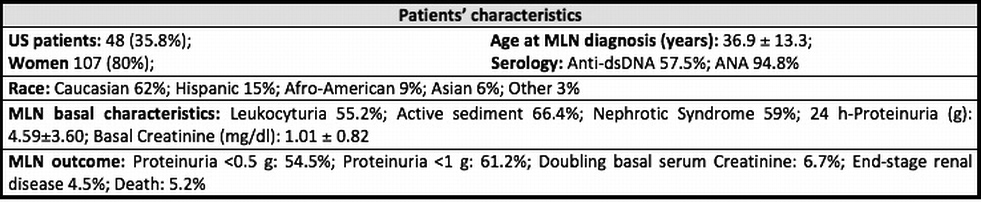
Conclusions: MLN usually begins with nephrotic syndrome, high proteinuria and normal BSC. Its prognosis is favourable in maintaining renal function although proteinuria usually persists over time. Cardiovascular disease and some socio-sanitary factors are related with bad prognosis.
Disclosure of Interest: None Declared