fetching data ... 
Background: Most rheumatoid arthritis (RA) patients achieve remission, have marginal radiographic progression and sustain normal function when an initial aggressive combination treatment with three disease modifying antirheumatic drugs (DMARDs) and prednisolone (PRD) is used, with or without early biologics. Still, a minority of patients have active, progressing disease [
Objectives: To identify progressing RA despite aggressive treatment early in the disease run.
Methods: Ninety-nine patients with early (<1 year), DMARD-naïve, active RA were treated with a combination of methotrexate, sulfasalazine, hydroxychloroquine, and PRD, and randomized to blindly receive either infliximab or placebo infusions during the first 6 months. After 24 months, if the patient was in remission, the treatments could be tapered, and, in case of flare-up, increased, with strict ACR remission as a goal. At 60 months, four different features of treatment failure were defined: Area under curve between 6-60 months (AUC6-60) for disease activity score assessing 28 joints (DAS28) >2.6; AUC6-60 for health assessment questionnaire (HAQ) >0.5; progression in total Sharp van der Heijde score 0-60 months >3 units; and need of PRD or biologic treatment at 60 months.
Results: Ninety-three patients (94%) were followed up for 60 months. Of these, 45 (48%) had no features of treatment failure, 30 (32%) had one, and only one (1%) patient had all four features (Figure). In a multivariate ordinal logistic regression model for the odds of having 0, 1, or 2-4 features of treatment failure, only the physician’s global estimate (OR 1.03, p=0,03) and HAQ (OR 2.25, p=0,05) at baseline were significant, while smoking, rheumatoid factor positivity, the randomization group, symptom duration, BMI, DAS28, sex, the presence of erosions, or age were not. However, with a ROC curve, DAS28>2.28 at 3 months predicted ≥2 features of treatment failure at 60 months; LR 3.07 (95% CI: 1.88 to 4.84), (sens 78%, spec 75%).
Image/graph:
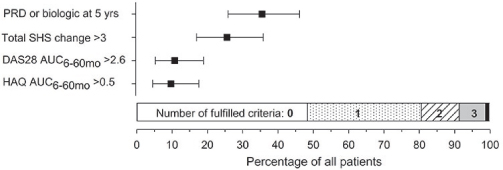
Conclusions: Only 20% of the early RA patients treated with a combination of DMARDs and PRD have more than one feature of treatment failure at 60 months. The most important predictor for identifying these patients early is the DAS28 at 3 months, with a cut-off value below the remission limit.
References:
Leirisalo-Repo et al. Ann Rheum Dis 2012 Jun 30 [Epub ahead of print] Rantalaiho V et al. Ann Rheum Dis 2012;71(Suppl 3): 103.
Disclosure of Interest: None Declared