fetching data ... 
Background: Secukinumab has been shown to significantly improve plaque psoriasis and physical functioning in subjects with psoriasis and concomitant psoriatic arthritis (PsA) [1]. High sensitivity C-reactive protein (hsCRP) is an indicator of skin and joint inflammation and hsCRP levels >3 mg/L are indicative of increased cardiovascular risk [2].
Objectives: To evaluate the effect of secukinumab (a fully human anti–interleukin 17A monoclonal antibody) on serum hsCRP levels in subjects with psoriasis and concomitant PsA.
Methods: A total of 738 subjects aged ≥18 years with moderate-to-severe plaque psoriasis (incl. Psoriasis Area and Severity Index (PASI) score ≥12) were randomized 1:1:1 to subcutaneous secukinumab 150 mg or 300 mg or placebo given at weeks 0, 1, 2, 3, and 4 and every 4 weeks thereafter through week 48. At week 12, subjects in the placebo group not achieving a PASI 75 response were re-randomized 1:1 to secukinumab 150 mg or 300 mg. An analysis of change in hsCRP levels from baseline to week 52 in subjects with concomitant PsA is reported here.
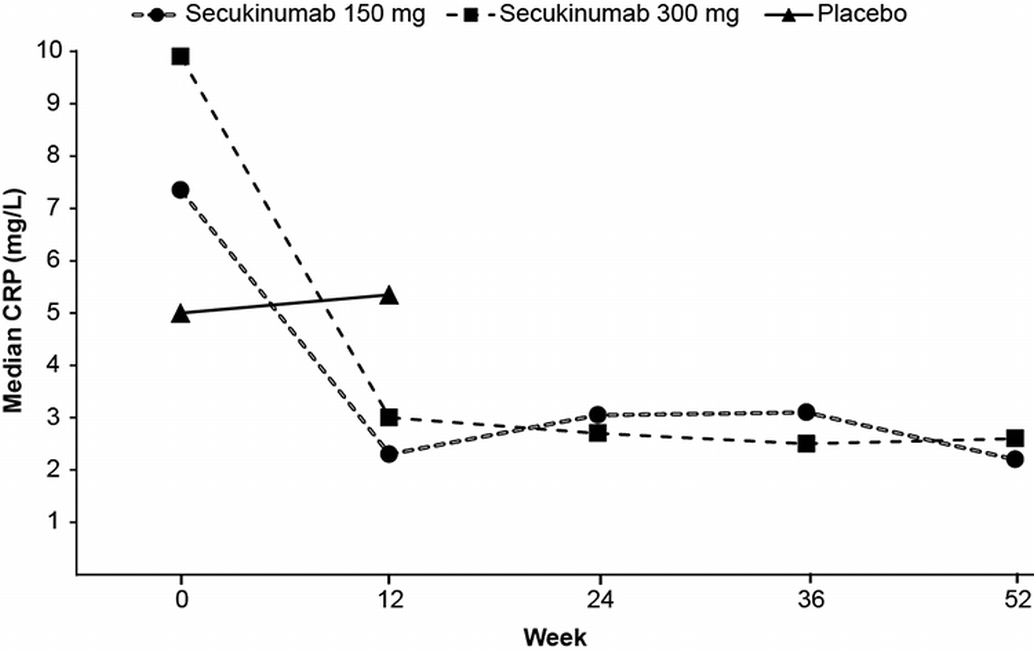
Results: In 171 (23.2%) subjects with concomitant PsA, baseline median hsCRP levels were in the high cardiovascular risk range at 5.2 mg/L, 4.0 mg/L, and 4.4 mg/L in the secukinumab 150 mg (n=46), 300 mg (n=57) and placebo (n=68) groups, respectively. At week 12, median hsCRP levels were reduced by ≥50% to 2.2 mg/L and 2.0 mg/L in the secukinumab 150 mg and 300 mg groups, and reductions were sustained to week 52. At week 12, the median hsCRP level increased slightly (4.7 mg/L) in the placebo group. Baseline median hsCRP levels were more elevated in subjects with greater baseline disability/reduced physical functioning (defined as Health Assessment Questionnaire–Disability Index [HAQ-DI] >0.5): 7.4 mg/L, 9.9 mg/L, and 5.0 mg/L in the secukinumab 150 mg (n=19), 300 mg (n=26) and placebo (n=38) groups, respectively. At week 12, median hsCRP levels were reduced by approximately 70% to 2.3 mg/L and 3.0 mg/L in the secukinumab 150 mg and 300 mg groups, with reductions sustained to week 52 (Fig. 1). In the placebo group, the median hsCRP level at week 12 was 5.4 mg/L. Secukinumab was well tolerated with no unexpected safety findings.
Figure 1. Median hsCRP levels from baseline to week 52 in patients with HAQ-DI >0.5.
Conclusions: In subjects with psoriasis and concomitant PsA, secukinumab was associated with pronounced and sustained reductions in serum hsCRP levels indicating a reduction in inflammatory burden during secukinumab therapy.
References:
1. Gottlieb AB et al. Secukinumab shows substantial improvement in both psoriasis symptoms and physical functioning in moderate-to-severe plaque psoriasis subjects with psoriatic arthritis: a subanalysis of a phase 3, multicenter, double-blind, placebo-controlled study. Presented at ACR2013, Oct, 25-30, San Diego, USA, Poster no. 319.
2. Pearson TA, Mensah GA, Alexander RW et al. Markers of inflammation and cardiovascular disease: application to clinical and public health practice: a statement for healthcare professionals from the Centers for Disease Control and Prevention and the American Heart Association. Circulation 2003; 107:499–511.
Disclosure of Interest: A. Gottlieb Grant/research support: Abbott Laboratories, Amgen, Celgene Corporation, Coronado Biosciences, Immune Control, Janssen-Ortho Inc., Lerner Medical Devices, Lilly ICOS LLC, Novartis Pharmaceutical Corporation, Novo Nordisk A/S, Pfizer Inc., UCB, Consultant for: Abbott Laboratories, AbbVie, Amgen, Canfite, Celgene Corporation, CSL Behring Biotherapies for Life, Glaxo Smith Kline, Incyte Corporation, Lilly ICOS LLC, Merck & Co., Novartis Pharmaceutical Corporation, Teva, Vertex Pharmaceuticals, B. Sigurgeirsson Grant/research support: Novartis Pharma AG, Consultant for: Novartis Pharma AG, A. Blauvelt Grant/research support: Novartis Pharmaceutical Corporation, Consultant for: Novartis Pharmaceutical Corporation, Speakers bureau: Novartis Pharmaceutical Corporation, Y. Gong: None declared, C. Papavassilis Shareholder of: Novartis Pharma AG, Employee of: Novartis Pharma AG, S. Mpofu Employee of: Novartis Pharma AG
DOI: 10.1136/annrheumdis-2014-eular.1109