fetching data ... 
Background: Early and intensive treatment with DMARDs are essential for remission induction in newly diagnosed RA patients. However, demographic, psychosocial and disease related factors may play a role as well.
Objectives: To investigate which demographic, psychosocial and disease related factors are associated with attaining remission at two consecutive visits in early RA patients treated in a treat-to-target manner
Methods: We used 12 months follow-up data from patients participating in the tREACH trial1,2 in which induction therapy strategies were compared: (A) combination high dose conventional therapy ((MTX + sulfasalazine + hydroxychloroquine or (B) MTX. Both groups had glucocorticoid (GCs) bridging. Disease activity (DAS) was assessed every 3 months. Remission was defined as DAS<1.6 at 2 consecutive visits (3 months). Univariate and multivariate logistic and Cox regression analyses were performed including demographic, disease related and psychosocial factors evaluated at baseline as predictors for attaining remission during 12 months of follow-up.
Results: 281 patients (68% female; mean DAS 3.4, median HAQ 1.00) were included. During 1 year of follow-up, 129 of 281 (46%) patients (group A: 90 (49%), group B: 39 (40%)) attained remission at 2 consecutive visits. 76/281 (27)% achieved remission within 6 months. Univariate analyses revealed that female sex was associated with a lower chance of attaining remission (demographic factors). Similar relations were observed for higher DAS, HAQ and worse physical functioning (disease factors) and higher levels of anxiety, depression, fatigue and passive coping with pain and lower levels of mental functioning and internal locus of control (psychosocial factors). In multivariate analyses, female sex, treatment and higher levels of fatigue were associated with a lower chance to attain remission within 6 months, whereas older age, female sex and higher levels of depression were associated with increased time to remission within 12 months.
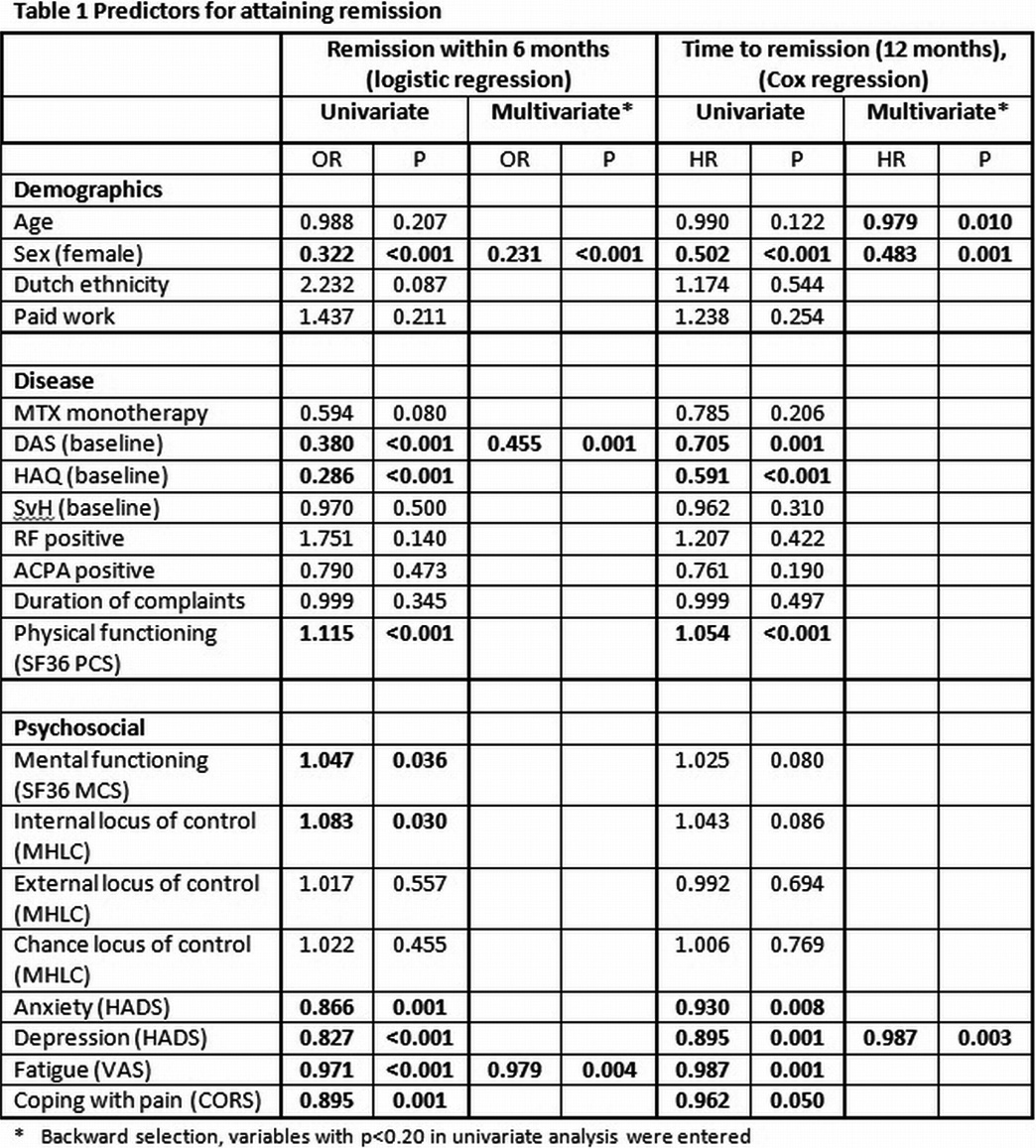
Conclusions: In the tREACH trial, 46% of early RA patients attained remission within 1 year of follow-up. Female sex, higher baseline DAS, HAQ, and several psychosocial factors were predictors for attaining remission, but in the final models age, sex, baseline DAS, fatigue and depression remained. Results suggest that high levels of fatigue and depressive symptoms may prevent patients from attaining remission despite treatment according to a tight control and treat-to-target strategy.
References:
1. Claessen et al. BMC Musculoskelet Disord 2009:71.
2. De Jong et al. Ann Rheum Dis. 2013 Jan;72.
Disclosure of Interest: None declared
DOI: 10.1136/annrheumdis-2016-eular.3946