fetching data ... 
Background: Finnish national combination treatment trials [1,2] have demonstrated excellent outcomes in patients with early rheumatoid arthritis (RA) including 90% of patients reaching 28-joint Disease Activity Score (DAS28) remission. Whether similar results are reached in clinical praxis is not known.
Objectives: To assess what proportion of patients with dmard-naïve early rheumatoid artritis (RA) reach DAS28 remission over one year and remission variability across clinics in Finland
Methods: Patients with dmard-naïve inflammatory arthritis diagnosed as new early RA were recruited. Comparison among sites were made in proportion of patients in 28-joint Disease Activity Score with 3 variables (DAS28–3) remission. Repeated measures were analyzed using mixed models approach with appropriate distribution and link function.
Results: 611 patients were recruited at 5 sites: 67% female; the mean age (SD) at diagnosis was 57 (16) years; respective 71% and 68% were RF and AntiCCP positive; 23% had radiographic erosions. A total of 506 (83%) fulfilled the ACR/EULAR 2010 classification criteria for RA for further analyses. DAS28–3 remission was met by 68% and 75% at 3 and 12 mo, respectively. Clinic had no effect in remission when adjusted for confounders (Figure 1). At baseline, a total of 68% used MTX based combination therapy, and 31% used triple therapy with methotrexate, hydroxychloroquine and sulphasalazine. In multivariate analysis, the only independent predictors of DAS28–3 remission at 12 mo were lower baseline DAS28–3 (odds ratio 0.6, 95% confidence interval 0.4–0.7, P<0.001) and triple therapy as the initial treatment (odds ratio 1.8, 95% confidence interval 1.0–3.3, P=0.048).
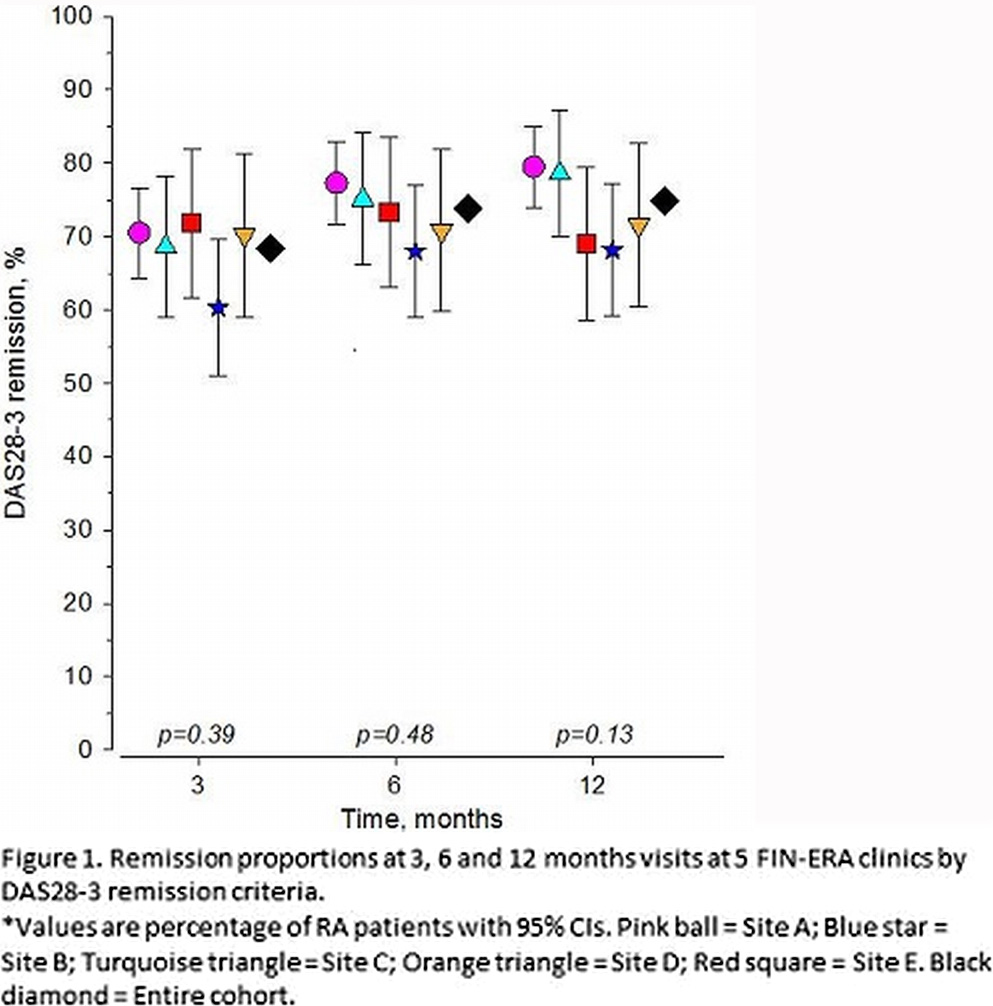
Conclusions: Three out of every four dmard-naïve early RA patients are in remission in Finland after 1 year of diagnosis. High remission rates were achieved with use of csDMARDs in combinations for majority of patients. Treatment with triple therapy is a predictor of DAS28–3 remission also in real-life rheumatology settings.
References:
1. Möttönen T, Hannonen P, Leirisalo-Repo M, Nissilä M, Kautiainen H, Korpela M, et al. Comparison of combination therapy with single-drug therapy in early rheumatoid arthritis: A randomised trial. FIN-RACo trial group. Lancet 1999; 353:1568–73
2. Leirisalo-Repo M, Kautiainen H, Laasonen L, Korpela M, Kauppi MJ, Kaipiainen-Seppänen O, et al. Infliximab for 6 months added on combination therapy in early rheumatoid arthritis: 2-year results from an investigator-initiated, randomised, double-blind, placebo-controlled study (the NEO-RACo Study). Ann Rheum Dis 2013;72:851–7
Acknowledgement: We would like to thank study nurses. This study was supported by Pfizer.
Disclosure of Interest: None declared
DOI: 10.1136/annrheumdis-2016-eular.4894