fetching data ... 
Background: Non-adherence to treatment, a major cause of continued lupus activity and flares, may be difficult to recognize.
Objectives: In this international prospective study, we evaluated adherence to hydroxychloroquine (HCQ) in SLE patients with flares (NCT01509989).
Methods: This study included 305 SLE patients (SLICC criteria) from 10 countries, all of whom had been prescribed HCQ for ≥2 months and were having a disease flare (SELENA-SLEDAI Flare Index). Adherence to HCQ was assessed by self-questionnaires (MASRI, Morisky), physician's assessment (VAS 0–100), and blood concentrations of HCQ and its main metabolite desethylchloroquine ([HCQ] and [DCQ]). Non-adherence was defined by MASRI <80%, Morisky<6, [HCQ] <200ng/ml and/or undetectable [DCQ].
Results: 305 patients (288 women; mean age 38 ± 12ys) met the inclusion criteria. The median SLE duration was 11ys [range 1–46]; 108 patients (35%) had a history of lupus nephritis.
At enrollment, the median SELENA-SLEDAI score was 8 [2–30] and the flare was considered severe in 43%. The HCQ dosage was 400mg/d in 72%, 200mg/d in 15%, or another dosage in 13%. The median [HCQ] was 718ng/ml [0–4345]. In addition, steroids were prescribed in 76%, and immunosuppressives in 46%.
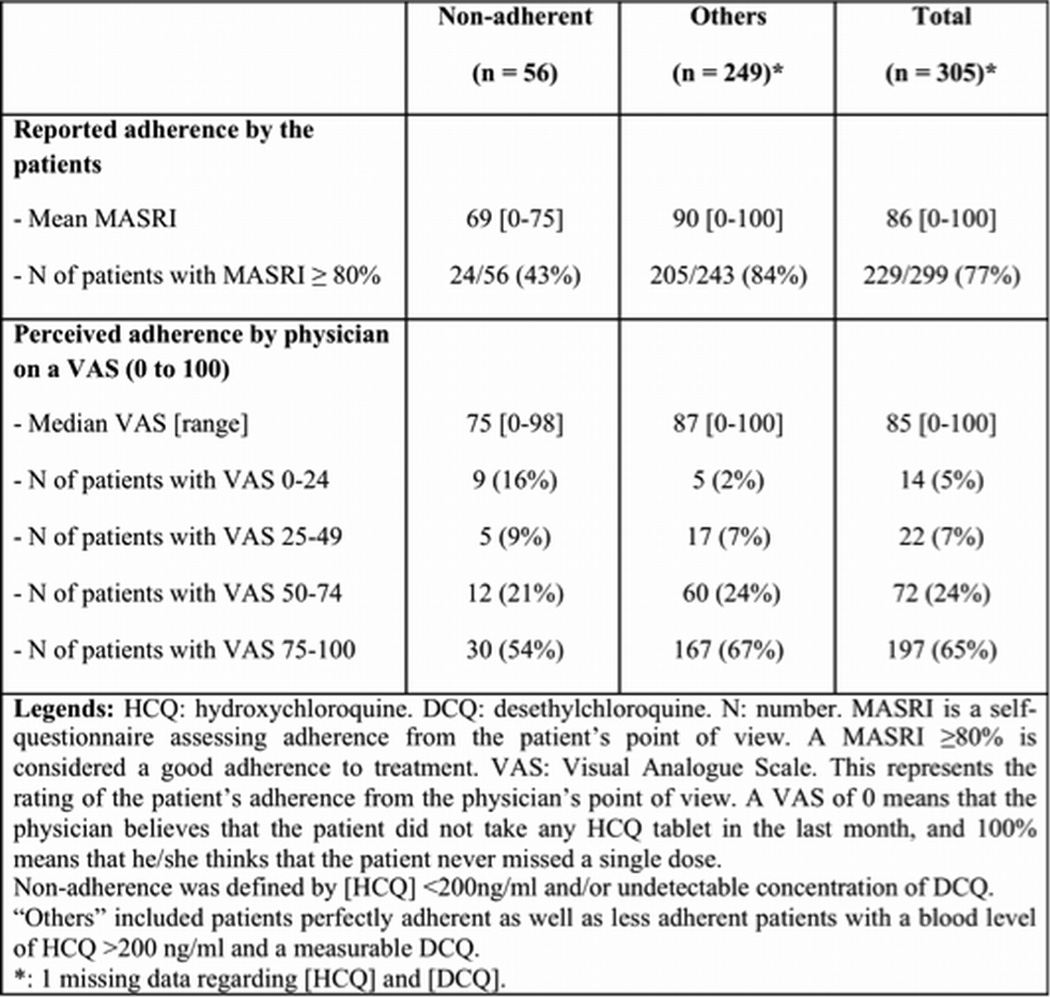
Severe non-adherence defined by [HCQ] <200ng/ml was found in 44 patients (14.4%). 12 additional patients with very low median [HCQ] of 235ng/ml [210–343] had an undetectable [DCQ] indicating a very recent resumption of treatment. Thus, 56 patients (18.4%) were objectively defined as severely non-adherent. Table 1 shows that the treating physician believed that 75% of these non-adherent patients were taking at least 50% of their prescribed HCQ dose, strongly suggesting that doctors were often unaware of non-adherence. The median VAS evaluating the adherence from the doctor's point of view was 75 [0–98] in objectively non-adherent patients vs 87 [0–100] in other patients. The doctor's opinion, therefore, was poorly informative.
Good adherence to treatment with HCQ (MASRI ≥80%) was self-reported by 77% of the patients, including by 43% of those objectively severely non-adherent.
On the other hand, the investigators felt that only 12% of patients took less than 50% of HCQ, with severe non-adherence confirmed in 39%. Conversely, while intake was estimated at ≥75% (65%), 15% of these patients were objectively severely non-adherent.
Non-adherent patients defined by self-questionnaires (MASRI<80% or Morisky <6) and/or drug blood levels, represented 47% of this cohort.
Conclusions: These data demonstrate that blood HCQ and DCQ measurements objectively identify significant non-adherence to HCQ in nearly 20% of SLE patients. Non-adherence was often unrecognized by the doctor, suggesting usefulness of blood assays to more accurately determine adherence.
Disclosure of Interest: None declared
DOI: 10.1136/annrheumdis-2016-eular.3610