fetching data ... 
Background: Guidelines recommend low-dose, short-term glucocorticoid (GC) treatment for rheumatoid arthritis (RA). 1,2 Long-term use, especially at prednisone-equivalent doses >5 mg/d, should be avoided, 2 but many patients (pts) with early established RA receive long-term GCs, often ≥5 mg/d. 3
Objectives: Compare GC tapering vs continuation to maintain disease control in RA pts with chronic GC exposure receiving tocilizumab (TCZ) in a randomized controlled trial.
Methods: Before randomization pts had to receive TCZ ± conventional synthetic (cs)DMARDs and GC (prednisone-equivalent dose 5-15 mg/d) for ≥24 wks. At randomization pts had to be in at least low disease activity (LDA: DAS28-ESR ≤3.2) and receiving stable concomitant therapy (prednisone 5 mg/d [GC5mg]) and TCZ ± csDMARDs) for ≥4 wks. Pts were randomized to continue blinded GC5mg for 24 wks or undergo blinded taper (GCtaper, from 4 mg/d with 1-mg reduction every 4 wks to 0 mg/d at wks 16-24) while receiving stable TCZ and csDMARD doses. Pts with RA flare (DAS28-ESR >3.2 and increase >0.6 vs baseline) received open-label rescue GC5mg for 2 wks and continued blinded treatment. Primary outcome was mean change in DAS28-ESR at wk 24. Key secondary outcome was treatment success—DAS28-ESR ≤3.2 at wk 24 and no RA flare during 24 wks and no adrenal insufficiency necessitating replacement therapy.
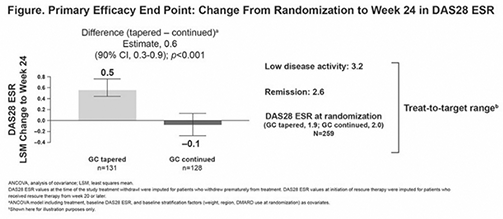
Results: 259 pts were randomized to GCtaper (n=131) or GC5mg (n=128); 114 and 112, respectively, completed 24 wks. Mean baseline DAS28-ESR was 1.9. Mean RA duration was 9.2 y. For the primary endpoint, the between-arm difference was 0.6 DAS28-ESR units (95% CI, 0.3, 0.9; p <0.001, ANCOVA) favoring GC5mg (Figure). Results were consistent for key subgroups (DAS28-ESR between-arm difference 0.5 [95% CI –0.1, 1.0] for TCZ monotherapy, 0.7 [0.4-1.0] for TCZ + csDMARDs, 0.6 [0.2-1.0] for baseline DAS28 <2, and 0.6 [0.2-1.0] for baseline DAS28 ≥2). Most pts in both arms achieved treatment success (65% GCtaper vs 77% GC5mg; relative risk, 0.83 [0.71-0.97]; p =0.021, Cochran-Mantel-Haenszel test); 11% of GC5mg pts and 26% of GCtaper pts experienced RA flare. One GC5mg pt and no GCtaper pts discontinued blinded treatment due to insufficient flare control. Serious adverse events (no deaths) were reported for 5% of GC5mg vs 3% of GCtaper pts. No pts had symptomatic adrenal insufficiency.
Conclusion: Continued GC5mg provided better DAS28-ESR control than GC taper in RA pts in LDA or remission. The 0.6 DAS28-ESR unit between-arm difference should be interpreted in the context of approximately two-thirds of tapered pts experiencing treatment success and no tapered pts discontinuing due to lack of flare control. The taper schedule was safe regarding adrenal insufficiency. The results suggest that all pts achieving LDA or remission with TCZ and receiving long-term low-dose GC should be considered for GC tapering, ideally targeting discontinuation.
REFERENCES:
[1] Singh JA et al. Arthritis Rheum. 2016;68:1.
[2] Smolen JS et al. Ann Rheum Dis. 2017;76:960.
[3] Buttgereit F, Bijlsma JW. Ann Rheum Dis. 2017;76:1785.
Disclosure of Interests: Gerd Rüdiger Burmester Consultant for: Roche, Sanofi-Genzyme, Speakers bureau: Roche, Sanofi-Genzyme, Frank Buttgereit: None declared, Corrado Bernasconi Consultant for: Roche, Jose-Maria Alvaro-Gracia Consultant for: AbbVie, Bristol-Myers Squibb, Eli Lilly, MSD, Novartis, Pfizer Inc, Roche, Sanofi, and UCB, Speakers bureau: AbbVie, Bristol-Myers Squibb, Eli Lilly, MSD, Novartis, Pfizer Inc, Roche, Sanofi, and UCB, Nidia Castro Shareholder of: F. Hoffmann-La Roche, Employee of: F. Hoffmann-La Roche, maxime dougados Grant/research support from: Eli Lilly and Company, Pfizer, AbbVie, and UCB Pharma, Consultant for: Eli Lilly and Company, Pfizer, AbbVie, and UCB Pharma, Cem Gabay Grant/research support from: Roche, Pfizer, AB2 Bio Ltd, Consultant for: Roche, Pfizer, Lilly, AbbVie, Sanofi, Regeneron, Bristol-Myers Squibb, Novartis, UCB, AB2 Bio Ltd, Debiopharm, Jacob M. van Laar Grant/research support from: Genentech, Consultant for: F. Hoffmann-La Roche, J. Michael Nebesky Shareholder of: F. Hoffmann-La Roche, Employee of: F. Hoffmann-La Roche, Attila Pethoe-Schramm Shareholder of: F. Hoffmann-La Roche, Employee of: F. Hoffmann-La Roche, Carlo Salvarani: None declared, Marc Y. Donath Consultant for: Roche, Markus R. John Shareholder of: Roche, Employee of: Roche
DOI: 10.1136/annrheumdis-2019-eular.2883