fetching data ... 
Background: Efficacy observed in controlled trials may not reflect RW effectiveness, given documented differences in patient populations and management. 1
Objectives: This study aimed to assess disease measures over time as measured in a trial setting (AMPLE) and in a separate RW observational setting, both among patients with RA treated with abatacept.
Methods: The RW cohort comprised retrospective patient-level data abstracted by 31 community rheumatologists for adult RA patients treated with abatacept who had an anti-cyclic citrullinated peptide-2 titer ≥250 AU/mL. AMPLE was a phase III, randomized controlled trial of RA patients treated with abatacept that assessed disease measures over a 2-year follow-up. Data included demographics, treatments, labs, and disease measures (tender and swollen joint counts (TJC, SJC), C-reactive protein (CRP), American College of Rheumatology-20 (ACR20) and ACR50 at baseline and 3 and 6 months) and were summarized descriptively. Disease measures were evaluated across AMPLE and RW cohorts.
Results: Of the 291 RW patients and 318 AMPLE patients, the majority were female (70%, 81%), white (72%, 81%), and RF-positive (91%, 76%), respectively (
Patient Characteristics.
|
RW cohort
|
AMPLE cohort
|
|
|---|---|---|
| Female (n, %) | 205 (70%) | 259 (81%) |
| White (n, %) | 209 (72%) | 257 (81% |
| Age at abatacept initiation, years (mean, SD) | 54.7 (14.8) | 51.4 (12.6) |
| RF-positive* (n, %) | 249 (91%) | 240 (76%) |
| Concomitant medications (n, %) | ||
| Corticosteroids † | 132 (45%) | 207 (65%) |
| Methotrexate | 179 (62%) | 318 (100%) |
| Prior biologic use (n, %) | 241 (83%) | 0 (0%) |
| Route of administration (n, %) | ||
| Intravenous | 183 (63%) | 0 (0%) |
| Subcutaneous | 108 (37%) | 318 (100%) |
LEGEND : *among 274 with known RF status; † corticosteroids in AMPLE cohort at any time in the 2-year study period
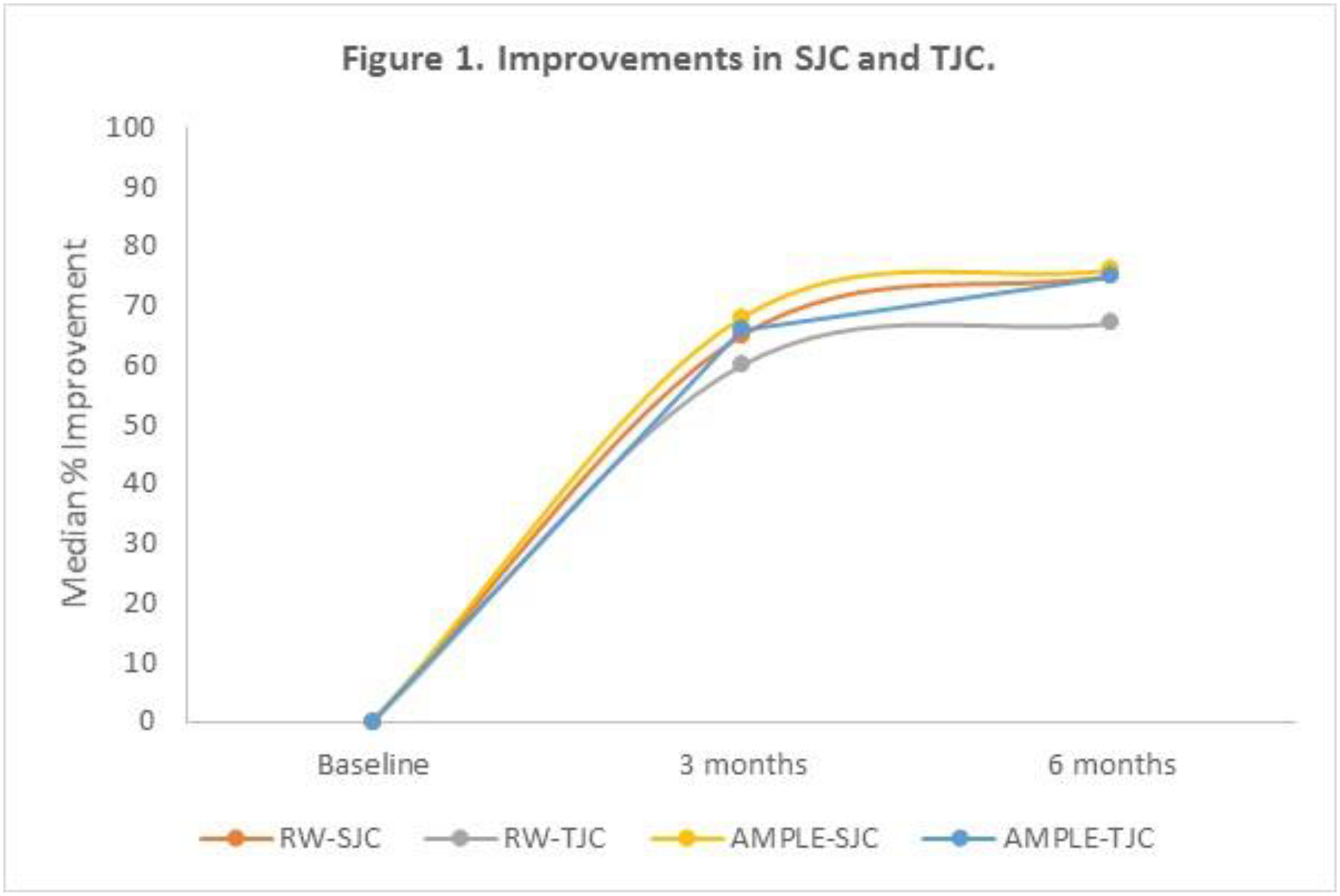
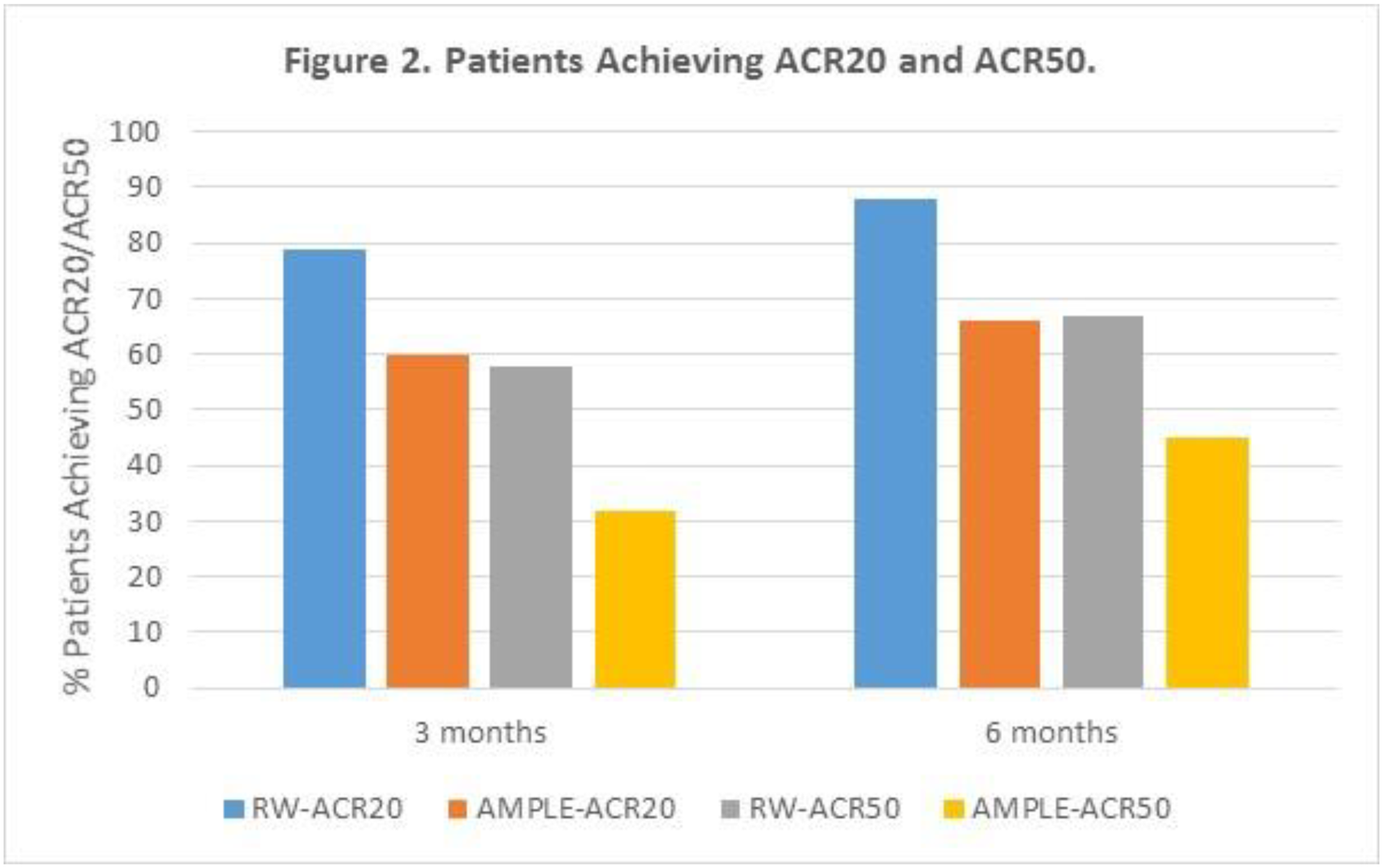
Changes in Disease Activity.
|
RW cohort
|
AMPLE cohort
|
|
|---|---|---|
| SJC (median) | ||
| Baseline value | 6 | 13 |
| 3-month value | 2 | 4 |
| 6-month value | 1 | 3 |
| TJC (median) | ||
| Baseline value | 8 | 22 |
| 3-month value | 3 | 7 |
| 6-month value | 2 | 5 |
| CRP, mg/dL (mean) | ||
| Baseline value | 1.08 | 1.6 |
| 3-month value | 0.47 | 0.8 |
| 6-month value | 0.30 | 0.8 |
| ACR20 achieved (n, %) | ||
| 3-month value | 194 (79%) | 191 (60%) |
| 6-month value | 78 (88%) | 209 (66%) |
| ACR50 achieved (n, %) | ||
| 3-month value | 144 (58%) | 103 (32%) |
| 6-month value | 60 (67%) | 144 (45%) |
LEGEND : values soonest after 3 months and value between 6-9 months used for RW cohort; values at days 85 and 197 used for AMPLE cohort.
Conclusion: Despite differences in patient characteristics, improvements in SJC and TJC, as well as high rates of ACR20 and ACR50, were observed in both trial setting and RW settings. These improvements in disease activity were observed at similar magnitudes in both settings, demonstrating that trial efficacy is achievable in RW clinical practice with abatacept treatment.
REFERENCES:
[1]Kilcher G, Hummel N, Didden EM, et al. Rheumatoid arthritis patients treated in trial and real-world settings: comparison of randomized trials with registries. Rheumatology . 2018;57(2):354-369.
Disclosure of Interests: Andrew Klink Employee of: I am employed by Cardinal Health., Xue Han Employee of: BMS, Francis Lobo Shareholder of: Bristol-Myers Squibb (US), Employee of: Bristol-Myers Squibb (US), Rick Szymialis Shareholder of: BMS, Employee of: BMS, Jenny Lam Shareholder of: A few shares in Gilead in IRA account, Grant/research support from: Currently, a BMS fellowship (not a full-time employee), Bruce Feinberg Employee of: I am employed by Cardinal Health.