fetching data ... 
Background: Most of the rheumatic diseases are more common in women than in men. Because many of these conditions may interact with pregnancy, reproductive issues related to disease management should be discussed with all women with rheumatic diseases who are in reproductive age group. Some rheumatic diseases (i.e. systemic lupus erythematosus (SLE) are associated with flares in pregnancy, while others (i.e. rheumatoid arthritis (RA) have been known to improve or not deteriorate during pregnancy. However, pregnancies in women with rheumatic diseases are still at risk of maternal/fetal complications. Nevertheless, no detailed analysis of pregnancy outcomes in women with various types of systemic connective tissue diseases has been carried out in the recent studies.
Objectives: This study aimed to compare pregnancy outcomes in women with various types of systemic rheumatic disease and analyze influence of clinical features/laboratory parameters on risk of maternal and fetal complications.
Methods: A retrospective single-center cohort study 11/2014-12/2019: 191 pregnancies in 181 patients with proved rheumatic diseases > 20 weeks of gestation, mean age was 31.6 years. Proved SLE was observed in 67 patients, 8 of them had antiphospholipid syndrome (APS) secondary to SLE. 40 patients had proved RA, 24 – vasculitis, 18 – primary Sjögren syndrome (pSS), 30 – seronegative spondyloarthropathies (SpA). Clinical and laboratory parameters, renal function at conception and after delivery and pregnancy outcomes were collected. Preeclampsia (PE) was diagnosed by the 2008 WHO criteria.
Results: Rate of PE was significantly higher in women with SLE and SLE+APS compared to women with RA (p < 0.05). We found a threefold increase of PE risk in patients with high activity of the rheumatic disease (p = 0.001, OR = 3.4, 95% CI 1.7-6.7) and fivefold increase of PE risk in patients with chronic hypertension (p = 0.002, OR = 5.3, 95% CI 1.9-15).
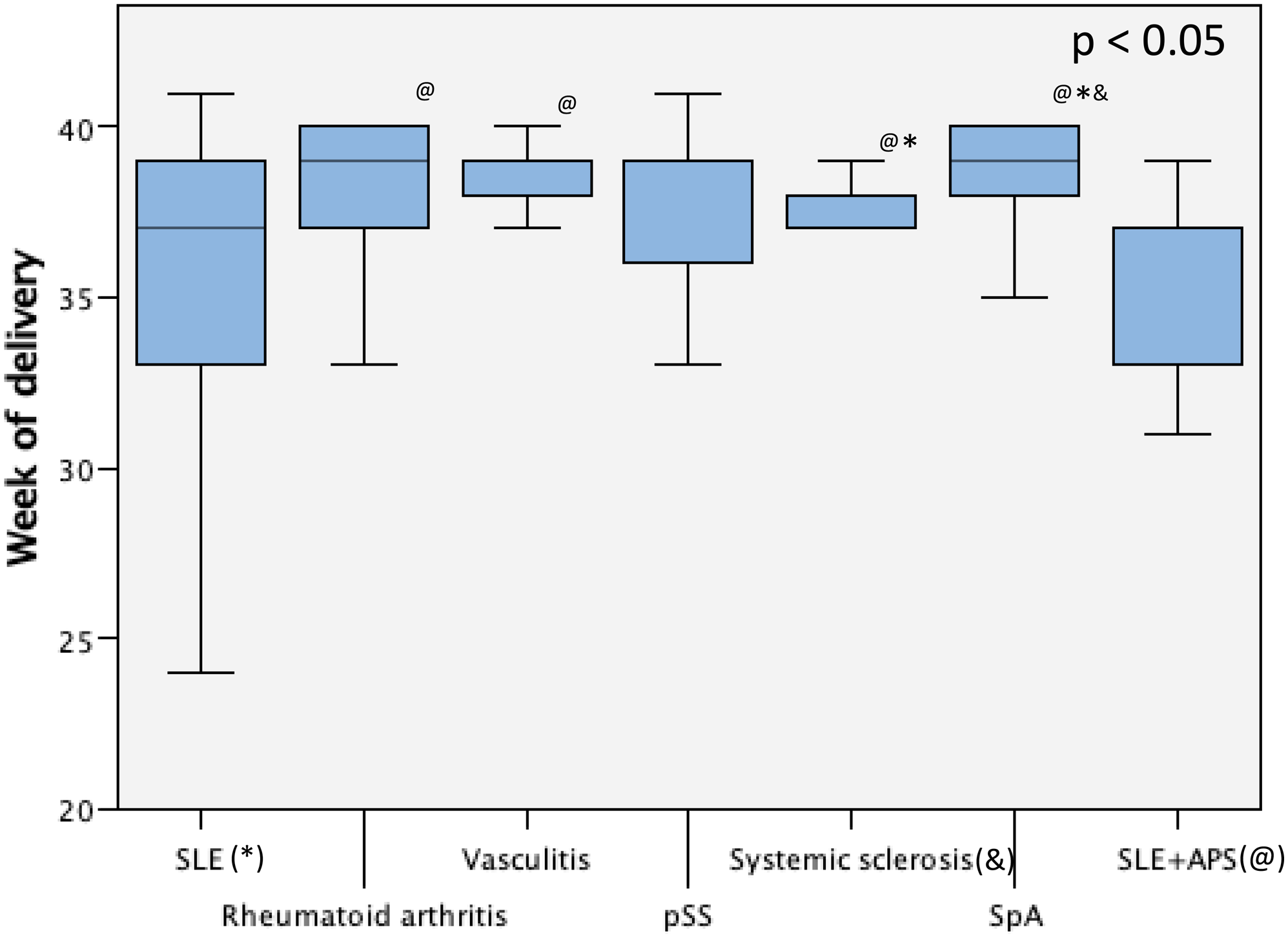
Week of delivery was significantly lower in women with SLE+APS compared to women with RA, vasculitis, systemic sclerosis (SSc), in women with SLE compared to women with SSc and SpA and in women with SSc compared to women with SpA (p < 0.05).
Rate of preterm birth was higher in patients with SLE+APS compared to women with SLE, RA and vasculitis, in patients with SLE compared to patients with RA and SpA, in patients with RA compared to patients with vasculitis, SSc and SpA (p < 0.05).
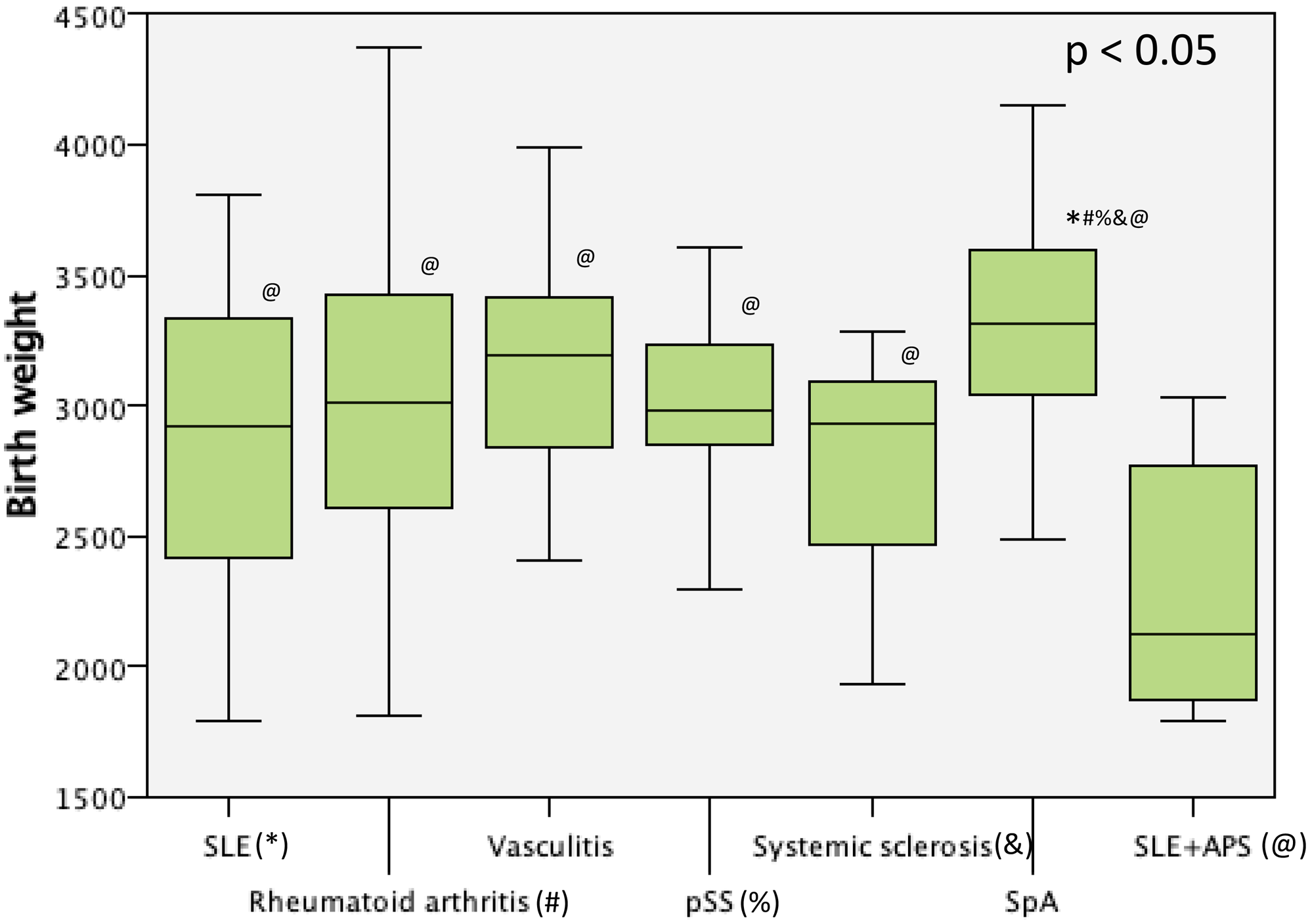
Birth weight was significantly higher in babies born to women with SSc compared to newborns to women with SLE, RA, pSS, SpA and SLE+APS and lower in newborns to women with SLE+APS compared to other groups (p < 0.05).
Newborns to women with SLE and SLE+APS had lower Apgar scores than newborns to women with SpA. Low GFR (p = 0.004, OR = 1.03), high urea (p < 0.001, OR = 1.5, 95% CI 1.2-1.8), creatinine (p = 0.005, OR = 1.02, 95% CI 1-1.04) and LDH concentrations (p = 0.009, OR = 1.01, 95% CI 1-1.02) in 3 rd trimester increased the risk of low Apgar scores of a newborn (p < 0.05).
Conclusion: Patients with SLE with/without secondary APS have significantly increased rates of preeclampsia, preterm birth and lower Apgar scores. Risk of adverse pregnancy outcomes can be significantly reduced by good disease control.
Comparison of the pregnancy outcomes in women with various rheumatic diseases
| SLE (*)
| RA (#)
| Vasculitis ($)
| pSS (%)
| SSc (&)
| SpA (^)
| SLE + APS
|
|
|---|---|---|---|---|---|---|---|
| Age,
| 31 ± 4 | 32 ± 5 | 30 ± 7 | 32 ± 5 | 32 ± 5 | 33 ± 6 | 32 ± 4 |
| Preterm birth,
| 25
| 9
| 2
| 6
| 1
| 2
| 5
|
| Preeclampsia
| 13
#
| 0 | 1
| 0 | 3
| 2
| 3
#
|
| Low Apgar score
| 14^
| 4
| 2
| 4
| 1
| 2
| 3^
|
* ,#,$,%,&,^ p < 0.05
REFERENCES:
[1] Gayed M, Gordon C. Pregnancy and rheumatic diseases. Rheumatology . 2007;46(11):1634–1640. doi:10.1093/rheumatology/kem156
Disclosure of Interests: None declared