fetching data ... 
Background: BAFF and APRIL are TNF superfamily members that bind both TACI and BCMA on B cells; BAFF also binds BAFF-R. Together, BAFF and APRIL support B cell development, differentiation, and survival. Their co-neutralization dramatically reduces B cell function, including antibody production, whereas inhibition of either BAFF or APRIL alone mediates relatively modest effects.
Objectives: While CTLA-4-based therapeutics that block T cell costimulation provide safe and moderately effective T cell inhibition in many disease settings, and while B cell targeting therapies have demonstrated promising therapeutic potential, we postulate that improved, combined BAFF and APRIL inhibition, either alone or coupled with inhibition of T cell costimulation, will provide more effective and durable relief from severe B cell-related autoimmune diseases like SLE.
Methods: We used our directed evolution platform to identify variant domains of the TNF family receptors TACI or BCMA that exhibit enhanced affinity for BAFF and APRIL as compared to their wild-type (WT) counterparts. These variant TACI or BCMA domains (vTD), alone or together with platform-derived CTLA-4 domains (vIgD), were fused to a modified human IgG1 Fc lacking effector function, yielding a panel of immunomodulatory molecules: TACI vTD-Fc, BCMA vTD-Fc, TACI vTD/CTLA-4 vIgD-Fc, & BCMA vTD/CTLA-4 vIgD-Fc. All were evaluated for functional activity: 1) in vitro in primary human B cell & MLR assays and in a Jurkat/NF-kB reporter cell line expressing TACI, and 2) in vivo in standard immunization models, and in the bm12-induced and NZB/NZW spontaneous mouse models of lupus.
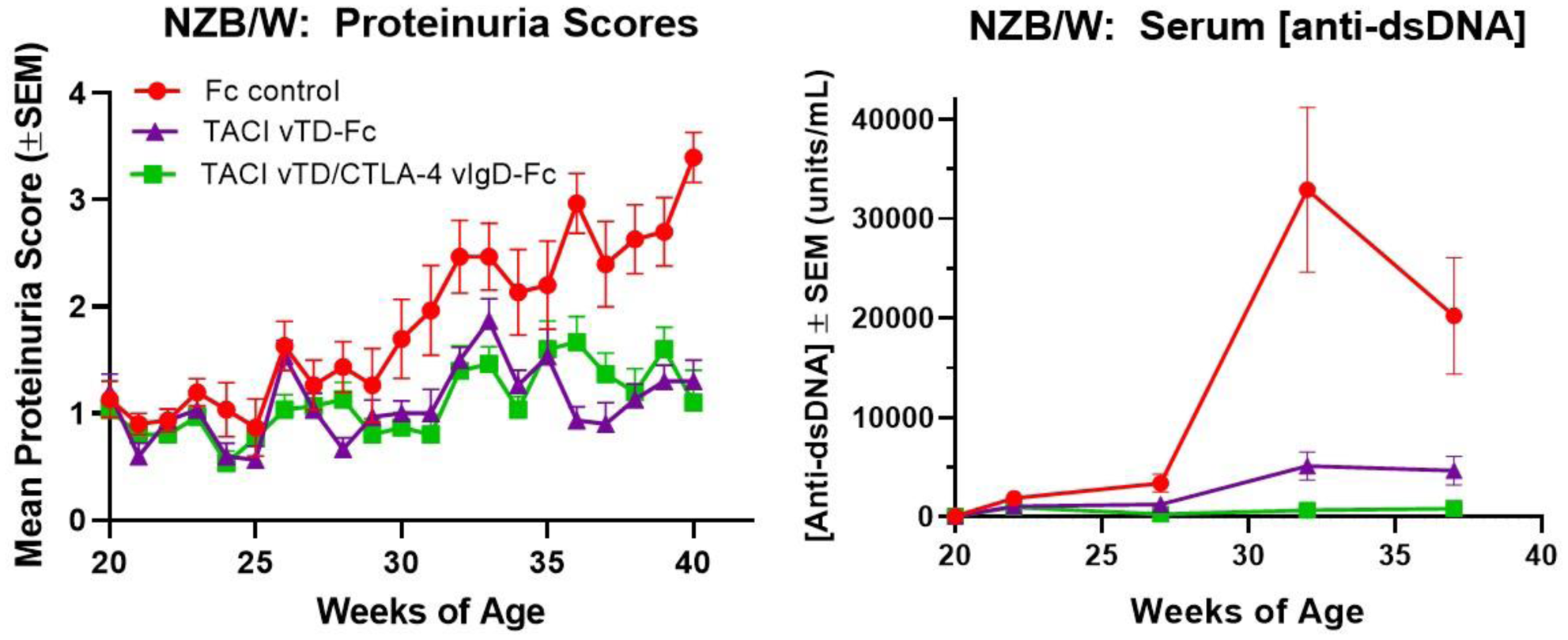
Results: The novel engineered TACI vTD-Fc or BCMA vTD-Fc fusion proteins significantly inhibited BAFF- and APRIL-mediated signaling in vitro in TACI + Jurkat cells. TACI (or BCMA) vTD/CTLA-4 vIgD-Fc proteins also attenuated T cell activation in primary human lymphocyte assays. When administered to mice, these molecules rapidly and potently reduced key B and T cell subsets, including plasma cells, follicular T helper cells, germinal center cells, & memory T cells. Treatment with TACI vTD-Fc or TACI vTD/CTLA-4 vIgD-Fc proteins also significantly reduced titers of antigen-specific antibodies in immunized mice more so than abatacept or WT TACI-Fc, and potently suppressed anti-dsDNA autoantibodies, blood urea nitrogen levels, proteinuria, and renal immune complex deposition in the bm12 & NZB/W lupus models.
Conclusion: Directed evolution of TNFR and IgSF domains has successfully facilitated the development of Fc fusion proteins containing TACI or BCMA vTDs, with or without fusion to CTLA-4 vIgDs. These novel immunomodulators consistently demonstrate potent immunosuppressive activity and efficacy in vitro and in vivo , appearing superior to existing and/or approved immunomodulators like belimumab, abatacept, or atacicept. Such biologics may therefore be attractive candidates for the treatment of serious autoimmune diseases, particularly B cell-related diseases such as SLE, Sjogren’s syndrome, etc.
Disclosure of Interests : Stacey R. Dillon Shareholder of: Shareholder of Alpine Immune Sciences, Inc., Employee of: Employee of Alpine Immune Sciences, Inc., Lawrence S. Evans Shareholder of: Shareholder of Alpine Immune Sciences, Inc., Employee of: Employee of Alpine Immune Sciences, Inc., Mark W. Rixon Shareholder of: Shareholder of Alpine Immune Sciences, Inc., Employee of: Employee of Alpine Immune Sciences, Inc., Joe Kuijper Shareholder of: Shareholder of Alpine Immune Sciences, Inc., Employee of: Employee of Alpine Immune Sciences, Inc., Dan Demonte Shareholder of: Shareholder of Alpine Immune Sciences, Inc., Employee of: Employee of Alpine Immune Sciences, Inc., Katherine E. Lewis Shareholder of: Shareholder of Alpine Immune Sciences, Inc., Employee of: Employee of Alpine Immune Sciences, Inc., Steve Levin Shareholder of: Shareholder of Alpine Immune Sciences, Inc., Employee of: Employee of Alpine Immune Sciences, Inc., Kayla Kleist Shareholder of: Shareholder of Alpine Immune Sciences, Inc., Employee of: Employee of Alpine Immune Sciences, Inc., Sherri Mudri Shareholder of: Shareholder of Alpine Immune Sciences, Inc., Employee of: Employee of Alpine Immune Sciences, Inc., Susan Bort Shareholder of: Shareholder of Alpine Immune Sciences, Inc., Employee of: Employee of Alpine Immune Sciences, Inc., Janhavi Bhandari Shareholder of: Shareholder of Alpine Immune Sciences, Inc., Employee of: Employee of Alpine Immune Sciences, Inc., Fariha Ahmed-Qadri Shareholder of: Shareholder of Alpine Immune Sciences, Inc., Employee of: Employee of Alpine Immune Sciences, Inc., Jing Yang Shareholder of: Alpine Immune Sciences, Inc., Employee of: Alpine Immune Sciences, Inc., Michelle A. Seaberg Shareholder of: Shareholder of Alpine Immune Sciences, Inc., Employee of: Employee of Alpine Immune Sciences, Inc., Rachel Wang Shareholder of: Shareholder of Alpine Immune Sciences, Inc., Employee of: Employee of Alpine Immune Sciences, Inc., Russell Sanderson Shareholder of: Alpine Immune Sciences, Inc., Employee of: Alpine Immune Sciences, Inc., Martin F. Wolfson Shareholder of: Shareholder of Alpine Immune Sciences, Inc., Employee of: Employee of Alpine Immune Sciences, Inc., Jan Hillson Shareholder of: Alpine Immune Sciences, Inc., Employee of: Alpine Immune Sciences, Inc., Stanford L. Peng Shareholder of: Alpine Immune Sciences, Inc., Employee of: CMO and President of Alpine Immune Sciences, Inc., Kristine M. Swiderek Shareholder of: Shareholder of Alpine Immune Sciences, Inc., Employee of: Employee of Alpine Immune Sciences, Inc.