fetching data ... 
Background: Optimal prognostic predictors in lupus nephritis (LN) are still not clearly defined. Studies have recently shown that albumin-to-globulin ratio (A/G) is not only a good predictor of outcomes in malignancy, infection and renal disease, but is also a potential marker of increased immunoglobulin synthesis and LN activity and might be useful as a predictor of the development of LN in SLE patients. Studies on the role of A/G in predicting outcomes in LN are, however, lacking.
Objectives: To assess a potential prognostic value of A/G at renal biopsy in predicting outcomes in LN.
Methods: In this retrospective study we analyzed the demographic, histologic, laboratory and clinical characteristics of patients with biopsy-proven LN diagnosed between 2011 and 2020. All patients met the 1997 revised American College of Rheumatology classification criteria for SLE. Complete remission was defined as proteinuria <0.5 g/day and serum creatinine within 10% from baseline, and partial remission as more than 50% reduction in proteinuria to sub-nephrotic levels and serum creatinine within 10% from baseline.
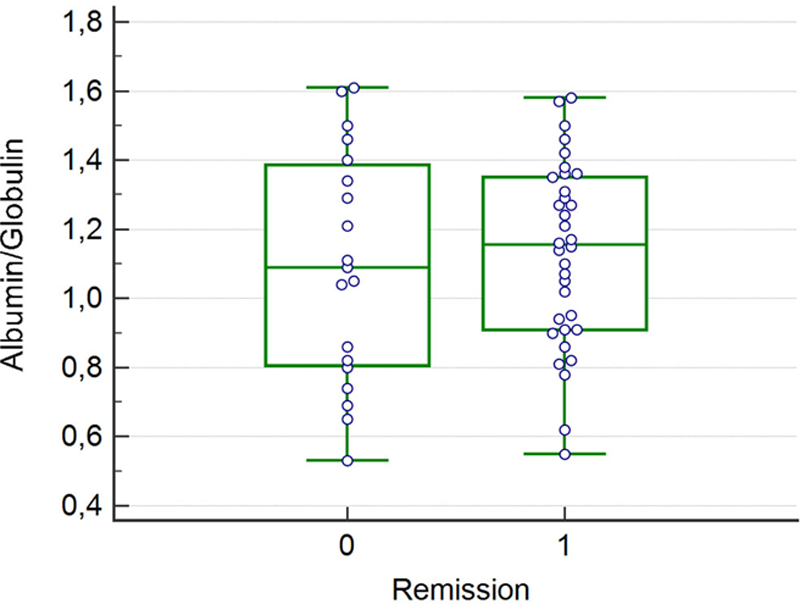
Results: We have included 55 patients (80% women) with biopsy-proven LN (age at biopsy 38±13 years). On renal histology, one patient was class I LN, two patients were class II, 7 were class III, 5 were class III+V, 23 were class IV, two were class IV+V, 11 class VI and 4 had other features. Median eGFR and proteinuria at biopsy were 69 (IQR: 44, 100) mL/min/1.73 m
2
and 3.5 (2.3, 5.6) g/day, respectively. Baseline mean A/G was 1.12±0.29 and did not differ between LN classes (p=0.91). At one-year follow-up eGFR increased non-significantly (69 vs. 82 mL/min/1.73 m
2
, p=0.13) and proteinuria decreased (3.5 vs. 0.6 g/day, p<0.001). Eighteen patients achieved complete remission (CR), 16 partial remission and 21 did not achieve remission. None progressed to ESRD and two patients died, both from sepsis. A/G at the time of biopsy did not differ between group which achieved CR/PR vs. no remission (p>0.05;
Conclusion: While being a potential marker for transition of SLE to LN, A/G was not showed to be a predictor of renal remission in LN.
REFERENCES:
[1]Liu XR, et al. Lupus. 2021 Jan 6:961203320981139.
[2]Kwon OC, et al. Semin Arthritis Rheum. 2018 Dec;48(3):462-466ck
Disclosure of Interests: None declared