fetching data ... 
Background: Diet has been previously described as an impact factor on the course of rheumatic diseases, such as rheumatoid arthritis and systemic lupus erythematosus (SLE). It has been previously reported that dietary sugar intake may contribute to subclinical inflammation and disease activity in SLE. However, there is very little investigation on the possible association between nutritional parameters and their influence on spondyloarthritis (SpA).
Objectives: To investigate the possible impact of nutritional parameters on the disease activity in patients with SpA.
Methods: Patients with radiographic axial SpA and starting a biological therapy were recruited between 2015 and 2019 in an extension of the prospective German Spondyloarthritis Inception Cohort (GESPIC). Dietary habits were collected at baseline using the country-specific validated food frequency questionnaire (FFQ) developed for the use in the German Health examination Survey for Adults 2008-2011. The FFQ includes questions about the frequency and amount of 53 food items, consumed during the past 4 weeks, and enabled to compute individual mean consumptions of foods in grams per day. Total energy intake (in Kcal per day) and nutritional parameters: carbohydrates, free sugars, total fats, saturated fats, mono and poly-unsaturated fats, proteins and dietary fiber, were calculated for each patient using a nutrition organization software and the database of Federal Food Code (Bundeslebensmittelschlüssel), version 3.02. Disease activity measures (BASDAI, CRP and ASDAS), as well as height, weight and body mass index (BMI) were assessed at baseline before starting the biological treatment.
Results: A total of 104 patients from 129 patients with axial SpA enrolled in the cohort were included in this nutritional analysis. The mean age (mean±SD) was 37.0±11.0 years old with symptoms duration of 11.3±9.9 years, 68.3% were males, and 86.5% were HLA-B27 positive. Patients presented BMI of 25.1±4.3 kg/m 2 , BASDAI 5.6±1.4, CRP 14.0±18.2 mg/l, and ASDAS 3.5±1.0.
In the univariable and multivariable regression analysis, a higher energy intake and carbohydrates were associated with higher disease activity, measured by ASDAS, BASDAI and CRP. This association was attributable to the full intake of carbohydrates and specifically to the total of free sugars (monosaccharides and disaccharides) and the decrease of dietary fiber as shown in the multivariable analyses (
Conclusion: A higher intake of carbohydrates and a higher consumption of free sugars are associated with higher disease activity in patients with AS.
Multivariable linear regression analysis of the association between CRP and nutritional parameters in patients with radiographic axial SpA (n=104), adjusted for age, sex, body mass index and smoker status. Model 1 included variable of total energy intake, model 2 included variable of total intake of carbohydrates (CH) and model 3 included variable of free-sugar (monosaccharides and disaccharides).
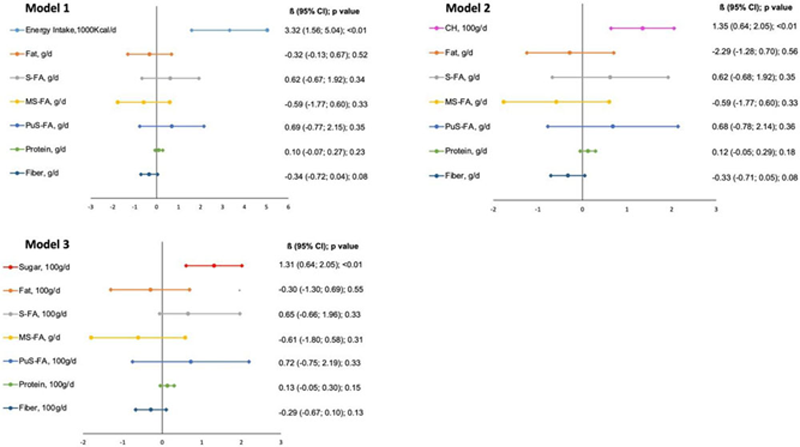
B, linear regression coefficient; CH, carbohydrates; CI, confidence interval; MS-FA, monosaturated fatty acids; PuS-FA, polyunsaturated fatty acids, S-FA, saturated fatty acids.
Disclosure of Interests: None declared.