SIX-YEAR RESULTS FROM THE ESPERANZA COHORT: EVALUATION OF CLINICAL FEATURES, DISEASE ACTIVITY MEASURES AND TREATMENT ASPECTS IN AXIAL AND PERIPHERAL EARLY SPONDYLOARTHRITIS
C. Tornero1, V. Navarro-Compán1, B. Joven-Ibáñez2, R. Almodovar3, X. Juanola-Roura4, C. Fernández-Carballido5, J. C. Quevedo-Abeledo6, J. Rosas7, A. Hernández8, C. A. Montilla-Morales9, J. R. Maneiro10, A. Juan-Mas11, J. A. Pinto Tasende12, M. Moreno13, J. Sanz14, T. Ruiz Jimeno15, M. Moreno16, M. L. Ladehesa Pineda17, E. De Miguel18, on behalf of Esperanza study group
1Hospital Universitario La Paz., Department of Rheumatology., Madrid, Spain
2Hospital Universitario 12 de Octubre, Department of Rheumatology, Madrid, Spain
3Hospital Universitario Fundación Alcorcón, Department of Rheumatology, Madrid, Spain
4Hospital Universitari de Bellvitge, Department of Rheumatology, Barcelona, Spain
5Hospital General Universitario de Elda, Department of Rheumatology, Alicante, Spain
6Hospital Universitario de Gran Canaria Doctor Negrín, Department of Rheumatology, Las Palmas de Gran Canaria, Spain
7Hospital Marina Baixa, Department of Rheumatology, Alicante, Spain
8Hospital Virgen de la Salud, Department of Rheumatology, Toledo, Spain
9Hospital Universitario de Salamanca, Department of Rheumatology, Salamanca, Spain
10Complejo Hospitalario Universitario de Santiago de Compostela, Department of Rheumatology, Santiago de Compostela, Spain
11Hospital Universitario Son Llàtzer, Department of Rheumatology, Palma de Mallorca, Spain
12Complejo Hospitalario Universitario de A Coruña, Department of Rheumatology, La Coruña, Spain
13Hospital Parc Tauli, Department of Rheumatoloy, Barcelona, Spain
14Hospital Universitario Puerta de Hierro, Department of Rheumatology, Madrid, Spain
15Hospital de Sierrallana, Rheumatology, Torrelavega, Spain
16Hospital Clínico Universitario Virgen de la Arrixaca, Department of Rheumatology, Murcia, Spain
17Hospital Universitario Reina Sofía, Department of Rheumatology, Córdoba, Spain
18Hospital Universitario La Paz, Department of Rheumatology, Madrid, Spain
Background: Esperanza was a multicenter national health program developed to facilitate an early diagnosis of patients with Spondyloarthritis (SpA) in Spain.
Objectives: To compare the clinical evolution of patients with axial SpA (axSpA) and peripheral SpA (pSpA) included in this program.
Methods: Patients from the Esperanza cohort fulfilling ASAS criteria for axSpA or pSpA and completed the 6-year follow-up were included. Patients were classified according to the predominant symptom. In case of having axSpA and pSpA, they were classified as axSpA. Clinical features, disease activity and treatment aspects at baseline and 6-year visit were evaluated.
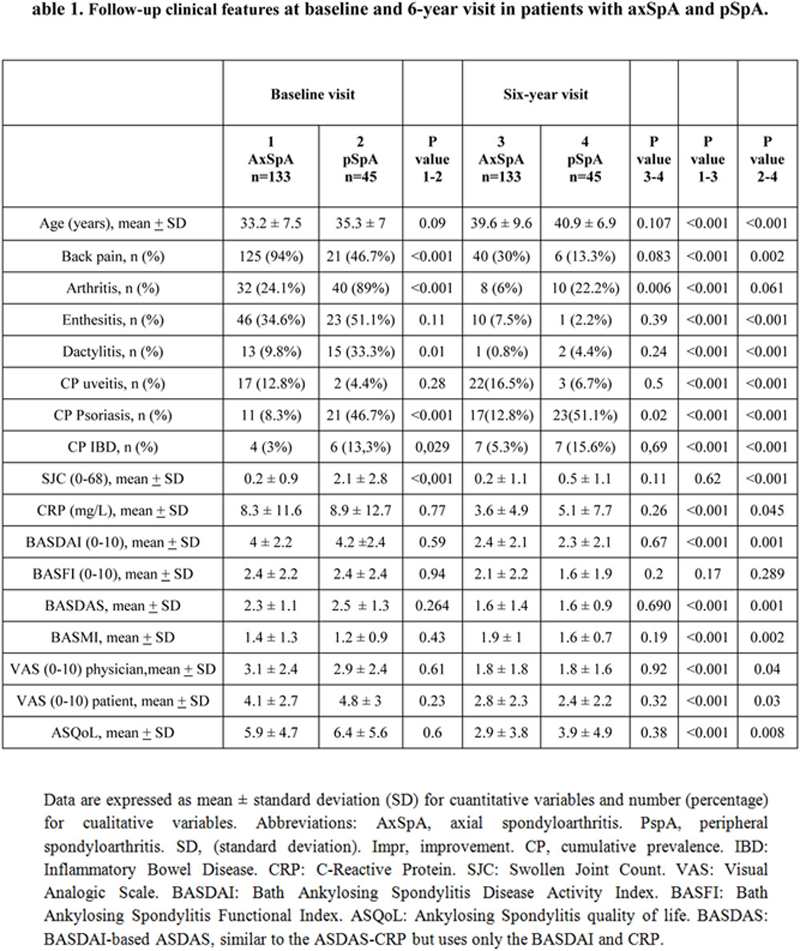
Results: From 775 patients recruited at baseline, 6-year follow-up data from 178 (83.5%) fulfilling ASAS criteria at the final visit were available: 133 (74.7%) for axSpA and 45 for pSpA (25.3%). 118 (66.3%) were males (50.6% with axSpA and 62.2%, pSpA, p=0.4). Patients with axSpA had more frequently positive HLA-B27 (90.5%) vs. (9.5%), p<0.001. Follow-up clinical features are shown in
Table 1
. At the final visit, both axSpA and pSpA presented an improvement in clinical symptoms, disease activity (CRP, BASDAI, ASDAS and VAS-pt) and quality of life (ASQoL). A worsening of mobility (BASMI) was observed in both groups. The prevalence of uveitis, psoriasis and inflammatory bowel disease (IBD) at baseline was 10.7%, 18% and 5.6%, respectively. At the 6-year visit, the cumulative prevalence (CP) was 14% for uveitis (16.5% in axSpA and 6.7% in pSpA), 22.5% for psoriasis (12.8% in axSpA and 51.1% in pSpA) and 7.9% for IBD (5.3% in axSpA and 15.6% in pSpA). Most of the patients were prescribed NSAIDS at baseline and more patients maintained this treatment at the 6-year visit in axSpA compared with pSpA (96.9% vs 87.5%, p=0.02). At the final visit, a higher percentage with pSpA received csDMARDs in comparison with axSpA (81% vs. 35.7%, p<0.001). Sixty (44.4%) patients received biologic therapy at the final visit and no differences were observed in their prescription: 43% in axSpA and 48.6% in pSpA(p=0.6).
Conclusion: The early diagnosis of recent-onset SpA achieves a significant improvement in clinical features, disease activity and quality of life in patients with axSpA and pSpA after 6 years of follow-up. Although previous publications revealed a low radiographic progression in this cohort
1
, the worsening of BASMI must aware clinicians of possible evolutive structural damage.
REFERENCE:
[1]Fernández-Carballido et al. RMD Open. 2020 Sep;6(2):e001345
Acknowledgements: The Spanish Foundation of Rheumatology received funding from Pfizer (formerly Wyeth) to develop the Esperanza Program. Later, the Program has been supported by restricted grants from the Instituto de Salud Carlos III and Fondos FEDER (FIS PI13/02034 and PI17/01840) and AbbVie.
Disclosure of Interests: Carolina Tornero: None declared, Victoria Navarro-Compán: None declared, Beatriz Joven-Ibáñez: None declared, RAQUEL ALMODOVAR: None declared, Xavier Juanola-Roura: None declared, Cristina Fernández-Carballido: None declared, Juan Carlos Quevedo-Abeledo: None declared, Jose Rosas: None declared, Azucena Hernández: None declared, Carlos A. Montilla-Morales: None declared, Jose Ramón Maneiro: None declared, A. Juan-Mas: None declared, Jose Antonio Pinto Tasende: None declared, Mireia Moreno: None declared, Jesus Sanz: None declared, Teresa Ruiz Jimeno: None declared, Manuel Moreno: None declared, María Lourdes Ladehesa Pineda: None declared, Eugenio de Miguel Speakers bureau: AbbVie, Novartis, Pfizer, MSD, BMS, UCB, Roche, Grunental, Janssen, Sanofi., Paid instructor for: Janssen, Novartis, Roche, Consultant of: AbbVie, Novartis, Pfizer, Galapagos, Grant/research support from: Abbvie, Novartis, Pfizer.
Citation: Ann Rheum Dis, volume 80, supplement 1, year 2021, page 766
Session: Spondyloarthritis - clinical aspects (other than treatment)
(POSTERS only)