fetching data ... 
Background: Systemic lupus erythematosus (SLE) is a chronic autoimmune disorder characterized by abnormal activity of the immune system, producing the autoantibodies directed against nuclear and cytoplasmic antigens 1 . Infection is known as one of the common trigger factors for SLE. Coronavirus disease in 2019 (COVID-19), a severe acute respiratory syndrome, is now spreading rapidly throughout the world 2 .Though previous studies have addressed the susceptibility of lupus patients to the virus but how patients with SLE deal with COVID-19 is unclear up until now.
Objectives: To clarify the common pathogenesis of SLE and COVID-19, and find the appropriate treatment for Lupus and prevent COVID-19.
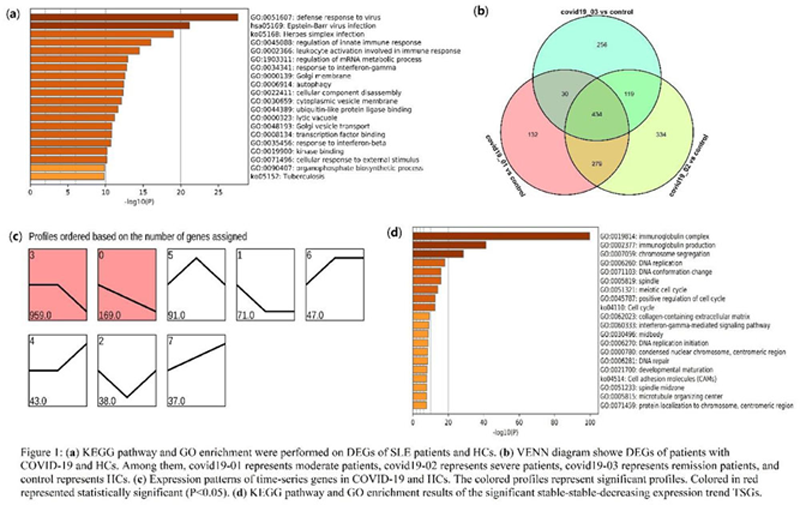
Methods: The transcription profile of SLE (GSE38351) and COVID-19 (GSE161778) were obtained from the Gene Expression Omnibus database (GEO). R package was used to find differentially expressed genes (DEGs) between lupus patients and HCs. After background adjustment and other pre-procession, DEGs were extracted from the peripheral blood of patients with COVID-19 at three different disease progression(moderate, severe and remission status). The Short Time-series Expression Miner (STEM) was used to cluster and compare average DEGs with coherent changes. The different expression patterns of time-series genes (TSGs) were also compared among these patients. GO and KEGG pathway enrichment analysis of TSGs and DEGs were performed by Metascape.
Results: Compared with HC, patients with SLE expressed 977 DEGs, which were mainly associated with defense response to virus, Epstein-Barr virus infection and response to interferon-γ(INF-γ) (
Conclusion: INF-γ is an important common node of SLE and COVID-19. Controlling the production of INF-γ not only has therapeutic effect on SLE patients, but also may prevent COVID-19.
REFERENCES:
[1]Tsokos GC. Systemic lupus erythematosus. N Engl J Med 2011;365(22):2110-21. doi: 10.1056/NEJMra1100359 [published Online First: 2011/12/02]
[2]Wan DY, Luo XY, Dong W, et al. Current practice and potential strategy in diagnosing COVID-19. Eur Rev Med Pharmacol Sci 2020;24(8):4548-53. doi: 10.26355/eurrev_202004_21039 [published Online First: 2020/05/07]
Acknowledgements: This project was supported by National Science Foundation of China (82001740), Open Fund from the Key Laboratory of Cellular Physiology (Shanxi Medical University) (KLCP2019) and Innovation Plan for Postgraduate Education in Shanxi Province (2020BY078).
Disclosure of Interests: None declared.