fetching data ... 
Background: Although biological drugs have dramatically changed and improved the outcome of patients with rheumatoid arthritis (RA), a lot of unresolved problems still exist. Although comorbidity by which enough treatment drugs cannot be prescribed or RA patients refractory to biological agents are representatives, financial difficulty is another representative. There are RA patients who hesitate biological treatment or treatment with Janus-kinase inhibitor due to financial difficulty. Although biosimilar disease-modifying anti-rheumatic drugs (DMARDs) are promising treatment options for such patients, real-world clinical experiences are still lacking in respect to exchanging from biological originator DMARDs to biosimilar DMARDs.
Objectives: This retrospective study investigated the effects of switching from etanercept originator (ETN-OR) to ETN biosimilar (ETN-BS: LBEC0101 developed by LG Chem) on disease activity, physical function, and patient reported outcome (PRO) regarding a self-injection device in patients with well-controlled RA.
Methods: Data from the Toyohashi RA Database (TRAD) was used, which is a collection of single-center retrospective data. We retrospectively investigated disease activity, modified health assessment questionnaire (mHAQ), and patient characteristics in 42 RA patients that switched from ETN-OR to ETN-BS at least 6 months prior. Patients were also requested to answer the Toyohashi Self-Injection Assessment Questionnaire (T-SAQ), originally designed to assess PRO. T-SAQ consisted of 18 questions about self-injection device such as burden, learning, pain, convenience, handling and so on. Best was 0 and worst was 4 in each question and mean score of 18 questions was called total T-SAQ score.
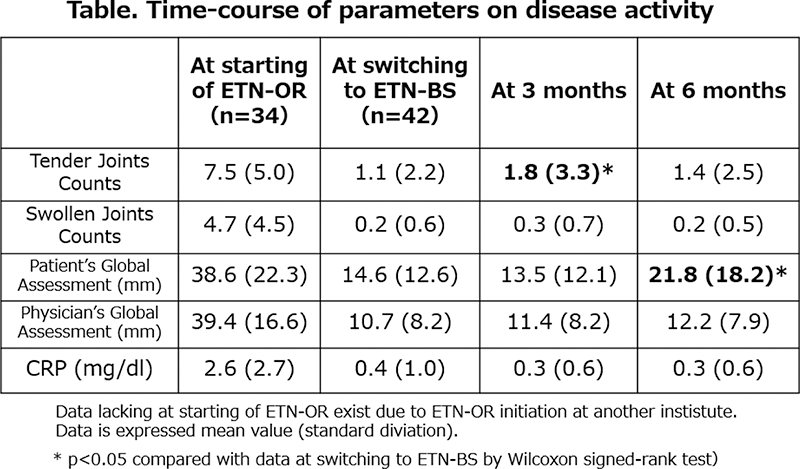
Results: All the patients were female. The mean age, RA duration, and ETN-OR treatment duration were 63.1 years, 18.3 years, and 3107 days, respectively. Mean disease activity and mean mHAQ after switching were as follows (baseline-3 months-6): DAS28-CRP (1.86-2.00-2.03), SDAI (4.3-5.0-5.3), and mHAQ (0.43-0.44-0.46). SDAI after 6 months was significantly elevated compare to baseline. Among each parameter, tender joints count at 3 months and patients’ global assessment at 6 months after switching are significantly increased compared to baseline (
Conclusion: Switching from ETN-OR to ETN-BS worsened disease activity in well-controlled RA patients in our real-world clinical practice due to not objective findings, but subjective complaints by RA patient. We thought that nocebo effect was one of the reasons to explain the results. On the other hand, the PRO regarding the injection device was improved. This improvement may be due to Finer needle of ETN-BS (ETN-OR: 27G, ETN-OR: 29G).
Disclosure of Interests: None declared