fetching data ... 
Background: In several rheumatic diseases, persistent inflammatory state has been related to an accelerated atherosclerosis. Although the risk of cardiovascular (CV) events and atherosclerosis is increased in patients with Systemic Sclerosis (SSc), the exact underlying process has not been well defined. Indeed, inflammation is not a remarkable feature of systemic sclerosis pathogenesis as in other inflammatory rheumatic diseases.
Objectives: The aim of this study was to evaluate the carotid intima-media thickness (c-IMT) as potential marker of cardiovascular damage in SSc patients.
Methods: Between April and July 2021, 14 consecutive patients with SSc and 14 control subjects were enrolled in the study. Participants were aged > 18 and were able to provide written informed consent. Demographic, anthropometric and cardiovascular risk factors (smoking, arterial hypertension, diabetes and family history of CV events) were collected for each subject. Moreover, an evaluation of the sero-haematological characteristics was also performed. The c-IMT was assessed by the same qualified physician through a B-mode ultrasound examination. C-IMT values ≥ 0.9 mm were considered pathological.
Results: Demographic and clinical characteristics are shown in
| Controls (n=14) | SSc patients (n=14) | p | |
|---|---|---|---|
| Demographic and Anthropometric | |||
| Age (years) | 60±4 | 61±13 | 0.836 |
| Gender, female (%) | 14 (100) | 14 (100) | - |
| Smoking habit, yes (%) | 5 (36) | 5 (36) | 1 |
| AH, yes (%) | 7 (50) | 8 (57) | 0.705 |
| T2DM, yes (%) | 5 (36) | 4 (29) | 0.686 |
| Dyslipidemia, yes (%) | 6 (43) | 4 (29) | 0.430 |
| CVD familiarity, yes (%) | 6 (43) | 4 (29) | 0.430 |
| Total Cholesterol (mg/dl) | 189 [167-218] | 170 [128-197] | 0.094 |
| LDL (mg/dl) | 117 [96-139] | 100 [80-115] | 0.125 |
| HDL (mg/dl) | 61 [50-77] | 56 [45-63] | 0.329 |
| Triglycerides (mg/dl) | 107 [62-133] | 107 [69-151] | 0.667 |
| Treatment | |||
| Iloprost | 0 (0) | 14 (100) | 1.21x10 -7 |
| ERA, yes (%) | 0 (0) | 9 (64) | 2.71x10 -4 |
| HMG-CoA reductase inhibitors, yes (%) | 6 (43) | 4 (29) | 0.430 |
Continuous data are presented as mean ± standard deviation or as median and interquartile range. Binomial data are shown as frequencies and percentages. The overall p-value was calculated by the Mann–Whitney non-parametric test for independent samples and by Chi-squared test as appropriate.
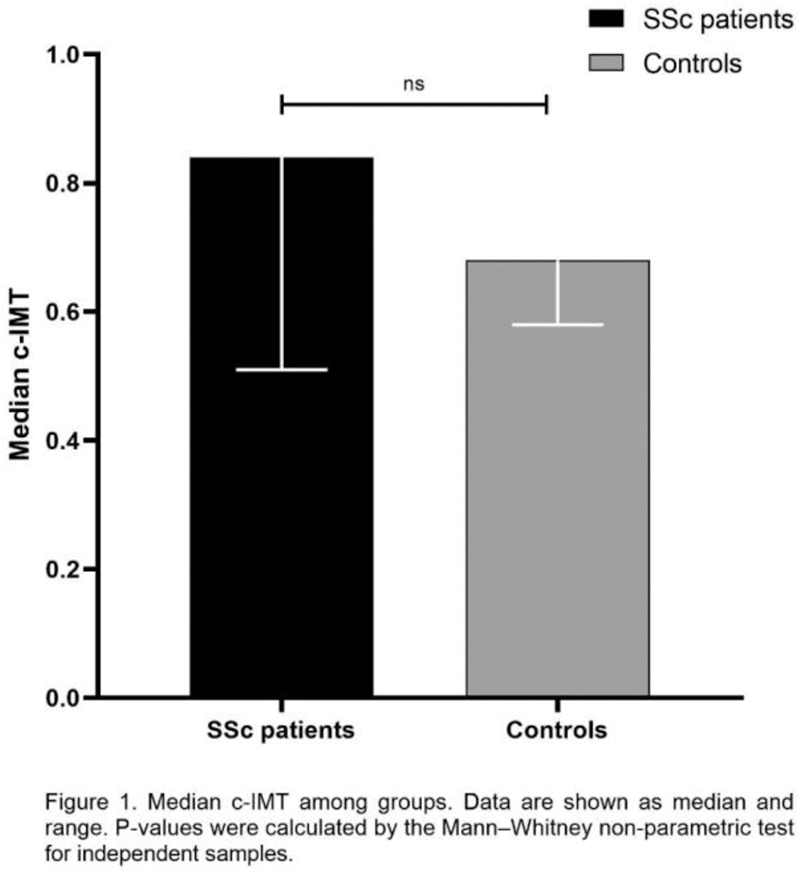
Conclusion: In our study patients with SSc had a non-significative increased c-IMT compared with controls ( p =0.164), however different results have been reported in previous studies. Although it is not clear whether c-IMT may be considered a marker of cardiovascular damage in SSc, further studies are needed to clarify its role.
REFERENCES:
[1]Nussinovitch U, Shoenfeld Y. Atherosclerosis and macrovascular involvement in systemic sclerosis: myth or reality. Autoimmun Rev. 2011 Mar;10(5):259-66. doi: 10.1016/j.autrev.2010.09.014. Epub 2010 Sep 21. PMID: 20863903.
Disclosure of Interests: None declared