fetching data ... 
Background: Poor adherence to rheumatologic diseases exist for various reasons.
Objectives: The objective of the study was to measure adherence with interventions.
Methods: It was a prospective cohort study for 52 weeks. Assuming adherence of 30%, power of the study as 90% and confidence interval 95% sample size was calculated as 323. Common rheumatologic disorders (Rheumatoid arthritis (RA), Spondyloarthropathy (SpA), Primary Sjogren’s Syndrome (PSS) and Systemic Lupus Erythematosus (SLE)) patients with at least 15% from each group who presented first time in our clinic were followed up. The interventions were two separate sessions of face-to-face counselling during first initial visits, telephone-based titration of drugs if there was poor control of the presenting symptoms and two-day prior reminder phone call for next follow up.
Results: Among 323 enrolled patients 27% were compliant with previous treatment. The relative ratio of compliant groups under follow up with the rheumatologist verses other clinicians was 2.2. Median duration of diagnosis of the 60% previously diagnosed verses 40% newly diagnosed at our clinic was 18 months verses 7 days. Among 64 cases of PSS 86% were undiagnosed with median duration of symptoms of 4 years. Knowledge about consequences of poor treatment between pre verses post counselling was 40% and 78% respectively. (
Comparison between pre and post intervention
| Variables | RA | ax-SpA | SLE | PSS (N=64) |
|---|---|---|---|---|
| (N=116) | (N= 72) | (N=71) | ||
| Before intervention | 3.5 | 2.5 | 3 | 4 |
| •Median duration of diagnosis (years) | 25 | 9 | 34 | 19 |
| •Number of adherence (87) | 9 | 4 | 7 | 3 |
| •Insight about the disease conditions | 17 | 17 | 16 | 16 |
| a.I don’t have disease | 30 | 17 | 16 | 31 |
| b.I have disease due to external factors | 28 | 23 | 25 | 11 |
| c.I have disease due to internal factors | 22 | 11 | 7 | 3 |
| d.‘c’ + I need medication for some time | <1 | 2 | <1 | 2 |
| e.‘c’ + I need medication per rheumatologist | 49 | 30 | 41 | 50 |
| After intervention | 5 | 4 | 5 | 1 |
| •Median duration of diagnosis (weeks) | 9 | 4 | 4 | 4 |
| •Number of adherence at 52 weeks (170) | 14 | 9 | 8 | 11 |
| •Insight about the disease conditions | 31 | 21 | 17 | 11 |
| a.I don’t have disease | 57 | 34 | 37 | 32 |
| b.I have disease due to external factors | ||||
| c.I have disease due to internal factor | ||||
| d.‘c’ + I need medication for some time | ||||
| e.‘c’ + I need medication per rheumatologist |
Adherence proportion with consequent follow up
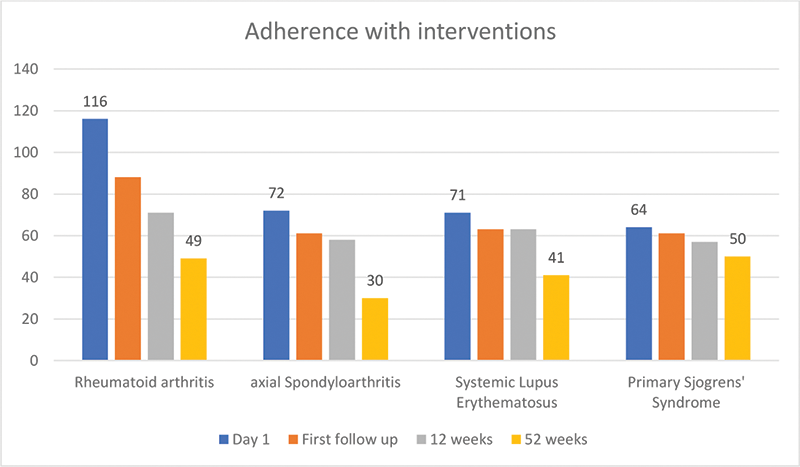
Conclusion: Early diagnosis, separate counselling sessions, effective control of symptoms and reminder to follow up significantly increases the adherence in rheumatological disorder.
REFERENCES:
[1]Safiri S, Kolahi A-A, Cross M, et al. Prevalence, deaths, and disability-adjusted life years due to musculoskeletal disorders for 195 countries and territories 1990–2017. Arthritis Rheumatol. 2021 Apr;73(4):702–714.g
Acknowledgements: I would like to acknowledge Dr Sanjay Geed medical superintendent Medanta Superspeciality Hospital Indore
Disclosure of Interests: None declared