fetching data ... 
Background: Secondary Sjogren’s syndrome(SS) is a common extra-articular manifestation of rheumatoid arthritis (RA)[1]. RA patients combined with SS have different outcomes from those without SS[2]. However, the studies investigated the characteristics of gut microbiota in patients with RA and SS is limited.
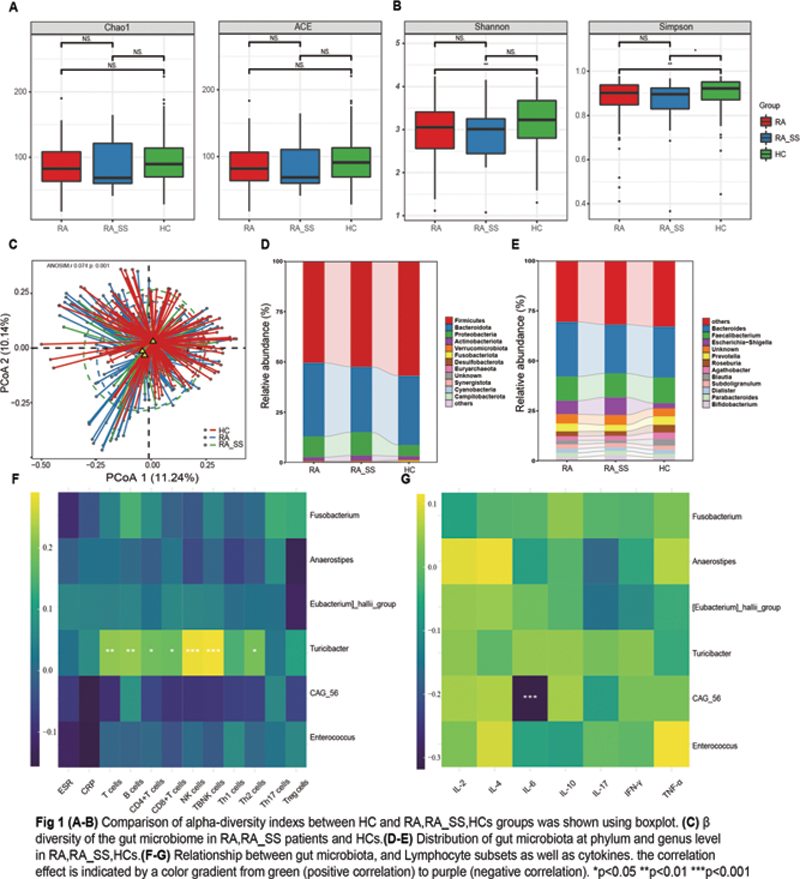
Objectives: To investigate the characteristics of gut microbiome and the associations between flora and peripheral lymphocyte subpopulations in RA patients with or without Sjogren’s syndrome.
Methods: A total of 326 samples from 145 RA patients without SS, 23 RA combined with SS patients(RA-SS) and 168 healthy controls (HCs) were recruit in this study from The Second Hospital of Shanxi Medical University (Taiyuan, Shanxi, China). The gut microbiota were investigated via 16s rRNA sequencing and the peripheral T lymphocyte subsets of these participants were assessed by flow cytometry. The Wilcoxon rank-sum test was used to compare alpha diversity indicesbetween groups. Differential abundance analysis was carried out the STAMP software. Spearman’s correlation analysis was used to assess the correlations between the relative abundances of bacterial genera and clinical meatures.
Results: Patients with RA and RA-SS exhibited a significant reduction in the richness and diversity of gut microbiota compared with those of HCs (
Conclusion: RA patients with deficiency of Turicibacter in flora had higer occurrence of Sjögren’s syndrome sjogren’s syndrome complication, which was correlated with peripherial lymphocyte subpopulations and cytokines.
REFERENCES:
[1]Chen Y, Ma C, Liu L, He J, Zhu C, Zheng F, Dai W, Hong X, Liu D, Tang D et al: Analysis of gut microbiota and metabolites in patients with rheumatoid arthritis and identification of potential biomarkers. Aging 2021, 13(20):23689-23701.
[2]Brown LE, Frits ML, Iannaccone CK, Weinblatt ME, Shadick NA, Liao KP: Clinical characteristics of RA patients with secondary SS and association with joint damage. Rheumatology (Oxf) 2015, 54(5):816-820.
Acknowledgements: This work was supported by the National Natural Science Foundation of China (No. 82001740).
Disclosure of Interests: None declared