fetching data ... 
Background: Cardiovascular (CV) disease is the leading cause of death in Ankylosing Spondylitis (AS ) 1 . The chronic inflammatory-driven endothelial dysfunction and accelerated atherosclerosis contribute to the enhanced CV risk in AS. However, the therapeutic options to treat the enhanced CV risk are limited.
Objectives: To investigate the impact of Olmesartan and Rosuvastatin on endothelial dysfunction and inflammation in AS.
Methods: 60 consequtive AS patients were randomized to receive 24-weeks of treatment with Olmesartan (OLME) (10 mg/day, n=20), Rosuvastatin (Rvs) (10 mg/day, n=20), or placebo (PL) (n=20) as an adjunct to existing stable csDMARDs. Endothelial function was assesed by brachial artery flow-mediated dilatation (FMD) using AngioDefender. EPCs (CD34 + /CD133 + ) were estimated by flow cytometry. Serum nitrite, TBARS, ICAM-1, VCAM-1 and lipids levels estimated at baseline and after treatment. Inflammatory measures included: ASDAS, BASDAI, BASFI, ESR and CRP, pro-inflammatory cytokines. Quality of life and CV 10-year risk (SCORE high risk charts) were estimated using standard tools.
Results: Baseline levels of FMD and EPC population were impaired indicating endothelial dysfunction. Basal concentrations of inflammatory markers, pro-inflammatory cytokines and markers of endothelial dysfunction were elevated among three groups. After 24-weeks of treatment, FMD improved significantly in the rosuvastatin and olmesartan group as compared to placebo from their baseline levels: {OLME vs. PL (p≤0.01), Rvs vs. PL (p<0.01), Rvs vs. OLME (p=0.10) (
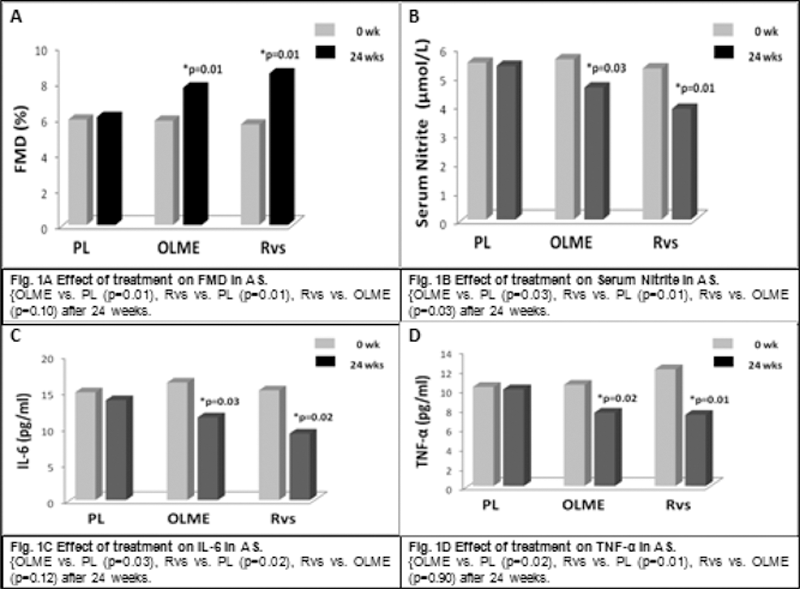
Conclusion: Olmesartan and rosuvastatin improve endothelial dysfunction and vascular inflammation and QoL in AS patients. Olmesartan and Rosuvastatin lower the proinflammatory cytokines, especially TNF-α, that upregulate eNOS and downregulates the production of adhesion molecules, CRP and nitric oxide which, in turn, improves endothelial dysfunction. Both drugs also decrease nitrite concentration and improve the EPC population in AS patients. The augmentation of EPCs by olmesartan and rosuvastatin represents a fascinating new approach for the management of AS. However, Rosuvastatin in addition also favorably impacted ICAM-1 and lipid abnormalities. In contrast, olmesartan has beneficial effect on blood pressure. Thus, both rosuvastatin and olmesartan have anti-inflammatory, immunomodulatory, vasculoprotective and cardioprotective effects in AS mediated through anti-proinflammatory cytokine action. These findings suggests that both drugs could mediate modest but clinically apparent anti-inflammatory effects with modification of CV risk in the context of high-grade autoimmune inflammation of AS and may provide a novel strategy to prevent cardiovascular events in these patients.
REFERENCES:
[1]Azevedo VF, Pecoits-Filho R. Atherosclerosis and endothelial dysfunction in patients with ankylosing spondylitis. Rheumatol Int 2010;30(11):1411–1416
Disclosure of Interests: None declared