fetching data ... 
Background: Currently available urate lowering therapies (ULTs) are limited in their use for gout patients with advanced CKD based on dosing restrictions, tolerability, safety concerns, and reduced effectiveness, compared to options for the broader gout population. In gout patients with advanced CKD, the intestinal tract becomes the major route of urate elimination, as opposed to in healthy people with normal kidney function where kidneys are the primary route of uric acid excretion. 1 Considering some of the limitations of present urate-lowering therapies (ULTs) in gout & CKD and the extra-renal pathway of urate secretion, a new oral therapy, ALLN-346 (engineered urate oxidase), is under development as a non-absorbed, urate specific enzyme, designed to enhance degradation and secretion of urate in the intestinal tract. 2
Objectives: To assess the safety, tolerability, and initial bioactivity data of ALLN-346 in adults with hyperuricemia and CKD.
Methods: This one-week inpatient Phase 2a study (NCT04987242) was conducted at a clinical pharmacology unit. Eleven otherwise healthy adult patients with hyperuricemia (sUA ≥ 6.8 mg/dL) and normal to Stage 2 CKD (eGFR ≥60), not on concurrent ULTs, were randomized (2:1) to receive either 5 capsules of ALLN-346 or matching placebo, three times daily for 7 days. Serum urate was measured daily, and urine uric acid was assessed on days -2, -1, 1, 4, and 7. Safety was monitored throughout the study. To assess possible ALLN-346 systemic absorption, a specific ELISA was used on serum samples collected pre- and post-dose over 7 days.
Results: Of the 11 patients 7 received ALLN-346 and 4 received placebo. Most patients had Stage 2 CKD, including 5 of the 7 subjects treated with ALLN-346. A statistically significant reduction in mean sUA was recorded with ALLN-346 compared to placebo [
Absolute and Percent Change from Baseline in Serum Urate over 7 -days of Treatment
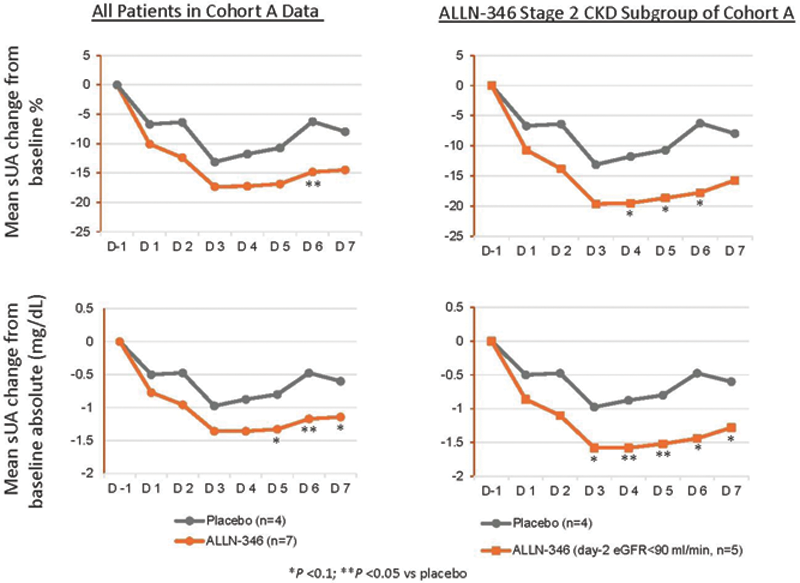
Conclusion: In this study, oral therapy with ALLN-346 for 7 days was well tolerated and resulted in a significant reduction in sUA. Consistent with the known pathophysiologic adaptation of increased intestinal elimination of uric acid in patients with impaired kidney function and the intestinal-based mechanism of action of ALLN-346, there was a strong correlation between the effect of ALLN-346 on sUA reduction and the level of kidney function. The generated data support proof of pharmacology for the intestinal mechanism of action of ALLN-346 to degrade urate either formed or secreted in the gut. Future studies in the larger gout population with CKD are underway.
REFERENCES:
[1]Sorensen BL. Role of the intestinal tract in the elimination of uric acid. Arthritis and Rheumatism, vol 8, part5 1965
[2]Pierzynowska K, Deshpande A, Mosiichuk N, et al. Oral Treatment with an Engineered Uricase, ALLN-346, Reduces Hyperuricemia, and Uricosuria in Urate Oxidase-Deficient Mice. Front Med (Lausanne). 2020 Nov 24;7:569215.
Disclosure of Interests: Robert Terkeltaub Consultant of: Allena, SOBI, Astra-Zeneca, Fortress, Grant/research support from: Astra-Zeneca, David Clark Shareholder of: Allena, Employee of: Allena, Christine Tosone Shareholder of: Allena, Employee of: Allena, Boris Kandinov Shareholder of: Allena, Employee of: Allena, Ping Zhang Shareholder of: Corbus, Employee of: Previous Corbus, Current Allena, Naomi Dahl Shareholder of: AbbVie shares, Allena options, Employee of: Allena, Danica Grujic Shareholder of: Allena, Employee of: Allena, David Goldfarb Consultant of: Allena, Alnylam, AstraZeneca, Cymabay, Dicerna, Sumitovant, Synlogic, Grant/research support from: Dicerna, Travere