fetching data ... 
Background: B cell depletion-based immunotherapies have transformed the treatment of autoimmune diseases. However, current T cell-based therapeutic modalities, including CAR-T and T cell engagers (TCEs), present substantial safety risks—most notably cytokine release syndrome (CRS)—which is particularly concerning in autoimmune patients who require a high safety margin. Moreover, plasma cells play a critical role in driving disease progression and relapse, yet CD19-targeted therapies fail to eliminate these autoantibody-secreting cells.
Objectives: We aimed to develop a first-in-class mRNA-encoded trispecific TCE targeting CD19, BCMA, and CD3 to achieve broad depletion of B cells and plasma cells with an improved safety profile for the treatment of B cell-driven autoimmune diseases.
Methods: The TCE was engineered by fusing single-chain variable fragments (scFvs) targeting CD3 and two VHH antibodies against CD19 and BCMA, respectively. The mRNA encoding the TCE was optimized through codon usage modifications to balance the Codon Adaptation Index (CAI) and Minimal Free Energy (MFE), taking into account the entire mRNA sequence, including untranslated regions (UTRs) and the coding sequence (CDS). The mRNA was encapsulated in a novel LNP for preferential delivery to secondary lymphoid organs including spleen, bone marrow and lymph nodes. TCE’s B cell-killing activity was tested in PBMC from healthy individuals or patients with autoimmune diseases. In vivo functional activities, safety, pharmacokinetics (PK) and biodistribution were assessed in immune-deficient mice reconstituted with either CD34+ hematopoietic stem cell (HSC) or systemic lupus erythematosus (SLE) patient PBMC, in human CD19/CD3 transgenic mice and in non-human primates (NHPs).
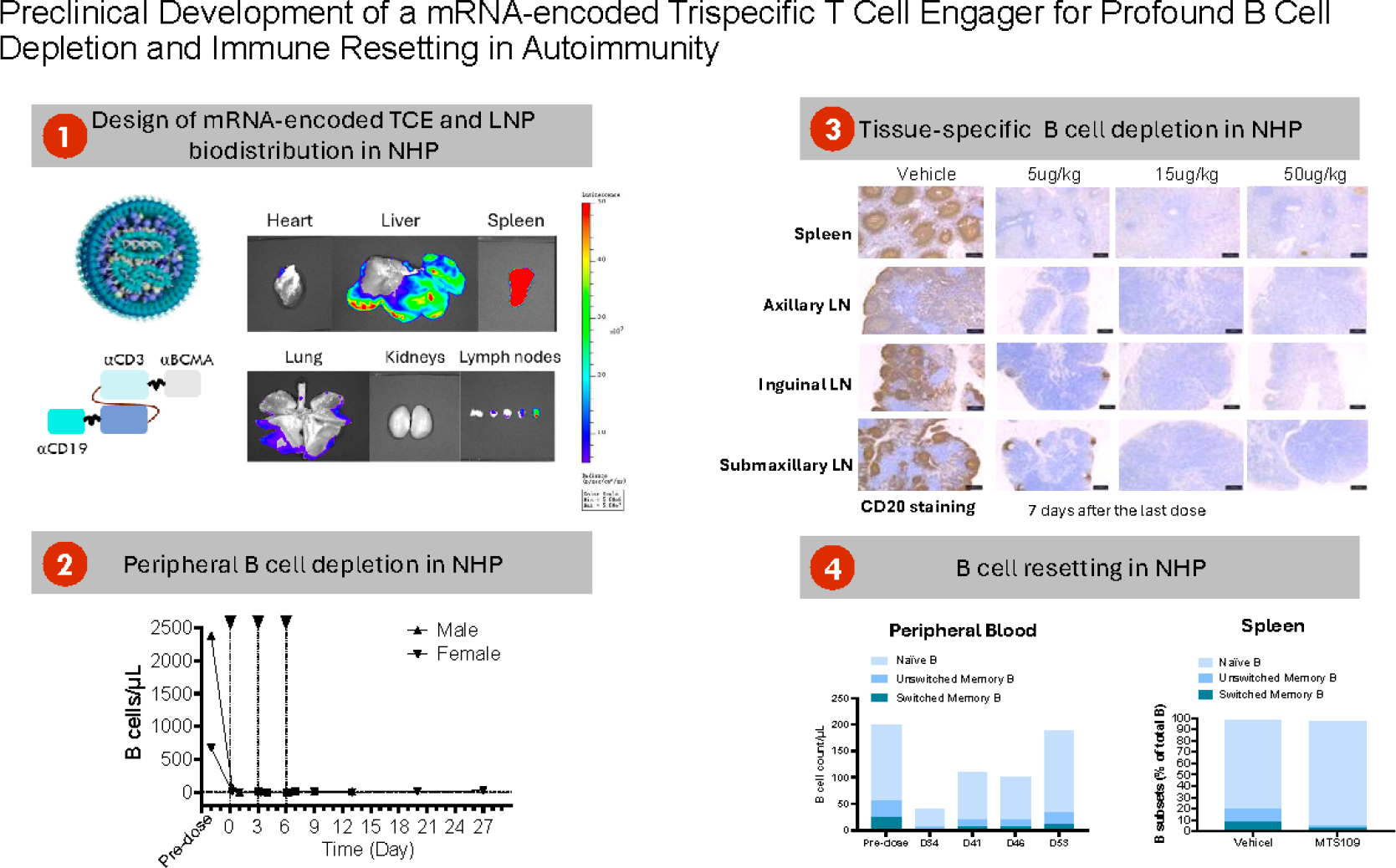
Results: In human PBMC assays, the mRNA-TCE demonstrated potent B cell depletion with an EC 50 of approximately 0.1 pM. Robust B-cell depletion was observed across multiple mouse models. In the SLE-PBMC model, treatment significantly reduced autoantibody levels. In OPM2 tumor-bearing mice, the TCE induced profound depletion of CD19+ B cells in peripheral blood and lymphoid tissues and achieved complete regression of BCMA+ tumors. In NHPs, ultra-low mRNA-LNP dosing (5 µg/kg) resulted in complete peripheral B cell depletion within 6 hours, with broad elimination of naïve, memory, and plasma cell compartments in the spleen, lymph nodes, and bone marrow by day 15. B-cell reconstitution began ~3 weeks post-dose and was dominated by naïve phenotypes, suggesting immune resetting. Notably, subcutaneous administration achieved comparable efficacy to intravenous dosing while exhibiting an improved safety profile with respect to cytokine release, likely attributable to the favorable pharmacokinetics of mRNA-mediated protein translation. At efficacious dose levels, no elevations in clinical pathology markers or overt toxicities were observed.
Conclusions: This mRNA-encoded trispecific TCE represents a novel, lymphoid organ-targeted immunotherapy for B cell-driven autoimmune diseases. These findings provide a strong rationale for advancing to a First-in-Human clinical trial, which is currently ongoing.
Panel 1): Design of mRNA-encoded TCE and LNP biodistribution in NHP. Panel 2): Peripheral B cell depletion in NHP. Panel 3): Tissue-specific B cell depletion in NHP. Panel 4): B cell resetting in NHP.
REFERENCES: NIL.
Acknowledgments: NIL.
Disclosure of Interests: None declared.