fetching data ... 
Background: Cytokines of the Tumour Necrosis Factor (TNF) superfamily function as central drivers of immune-mediated inflammatory diseases (IMIDs) and constitute established drug targets. Following the broad clinical adoption of anti-TNF-α biologics such as adalimumab for rheumatologic conditions, attention has extended to other members within the superfamily. TNF-like ligand 1A (TL1A), a cytokine signaling through death receptor 3 (DR3), plays a role in amplifying pro-inflammatory responses and maintaining mucosal immune homeostasis. Evidence links dysregulated TL1A–DR3 signaling to the pathogenesis and severity of inflammatory bowel diseases (IBD), identifying TL1A as a candidate target for intervention. Accordingly, several anti-TL1A monoclonal antibodies are under evaluation in Phase 3 trials for ulcerative colitis (UC) and Crohn’s disease (CD).
Compared to biologic therapies, small-molecule inhibitors present potential advantages, including oral or topical administration routes, minimal immunogenicity, and potentially lower costs which may improve patient accessibility. The development of oral small-molecule antagonists for TL1A, however, remains at an early stage. A principal factor is the characteristically large and flat binding interface between TL1A and DR3, which complicates the design of conventional orthosteric inhibitors. An alternative strategy involves the use of allosteric inhibitors to stabilize the cytokine trimer in an inactive state, thereby inhibiting its pro-inflammatory signaling activity [1]. Building on this premise, the present work describes the discovery and characterization of a series of novel small-molecule compounds designed to act as TL1A antagonists through an allosteric mechanism.
Objectives: To discover small-molecule TL1A antagonist with direct target engagement and cellular functional blockade as oral therapy of UC/CD and other TL1A-driven IMIDs.
Methods: An AI-enabled, structure-based, chemistry-driven workflow was set up for TL1A antagonist hit finding. An in-house proprietary library was designed and evaluated by various biophysical methods such as differential scanning fluorimetry (DSF), and nuclear magnetic resonance (NMR) with TL1A trimer. Iterative high-throughput medicinal chemistry optimization was guided by structure–activity relationships and computation. Surface plasmon resonance (SPR) with recombinant human TL1A and functional antagonism in a soluble recombinant human TL1A-driven TF-1 apoptosis assay further confirmed the binding. Drug-target interaction was addressed by X-ray crystallography.
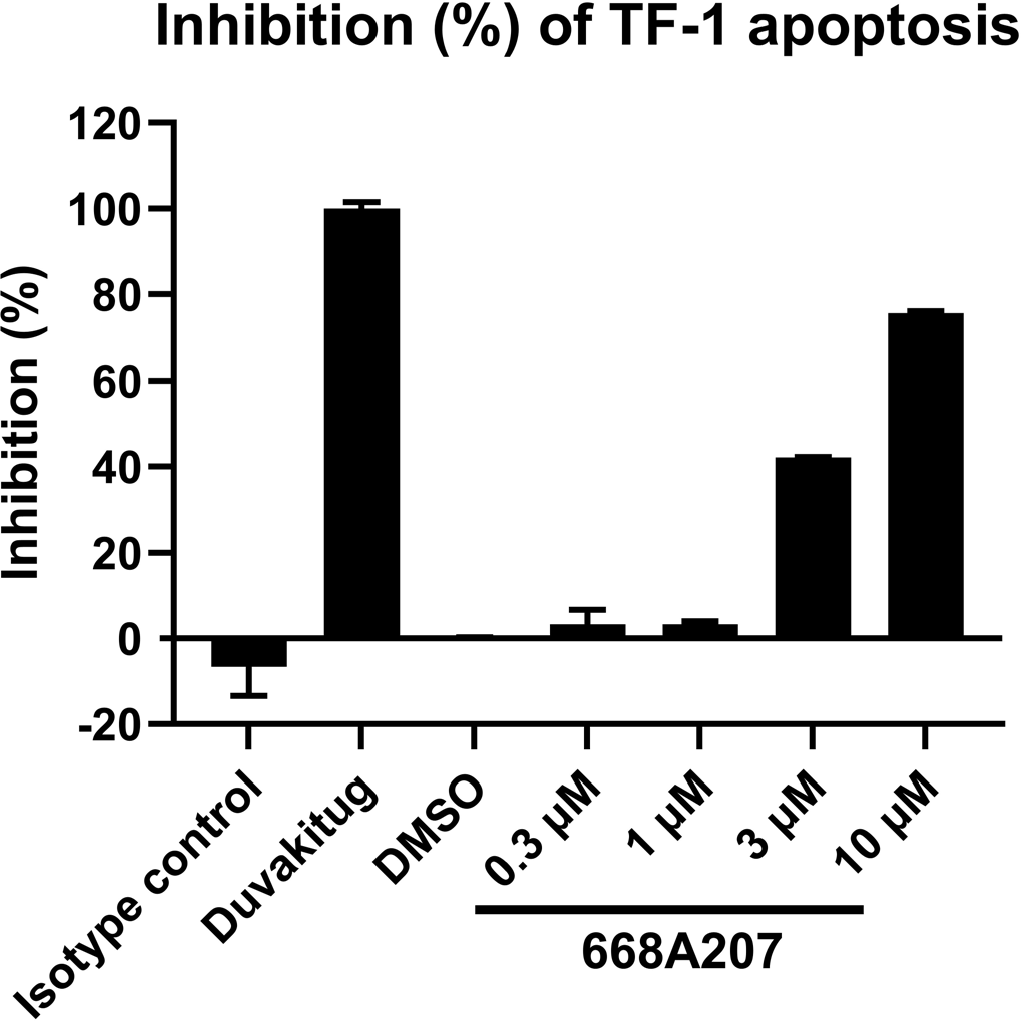
Results: Biophysical and cellular assays have been set up and validated to support TL1A antagonist. From in-house proprietary library, we identified a novel and tractable chemical series that directly engages TL1A. A representative compound demonstrated DSF evidence of TL1A stabilization and concentration-dependent binding by SPR with an estimated equilibrium KD at low micromolar level. These compounds are active at cellular level by inhibiting TL1A-mediated signaling.
Conclusions: We report a novel series of small-molecule antagonists that directly bind TL1A and block its cellular functions. These findings bridge clinically validated TL1A biology with a potentially differentiated oral therapeutic strategy, which may expand treatment options for ulcerative colitis and Crohn’s disease, as well as potentially other immune-mediated inflammatory diseases (IMIDs). This work also provides important insights for the discovery of allosteric inhibitors targeting cytokines within the TNF superfamily.
Inhibition of TL1A-induced TF-1 apoptosis by a representative small-molecule TL1A inhibitor.
REFERENCES: [1] J. Chen, J. Yu, J. Du, P. Shi, X. Wang, POS1135 Discovery and Characterization of Novel Oral TNF-Alpha Inhibitors as Potential Treatments for Autoimmune Diseases, Annals of the Rheumatic Diseases, Volume 84, Supplement 1, 2025, Page 1214.
Acknowledgments: NIL.
Disclosure of Interests: Jinhua Chen IntelliGen Therapeutics, Jingfeng Yu IntelliGen Therapeutics, Jingjing Du IntelliGen Therapeutics, Pu Shi IntelliGen Therapeutics, Xin Wang IntelliGen Therapeutics