fetching data ... 
Background: VEXAS syndrome is an adult-onset, X-linked, autoinflammatory disease with hematological involvement caused by somatic mutations in the UBA1 gene acquired by hematopoietic stem and progenitor cells (HSPCs). Understanding the dynamics of hematopoietic cell populations is essential. However, the factors influencing these dynamics remain poorly understood. In particular, it is unclear whether and how (i) different UBA1 mutations perturb hematopoietic cell populations (HCPs), and (ii) prior or ongoing anti-inflammatory treatments contribute to their shaping.
Objectives: We aimed to assess the influence of anti-inflammatory treatments and UBA1 mutations on HCPs in VEXAS patients.
Methods: VEXAS patients were recruited from the San Raffaele cohort and profiled by multiparametric flow cytometry and single-cell RNA-sequencing (scRNA-seq). Multiparametric flow cytometry was used to quantify the abundance and distribution of hematopoietic bone marrow (BM) cells. Healthy age and sex-matched individuals (HCs) were used as controls. First, abundance and distribution of HCPs were compared among HCs and VEXAS patients. Next, we repeated the analysis stratifying patients by UBA1 mutation genotypes (Thr-, Val-, Leu-mutated) and immunosuppressive treatments (steroid-only (PDN) versus anti-IL (including IL-1, IL-6)/anti-JAK (ruxolitinib). scRNA-seq was performed on CD45+ BM mononuclear cells (BMMCs) enriched in CD34+ HSPCs from the San Raffaele patient cohort, along with published datasets. Upon dimensionality reduction and unsupervised clustering, pathway enrichment analyses on significant differentially expressed genes were performed across clusters to identify transcriptional perturbation in VEXAS patients, either pooled or stratified by mutation genotype or treatment, versus HCs. Mann Whitney and Kruskal-Wallis tests was used for these analyses.
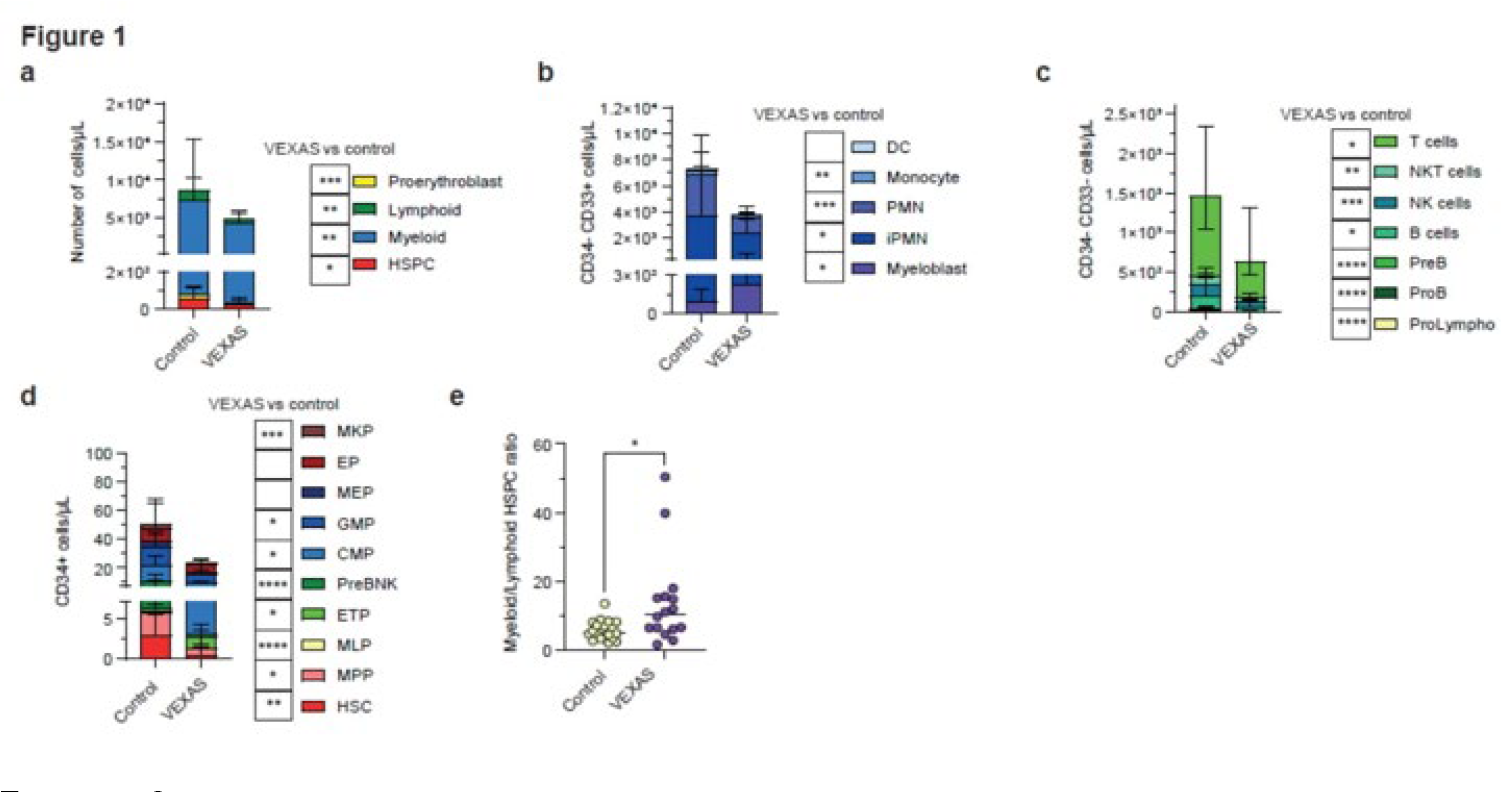
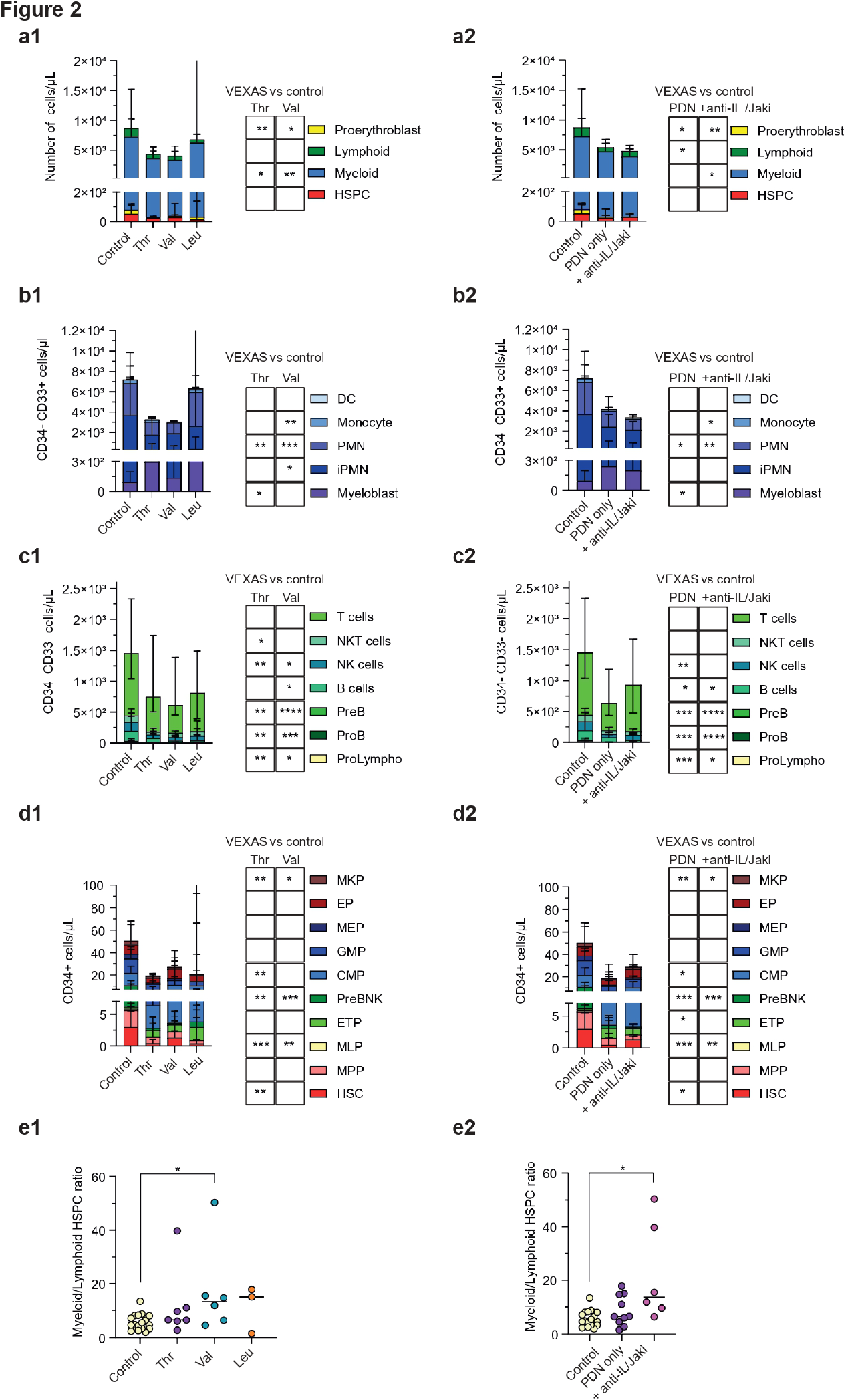
Results: A total of 16 VEXAS patients were analyzed. Clinical features are summarized in Table 1. The distribution of UBA1 mutations was as follows: 7(44%) p.Met41>Thr; 6(37%) p.Met41>Val, and 3(19%) p.Met41>Leu. 19 HCs were included. BM immunophenotypic analyses revealed a significant reduction across all hematopoietic lineages in VEXAS patients compared to HCs, including HSPCs as well as differentiated myeloid, lymphoid, and proerythroblast populations (Figure 1A–C). HSPCs in VEXAS patients exhibit a marked loss of phenotypically primitive HSCs/MPPs and a pronounced reduction in lymphoid progenitors (Figure 1D). This defect is propagated during differentiation, resulting in a limited contribution to B-cell lineages (Figure 1C). In contrast, myeloid progenitors are proportionally increased, indicating a myeloid-biased differentiation of HSPCs in VEXAS (Figure 1E). Stratification of VEXAS patients by mutation revealed a trend toward more severe phenotypes in patients harboring Thr or Val mutations compared with those carrying Leu mutations (Figure 2A1-E1). Thr-mutated VEXAS patients exhibit a more pronounced reduction in proerythroblasts (Figure 2A1), whereas Val-mutated VEXAS patients showed a significant greater decrease in myeloid and B-cell lineages (Figure 2B1,C1). Interestingly, within the lymphoid lineage NK and NKT cells were more severely affected in Thr-mutated patients (Figure 2C1). Notably, a significant reduction in phenotypically defined HSCs was observed exclusively in Thr-mutated patients (Figure 2D, while a significant myeloid skewing of HSPCs was detected only in Val-mutated VEXAS patients (Figure 2E1). When stratifying VEXAS patients by treatment with PDN alone versus combined PDN and anti–IL/JAK inhibitor therapy, we observed only limited differences in phenotypic composition across hematopoietic compartments (Figure 2A2–C2). Patients treated with PDN alone showed a significant reduction in HSCs (Figure 2D2), whereas patients receiving PDN in combination with anti–IL/JAK inhibitors exhibited a pronounced myeloid bias (Figure 2E2). However, these differences appear to be attributable to underlying mutation status rather than treatment effect, as the combination-therapy group included 4 of 6 patients harboring Val mutations. Regarding scRNA-seq, the Thr and Leu mutations had the greatest impact on inflammatory categories when comparing a subset of VEXAS patients with HCs. Conversely, Thr and Val mutations were more strongly associated with the activation of pathways linked to altered erythropoiesis. These data suggest that different UBA1 mutations may differentially influence the transcriptional profile across various cell lineages. Analyses on all VEXAS patients stratified by treatment are ongoing.
Conclusions: Taken together, these findings reveal a genotype-driven disruption of hematopoietic architecture in VEXAS, with UBA1 mutation status rather than treatment predominantly shaping HSPC and lineage compositions and transcriptional profiles.
REFERENCES: [1] Beck DB, Ferrada MA, Sikora KA, et al. Somatic Mutations in UBA1 and Severe Adult-Onset Autoinflammatory Disease. N Engl J Med . 2020;383(27):2628-2638. doi:10.1056/NEJMoa2026834
[2] Wu Z, Gao S, Gao Q, et al. Early activation of inflammatory pathways in UBA1-mutated hematopoietic stem and progenitor cells in VEXAS. Cell Rep Med . 2023;4(8):101160. doi:10.1016/j.xcrm.2023.101160
[3] Ainciburu M, Ezponda T, Berastegui N, et al. Uncovering perturbations in human hematopoiesis associated with healthy aging and myeloid malignancies at single-cell resolution. Elife . 2023;12:e79363. Published 2023 Jan 11. doi:10.7554/eLife.79363
[4] Molteni R, Fiumara M, Campochiaro C, et al. Mechanisms of hematopoietic clonal dominance in VEXAS syndrome. Nat Med . 2025;31(6):1911-1924. doi:10.1038/s41591-025-03623-9
Acknowledgments: NIL.
Disclosure of Interests: None declared.