fetching data ... 
Background: Xanthine oxidase (XO) inhibitors are the preferred first-line urate-lowering therapy (ULT) for gout and hyperuricemia, but the small number of available synthetic agents is constrained by hypersensitivity reactions, cardiovascular safety concerns, renal dosing limitations and flare risk at initiation. The buried molybdenum–pterin cofactor and narrow substrate channel of XO impose stringent geometric constraints on scaffold design, which may partly explain the limited expansion of this drug class despite the substantial global burden of urate crystal–mediated disease. In parallel with guideline-endorsed low-dose and combination ULT strategies, there is growing interest in safer, mechanistically plausible, non-synthetic XO-active agents that could support dose-sparing or adjunctive approaches.
Objectives: To identify and prioritize non-synthetic XO inhibitor candidates using an integrated in silico–to–in vitro workflow, and to characterize their semi-quantitative inhibitory profiles alone and in exploratory low-dose combinations with allopurinol.
Methods: A virtual screen of clinically relevant compounds was performed in Mcule using structure-based docking at the XO active site, followed by Chemmine Tools–based similarity clustering to enrich for pteridine-like small molecules. ADMET-guided filtering prioritized candidates with favorable predicted safety and drug-likeness. Shortlisted agents (folic acid, niacin, niacinamide; Moringa oleifera, Curcuma longa, Zingiber officinale ) and allopurinol were evaluated in a bench-top XO assay in which xanthine is converted to uric acid; uric acid production was monitored semi-quantitatively using commercially available colorimetric strips. Four prespecified groups were tested: synthetic comparators, vitamin B analogs, natural products, and non-synthetic combinations. Within each group, three doses and multiple time points were assessed. Relative strip intensity was compared versus uninhibited controls and allopurinol using nonparametric, rank-based analyses to describe inhibition patterns.
Results: Non-synthetic agents in both the vitamin B and natural product groups produced reproducible reductions in uric acid–associated color intensity versus uninhibited controls. Within the vitamin B group, folic acid consistently showed the strongest semi-quantitative XO inhibition (folic acid > niacinamide > niacin), consistent with prior evidence that folate analogues can interact with molybdenum cofactor-containing enzymes. Within the natural product group, Moringa oleifera outperformed Curcuma longa and Zingiber officinale , aligning with emerging data on Moringa-mediated XO inhibition and antihyperuricemic effects. For each monotherapy group, global nonparametric tests did not reach conventional statistical significance, reflecting small sample sizes and semi-quantitative readouts; however, rank-based profiles demonstrated coherent, concentration-dependent inhibitory trends favoring folic acid and Moringa. In an exploratory non-synthetic combination group constructed from the best performers of each class, low-dose allopurinol + folic acid, allopurinol + Moringa, and folic acid + Moringa yielded the most favorable inhibition profiles in the panel, suggesting additive or dose-sparing potential relative to single-agent conditions.
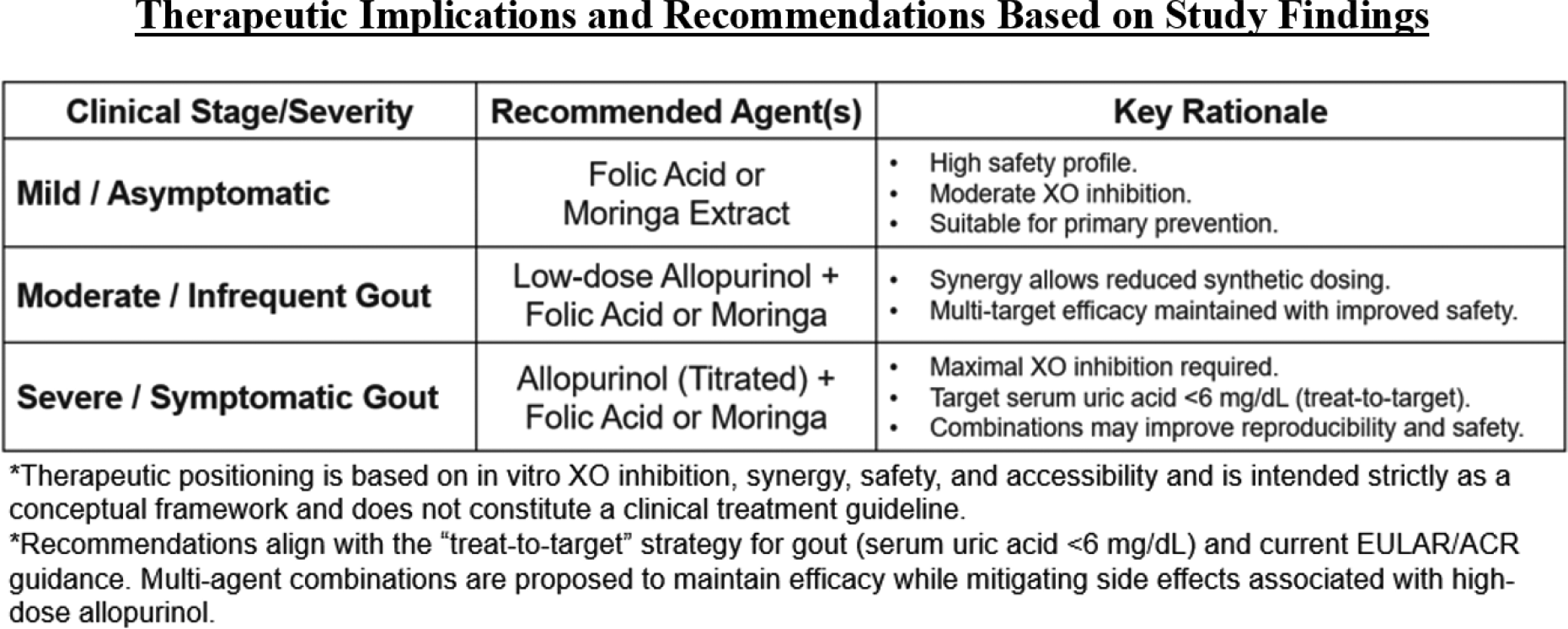
Conclusions: An integrated Mcule/Chemmine-guided virtual screen coupled to a simple colorimetric XO assay identified folic acid and Moringa oleifera as promising non-synthetic XO-active leads with semi-quantitative inhibitory profiles approaching those of allopurinol in vitro. These data support further kinetic and crystallographic studies to define binding modes at the molybdenum–pterin site, as well as in vivo assessment in hyperuricemia and gout models. In the longer term, such non-synthetic XO-targeted agents may complement existing ULT by enabling lower-dose or combination strategies aimed at achieving guideline serum urate targets while mitigating toxicity in patients with gout and other urate crystal–driven diseases.
Table 1.
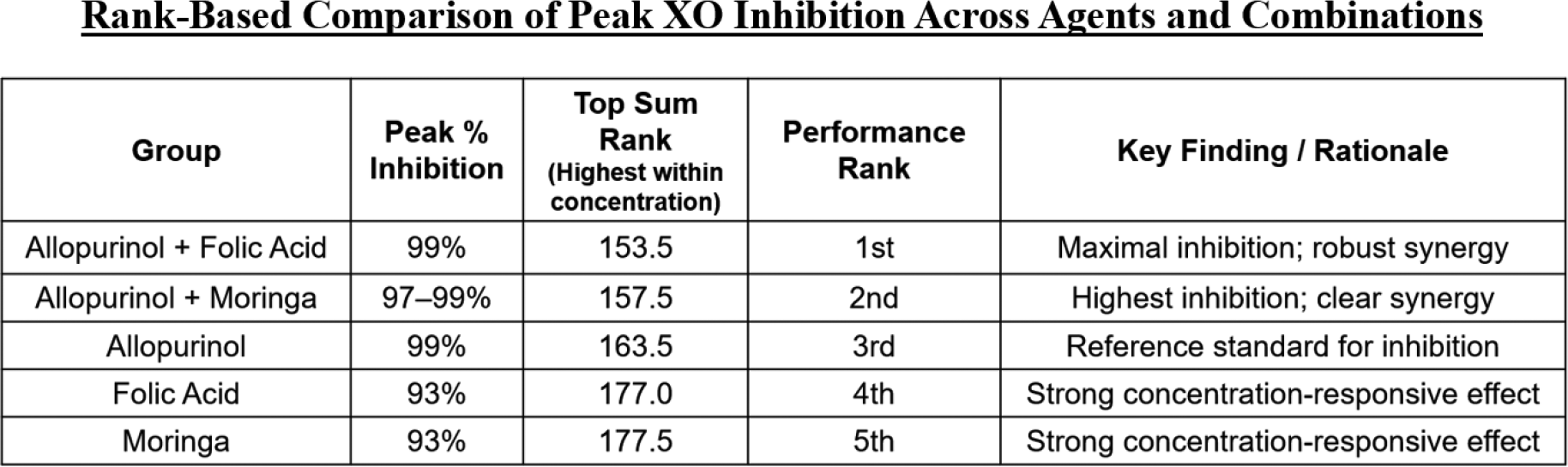
Table 2.
REFERENCES: NIL.
Acknowledgments: NIL.
Disclosure of Interests: None declared.