fetching data ... 
Background: Molecular targeted therapy for idiopathic inflammatory myopathies (IIMs) has not been established, despite many cases being refractory to non-specific immunosuppressive agents. Besides autoreactive T cells which are directly responsible for muscle injury, increasing evidence have been shown that monocytes and macrophages play exacerbating roles in the pathogenesis of IIM [1]. Ras guanyl-releasing protein 4 (RasGRP4), one of the Ras guanyl exchange factor, is expressed mainly in monocytes and macrophages. While the resistance of Rasgrp4 -deficient ( Rasgrp4 -/ - ) mice to experimental models of arthritis and inflammatory bowel disease [2] indicates its potential as a therapeutic target for autoimmune diseases, the role of RasGRP4 in IIM remains unclear. Furthermore, it has been difficult to verify the significance of RasGRP4 as a therapeutic target due to the lack of specific inhibitors.
Objectives: We aimed to clarify an exacerbating role of RasGRP4 in IIMs and to evaluate its utility as a therapeutic target with RasGRP4-targeted antisense oligonucleotides (ASO) which we developed.
Methods: The expression of RasGRP4 was examined immunohistochemically with in situ hybridization in muscle tissues from 8 patients with IIM and controls without muscle diseases. C protein-induced myositis (CIM) [3], a murine model of myositis, was induced in wild-type (WT) and Rasgrp4 -/ - mice. Expression levels of RasGRP4 in CIM mice was evaluated with qPCR sequentially. Cells isolated from digested muscle tissue from CIM mice were analyzed with flow cytometry (FCM). Muscle tissues from CIM mice were subjected to bulk RNA sequencing to identify differentially expressed genes (DEG) between WT and Rasgrp4 -/ - , followed by enrichment analysis. Cell migration of bone-marrow derived murine macrophages was evaluated using a two-chamber trans-well assay. RasGRP4-targeted ASO was synthesized in Nissan Chemical co. ltd. Two different RasGRP4-targeted ASO (50 mg/kg BW, n=7 per group) with distinct sequences or NS (n=7 per group) were administrated to CIM mice on day 0 and day 7 after immunization. Knockdown efficacy of ASO in vivo was verified by qPCR using muscles, kidney and liver from treated mice. Severity of myositis was evaluated with histological scores and muscle strength.
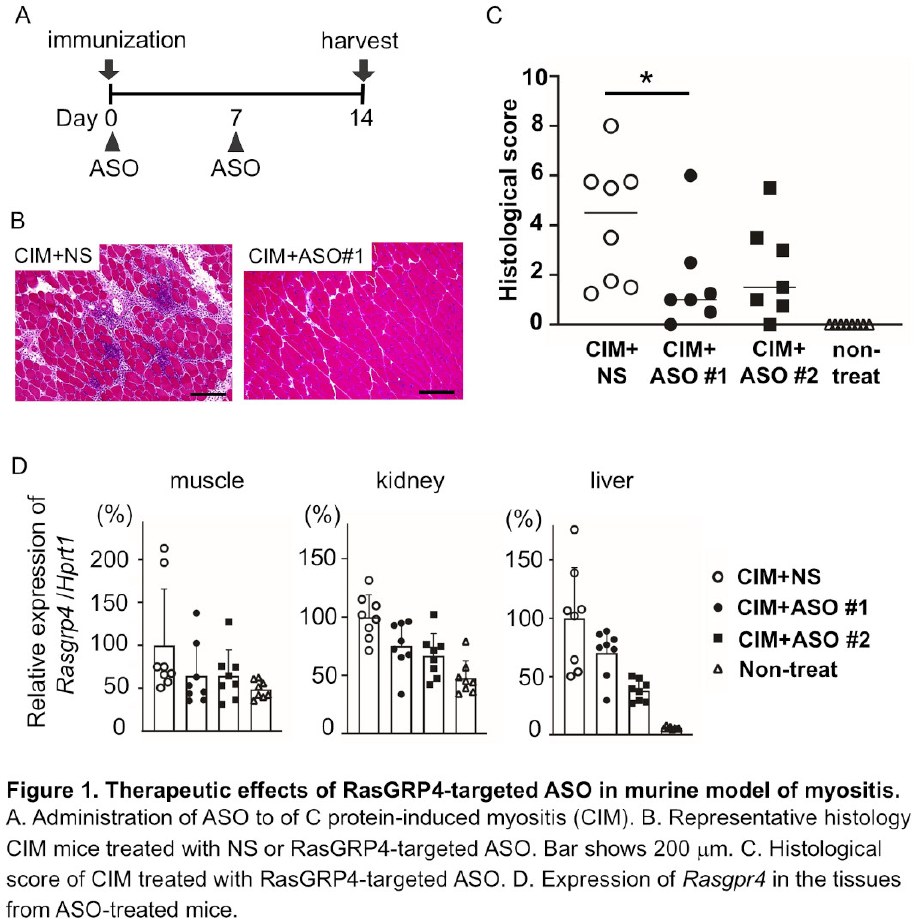
Results: Immunohistopathological analysis revealed that the number of RasGRP4-expressing cells was significantly higher in muscle tissues from IIM patients than controls. Co-staining of CD3 or CD68 revealed that RasGRP4 was expressed in a part of macrophages as well as lymphocytes. Single-cell RNA sequencing with inflamed muscle tissue from a patient with IIM, higher expression levels of RasGRP4 in CD14+ cells than CD4 or CD8+ cells. In CIM mice, the expression levels of RasGRP4 in the mononuclear cells isolated from inflamed muscle tissues were highest at day 14 after immunization, when the myositis reached its peak. The severity of myositis was significantly attenuated in Rasgrp4 -/ - mice (n=12) with CIM compared to WT with CIM (n=13). Furthermore, the muscle weakness in Rasgrp4 ---/ mice with CIM was significantly suppressed compared to WT mice with CIM. The FCM analysis of infiltrating cells into involved muscle tissue of CIM revealed that the number of CD3+ and CD11b+ cells was decreased in Rasgrp4 -/ - mice with CIM compared to WT with CIM. The rate of CD11b+Ly6C+ cells, so-called inflammatory monocytes/macrophages, were decreased in Rasgrp4 -/ - mice with CIM. Bulk RNA sequencing with mononuclear cells from inflamed muscle tissue revealed 751 DEGs between WT and Rasgrp4 -/ - ; 255 down-regulated genes including chemokine receptors and 496 up-regulated genes. The down-regulated genes in Rasgrp4 -/- were enriched predominantly in a phagocyte pathway. In vitro analysis, the migration of Rasgrp4 -/ - monocytes were impaired in comparison with that of WT. Among candidates of RasGRP4-targeted ASO, two different ASO which significantly suppressed Rasgrp4 expression in a dose-dependent manner in vitro were selected. The administration of those two different RasGRP4-targeted ASO to CIM mice ameliorated the myositis with 20-60% knockdown of RasGRP4 expression in muscle, liver and kidney (Figure 1 A-D).
Conclusions: Our results of RasGRP4 expression in involved muscle tissues and milder disease of myositis in Rasgrp4 -/ - mice indicated that RasGRP4 would play an exacerbating role in the pathogenesis of IIMs. As monocytes/macrophage infiltration into muscle were decreased in Rasgrp4 -/- and their migration ability was impaired in vitro , RasGRP4 would contribute to myositis partly through the recruitment of monocytes. The therapeutic effects of RasGRP4-targeted ASO in murine models of myositis suggest that RasGRP4 would be as a promising therapeutic target for IIM.
REFERENCES: [1] Izuka S, Umezawa N, Komai T, et al. Muscle tissue transcriptome of idiopathic inflammatory myopathy reflects the muscle damage process by monocytes and presence of skin lesions. Arthritis Rheumatol. 2025;77:99–106.
[2] Adachi R, Krilis SA, Nigrovic PA, et al. Ras guanine nucleotide-releasing protein-4 (RasGRP4) involvement in experimental arthritis and colitis. J Biol Chem. 2012;287:20047-55.
[3] Sugihara T, Sekine C, Nakae T, et al. A new murine model to define the critical pathologic and therapeutic mediators of polymyositis. Arthritis Rheum. 2007;56:1304-14.
Acknowledgments: NIL.
Disclosure of Interests: Natsuka Umezawa Astrazeneca, Novartis Pharmaceutical Co. Ltd., Taisho Pharmaceutical Co., Ltd., AsahiKASEI Co., Ltd., Yukino Ueoka Nissan Chemical Corporation, Tetsuya Saito Abbvie Japan Co., Ltd., Asahi Kasei Pharma Co., Ltd., Chugai Pharmaceutical Co., Ltd., Eisai, Eli Lilly Japan K.K., GlaxoSmithKline K.K., Mitsubishi Tanabe Pharma Co.Ltd., Ono Pharmaceutical Co. Ltd., Taisho Pharmaceutical Co., Ltd., and Astellas Pharma Inc., Eli Lilly Japan K.K., Takuna Tsubata: None declared, Rihan Da: None declared, Shiyao Li: None declared, Yuta Hirose Nissan Chemical Corporation, Yuki Hidaka Nissan Chemical Corporation, Shinsuke Yasuda Otsuka Pharmaceutical Co. Ltd., Abbvie Japan Co., Ltd., AsahiKASEI Co., Ltd., Astrazeneca, Chugai Pharmaceutical Co., Ltd., Eli Lilly Japan K.K., Mitsubishi-Tanabe Pharma Co.Ltd., Ono Pharmaceutical Co. Ltd. Otsuka Pharmaceutical Co. Ltd., Stratoimmune Co. Ltd., Chugai Pharmaceutical Co., Ltd., ImmunoForge, Novartis Pharmaceutical Co. Ltd., AsahiKASEI Co., Ltd.