fetching data ... 
Background: To treat synovial inflammation in osteoarthritis (OA) RNA targeting therapies could provide a versatile strategy for drug development. Identifying differentially expressed microRNAs, which have the ability to regulate a broad range of pathways at the same time, could lead to potential targets to treat this complex disease. To identify potential targetable miRNAs in this context, we integrated multiple sources of open access data and combined it with our own miRNA sequencing. By leveraging existing data, this approach eliminated the need to generate new sequencing data and provided an adaptable framework that can be used for other pathological processes in the future. In this specific case, a computational pipeline was used to select miRNAs governing synovial inflammation in fibroblasts and macrophages as potential therapeutic candidates that will be screened for the development of an intra-articular therapy for OA.
Objectives: 1. Predict dysregulated miRNAs governing synovial inflammation in OA using an integrative in-silico analysis 2. Establish an effective miRNA inhibition culture set up in primary human synovial cells
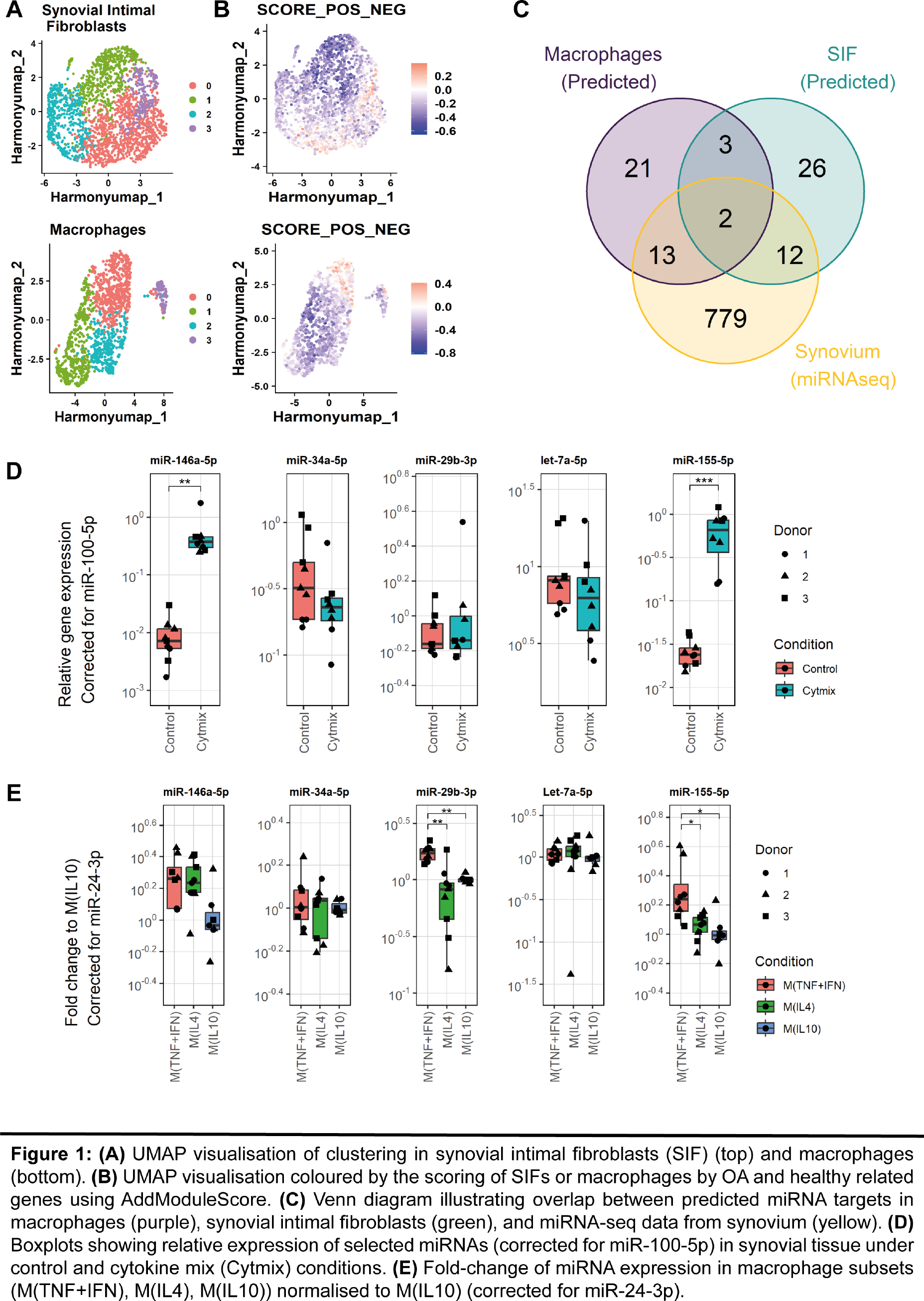
Methods: An open-access microarray of synovial tissue from 10 healthy donors and 10 OA patients (GSE55235) was analysed with DESeq2 to retrieve a healthy-related and an OA-related gene set. Open-access single cell RNA sequencing data from synovial cells of 3 OA patients (GSE152805) were processed using Seurat. Synovial intimal fibroblasts (SIF) and macrophages make up the lining layer of the synovial tissue and play an important role in the inflammatory factors released in the synovial fluid [1]. These cellular subsets were identified in the dataset and subclustered. Each subset was scored for the microarray gene sets using AddModuleScore, which were subtracted from each other to obtain an relative OA score. Differential expression analysis comparing high OA score versus low OA score clusters within each cellular subset was used in the Upstream regulator analysis (Ingenuity Pathway Analysis) to predicted dysregulated miRNAs. As the IPA tool predicts miRNAs without considering the tissue origin of the data, we performed a microRNA sequencing on synovial tissue from 3 OA patients using NebNext smallRNA library prep kit and NovaSeq PE100 flowcell, to identify miRNAs that are actually expressed in the relevant tissue. miRNAs with a minimum of 10 counts per million in two of the three donors were retained. The results were overlayed with the results of the upstream regulator analysis to obtain the final list of predicted upregulated miRNAs in synovium during OA. To validate miRNA induction, primary human OA synovial fibroblasts were stimulated with cytokines (0.1ng/ml TNFα, IL1β and IFNγ) and healthy human monocyte-derived macrophages were polarised with either 10ng/ml TNFα+ IFNγ or IL4 or IL10 for 48 hours. miRCURY miRNA inhibitors against miR-155-5p or miR-146a-5p were applied at 5 nM, 25 nM and 50 nM to determine optimal concentrations for inhibition. From all samples total RNA was isolated and miRNA expression determined using qPCR. Inhibition percentage was determined by (1-(2 -dCt(inhibitor) /2 -dCt(control) ))x100%.
Results: Specific subclusters of synovial intimal fibroblasts and macrophages showed an increased expression of OA-related markers (Figure 1A&B). Using the differential expressed genes from these clusters, a total of 77 miRNAs were predicted to be significantly (z-score ≥ 2) upregulated. Of this, 27 miRNAs were found to be expressed in our own miRNAseq of patient-derived synovial OA tissue (Figure 1C). A panel of miRNAs from this list was tested for in vitro regulation under inflammatory stimuli. Pro-inflammatory stimulation of synovial fibroblasts revealed miR146a-5p and miR-155-5p to be significantly upregulated (Figure 1D). Additionally, miR-29b-3p and miR-155-5p were expressed at a significantly higher level in TNFα+ IFNγ polarised macrophages compared to IL4 or IL10 polarised macrophages (Figure 1E). For miRNA inhibition synovial fibroblasts were pre-stimulated with cytokines for 24 hours before the miRCURY inhibitor was added including fresh cytokines for 48 hours. 25nM resulted in optimal inhibition at 84%±14.8% (mean±SD) in synovial fibroblasts for the inhibitor against miR-155-5p. In macrophages, the miRCURY inhibitor was added to the macrophages for 24 hours starting polarization, after which fresh cytokines were added for further polarization. 50 nM resulted in an optimal inhibition at 81%±5.1% for the inhibitor against miR-155-5p.
Conclusions: Integrative approaches of openly available data can accelerate the prediction and identification of potential new miRNA targets for RNA targeting therapies. In particular, we have predicted 27 miRNAs which may govern inflammation in osteoarthritic synovial intimal fibroblasts or macrophages. A panel of potentially interesting miRNAs was identified of which miR-155-5p & miR-146a-5p were used to successfully set up an effective inhibition strategy in primary OA synovial fibroblasts or human monocyte-derived macrophages. Building on this foundation, we aim to inhibit the candidate targets to validate their therapeutic potential. Ultimately, the most promising candidate miRNA inhibitors will be tested for the development of an intra-articular injectable therapy for OA.
REFERENCES: [1] K. Knab, D. Chambers, and G. Krönke, “Synovial Macrophage and Fibroblast Heterogeneity in Joint Homeostasis and Inflammation,” (in eng), Front Med (Lausanne), vol. 9, p. 862161, 2022, doi: 10.3389/fmed.2022.862161.
Acknowledgments: NIL.
Disclosure of Interests: Judith Veldman: None declared, Ronja Frei: None declared, Anna Hegger: None declared, Eric Farrell: None declared, Andrea Lolli The OAinject consortium is a collaborative research initiative involving academic institutions and industry partners. Any financial contributions from companies are directed to the consortium as a whole to support the research activities stated in the project agreement. The author has not received direct financial grants or personal payments from pharmaceutical companies outside of this collaboration., Gerjo van Osch The OAinject consortium is a collaborative research initiative involving academic institutions and industry partners. Any financial contributions from companies are directed to the consortium as a whole to support the research activities stated in the project agreement. The author has not received direct financial grants or personal payments from pharmaceutical companies outside of this collaboration.