fetching data ... 
Background: Gut dysbiosis and alterations in intestinal permeability have been associated with systemic low-grade inflammation, joint destruction, and, more recently, pain in osteoarthritis (OA). Bile acids (BAs), key regulators of gut microbiota composition and function, have been linked to systemic inflammation and other rheumatic diseases.
Objectives: The primary objective was to investigate whether serum BAs are associated with erosive hand OA (EHOA), the most severe and destructive hand OA phenotype. Secondary objectives included examining associations between BA profiles, clinical symptoms, and radiographic severity.
Methods: This study used cross-sectional and baseline data of the DIGItal Cohort Osteoarthritis Design (DIGICOD, NCT01831570), a prospective monocentric cohort including 426 patients with established hand OA. Clinical assessments such as AUSCAN (Australian/Canadian Hand Osteoarthritis Index) pain, function, and stiffness subscores, serum samples, and hand radiographs semi-quantitative scores were collected including the KL (Kellgren Lawrence) total sum score, number of joints with KL≥2, Verbruggen score. EHOA was defined as the presence of ≥2 erosions in Verbruggen score. Serum levels of 28 BAs were quantified on fasted samples using LC-20ADXR Shimadzu chromatography coupled to a SCIEX QTRAP 5500 system. Associations between BA and EHOA were analyzed using non-parametric Wilcoxon tests, and correlations between BA and symptoms or radiographic score were assessed using Spearman’s rank correlation. For multiple testing p-values were adjusted using a Benjamini-Hochberg correction. Random Forest models were applied to identify predictive BA combinations and discriminant biomarkers of EHOA. The dataset was split into training (75%) and testing (25%) subsets, and a ten-fold cross validation was performed on the training test.
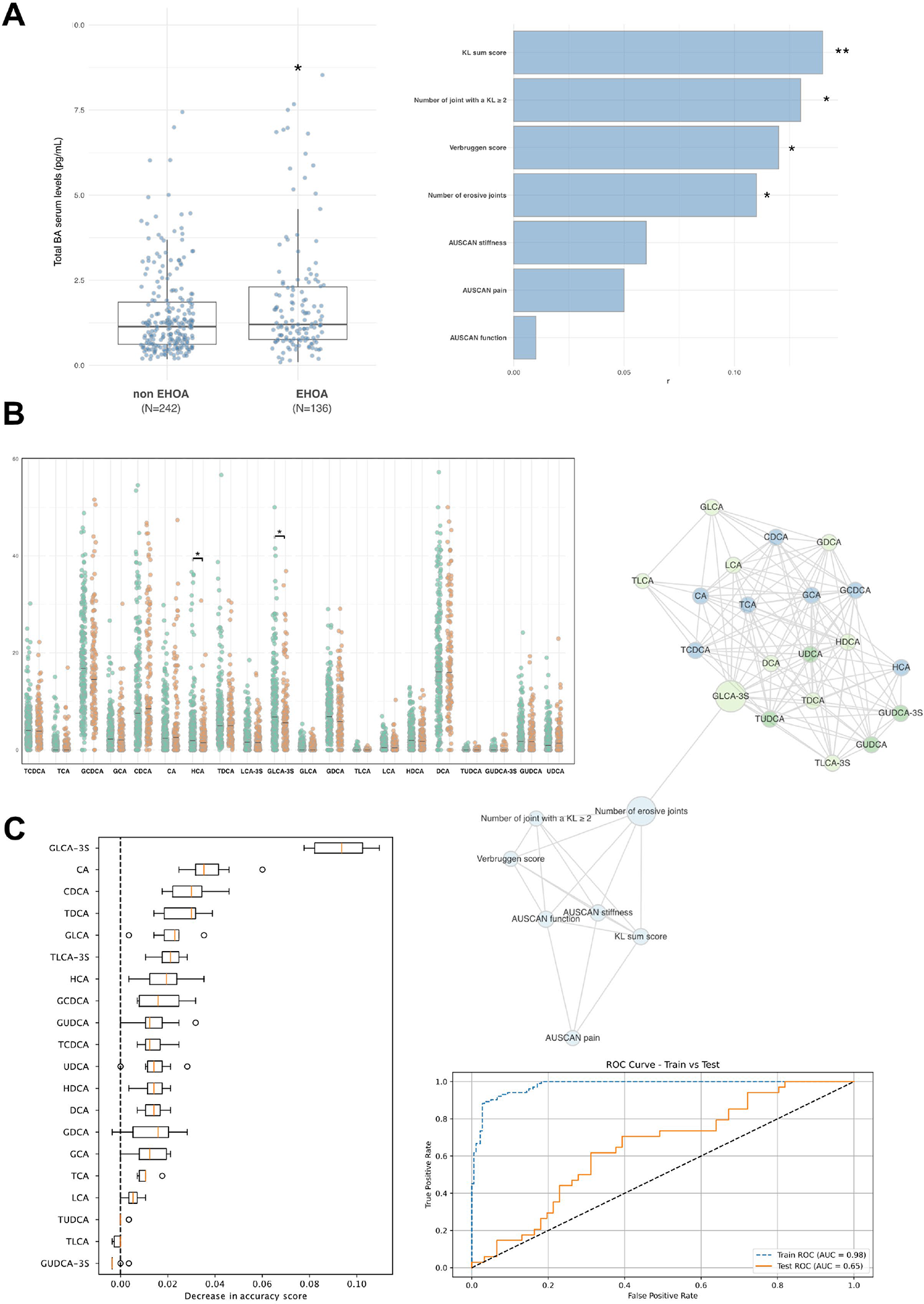
Results: 378 patients were included (85% women, mean age 67 years, mean BMI 25 kg/m 2 ). EHOA was present in 136 participants (36%). Total BA levels were significantly higher in EHOA compared to non-EHOA (median [Q1-Q3] 1.21 [0.76-2.30] vs 1.14 µmol/L [0.62-1.90], p=0.047), also total BA were positively associated with radiographic and EHOA severity (KL total sum score (r=0.14 (False discovery rate) FDR=0.007), number of joints with KL≥2 (r=0.31 FDR=0.016), Verbruggen score(r= 0.12, FDR=0.037), and number of erosive joints (r=0.11 FDR=0.016 ( Figure 1A ). The proportion of sulfated BAs was significantly reduced in EHOA (8.30% [4,56-13.08] vs 9.89% [6.36-14.47] p=0.029). GLCA-3S and HCA percentages were significantly decreased in EHOA vs non-EHOA (GLCA-3S: 5.58% [2.35-8.94] vs 6.8% [3.46-12.5] p=0.04; HCA: 1.5% [0-30.76] vs 1.92% [0.46-5.26], p=0.03). A correlation network analysis revealed a negative association between GLCA-3S and the number of erosive joints (r=-0.15 FDR=0.01) ( Figure 1B ). In the Random Forest model (training n = 283; testing n = 95), overall accuracy and ROC–AUC were of 0.97 on the training set and 0.98 and 0.65 on the testing dataset, suggesting that Fine tuning and hyperparameters optimization were not performed to limit overfitting. While the overall prediction performance of EHOA by BAs were low, MDI and permutation-test identified GLCA-3S emerged as the most important feature in the model (MDI 0.13, Performance score 0.09) ( Figure 1C ). To note GLCA-3S serum levels was not different according to sex and did not correlate with other confounding factors such as age, BMI.
Conclusions: These findings reveal a distinctive BA signature in erosive hand OA, marked by a reduction in sulfated species, especially GLCA-3S, the most informative serum marker of the erosive phenotype, independently of age, sex, and BMI. This supports a potential gut–BA–joint axis in hand OA and highlights GLCA-3S as a promising biomarker candidate that warrants validation in longitudinal cohorts
A Jitter plot of total BA levels between EHOA and non EHOA patients (Mann-Whitney U test p<0.05). Barplot of Spearman correlation between total BA and hand OA symptoms and radiographic variables (µmol/L, |R| > 0.1 FDR<0.05) B. Jitter plot of serum BA percentage between EHOA and non EHOA patients (Mann-Whitney U test p<0.05) Correlation network between serum BA and hand OA symptoms and radiographic variables (|R| > 0.1 FDR<0.05). C. Mean decrease impurity and permutation test for multi-collinear variables from the Random Forest Model.
REFERENCES: NIL.
Acknowledgments: NIL.
Disclosure of Interests: None declared.