fetching data ... 
Background: Knee osteoarthritis (kOA) is a clinically and biologically heterogeneous disease. This heterogeneity, coupled with a lack of molecular stratification, limits the development of targeted therapies and the success of clinical trials.
Objectives: The aim of this study is to identify and independently validate biologically distinct plasma proteomic endotypes of kOA, and to define circulating biomarkers with potential relevance for precision medicine.
Methods: The PIE-PROCOAC cohort included patients with radiographic kOA and OA-associated comorbidities (dyslipidaemia, diabetes and cardiovascular disease), as well as a human immunodeficiency virus (HIV) sub-cohort as a model of accelerated ageing (Table 1). In the discovery phase, plasma proteomes from 44 patients were generated by liquid chromatography coupled to mass spectrometry (LC-MS/MS). MS raw data were quality-controlled, imputed and normalised. A curated panel of 295 proteins was analysed using ConsensusClusterPlus with k-means resampling to identify stable clusters. Differential expression analyses (Benjamini–Hochberg correction) and pathway enrichment analyses were performed. In the validation phase, LC-MS/MS proteomics were generated from an independent set of 186 plasma samples. After identical preprocessing, 335 proteins were clustered using k-means. Endotype-specific protein signatures were evaluated using univariate linear models (ULM), and selected platelet-related proteins were orthogonally validated by immunoassay.
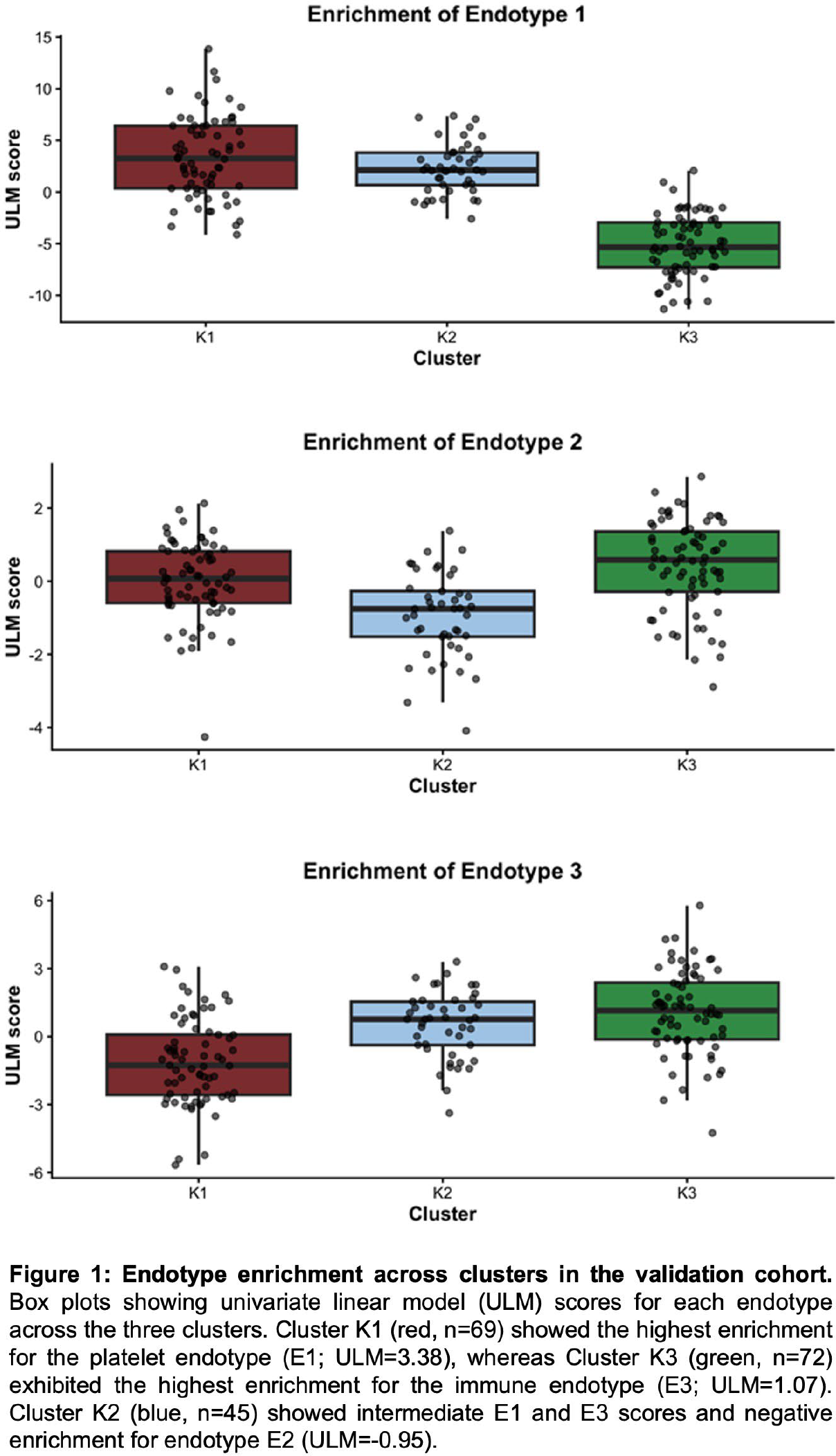
Results: Unsupervised clustering of the discovery cohort identified three robust and biologically distinct proteomic endotypes. One endotype was strongly enriched for platelet activation pathways, a second showed limited proteomic perturbation, and a third was characterised by immune-related pathway enrichment. These endotypes were reproducibly identified in the validation cohort (n=186). Thirty proteins defined a platelet-driven endotype (E1), three proteins defined an intermediate endotype (E2), and twenty-two proteins defined an immune-driven endotype (E3). ULM scores demonstrated strong and selective enrichment of E1 in cluster K1 and E3 in cluster K3, with clear separation between endotypes (Figure 1). Three circulating biomarkers of the platelet endotype (TSP1, CXCL7, PF4) were independently validated by immunoassay, showing significant discrimination between E1 and E2/E3 (AUC: TSP1=0.70, CXCL7=0.71 and PF4=0.60).
Conclusions: Machine learning-based plasma proteomics reveals reproducible platelet- and immune-driven endotypes in knee osteoarthritis. These molecular endotypes provide a biological framework for patient stratification and represent a step towards precision-based clinical trial design and targeted therapeutic strategies in kOA.
Demographic and clinical characteristics of the PROCOAC-PIE cohorts.
| Discovery ( n =44) | Validation ( n =186) | |
|---|---|---|
| Women n (%) | 26 (59.1 %) | 104 (55.9%) |
| Male n (%) | 18 (40.9%) | 82 (44.1%) |
| Age (Years) | 62.16 ± 10.78 | 67.10 ± 8.97 |
| BMI (kg/m2) | 29.64 ± 5.77 | 29.70 ± 4.94 |
| Cohort/Comorbidity n (%) | ||
| OA | 10 (22.7%) | 54 (29%) |
| HIV | 8 (18.2%) | 14 (7.5%) |
| Diabetes | 10 (22.7%) | 72 (38.7%) |
| Dyslipidemia | 7 (15.9%) | 1 (0.5%) |
| CVD | 9 (20.5%) | 45 (24.2%) |
| KL radiographic reading of the knee n (%) | ||
| Grade I | 31 (70.5 %) | 118 (63.4%) |
| Grade II | 13 (29.5 %) | 48 (25.8%) |
| Grade III | 20 (10.8%) | |
Continuous variables are mean (± SD) at baseline. BMI: Body mass index; KL: Kellgren- Lawrence; OA: Osteoarthritis; HIV: Human immunodeficiency; CVD: Cardiovascular disease.
REFERENCES: NIL.
Acknowledgments: NIL.
Disclosure of Interests: None declared.