fetching data ... 
Background: Metabolic syndrome–associated knee osteoarthritis (MetS-KOA) is a significant clinical phenotype marked by metabolic issues such as insulin resistance, abdominal fat, dyslipidemia, and hypertension, potentially speeding up joint deterioration. Considering the common occurrence of MetS and KOA along with their overlapping inflammatory processes, uncovering the genetic elements that contribute to their coexistence may deepen insights into disease mechanisms and refine risk assessment. This study aimed to pinpoint mitochondrial and nuclear genetic variations linked to MetS-KOA in a Spanish cohort.
Objectives: This study aimed to identify mitochondrial and nuclear genetic variants linked to the presence of metabolic syndrome and radiographic knee osteoarthritis in a Spanish population. Additional aims were to assess the role of these genetic variants in the long-term forecast of MetS-KOA and to explore if combining genetic data with clinical factors enhances the predictive accuracy of models in comparison to using clinical information by itself.
Methods: Participants were chosen from PROCOAC (Prospective Cohort of Osteoarthritis A Coruña), a multicenter longitudinal study comprising around 1,200 individuals with KOA. KOA was classified by a Kellgren–Lawrence grade of ≥2 in at least one knee, while MetS was identified based on ALAD criteria. Complete mitochondrial DNA (mtDNA) from a subset of 400 participants was extensively sequenced with the S5XL platform to identify potential mtDNA single-nucleotide polymorphisms (SNPs). Seven variants were chosen and then genotyped in the whole cohort using single-base extension (SBE). Simultaneously, a genome-wide association study (GWAS) was performed in the complete sample, controlling for age, sex, and ancestry principal components. Variants that fulfilled the criteria for linkage disequilibrium clumping, minor allele frequency thresholds, data completeness, and a significance threshold of p < 5×10 −6 were preserved. Generalized estimating equation (GEE) models were developed to assess the probability of MetS-KOA during each follow-up appointment. The evaluation of predictive performance was conducted using the area beneath the receiver operating characteristic curve (AUC) along with internal cross-validation. Ultimately, we evaluated a model that included only Sex and Age (Clinical model) as covariates against a model that incorporated those along with the genetic variables to measure the additional benefit of genetics to the model.
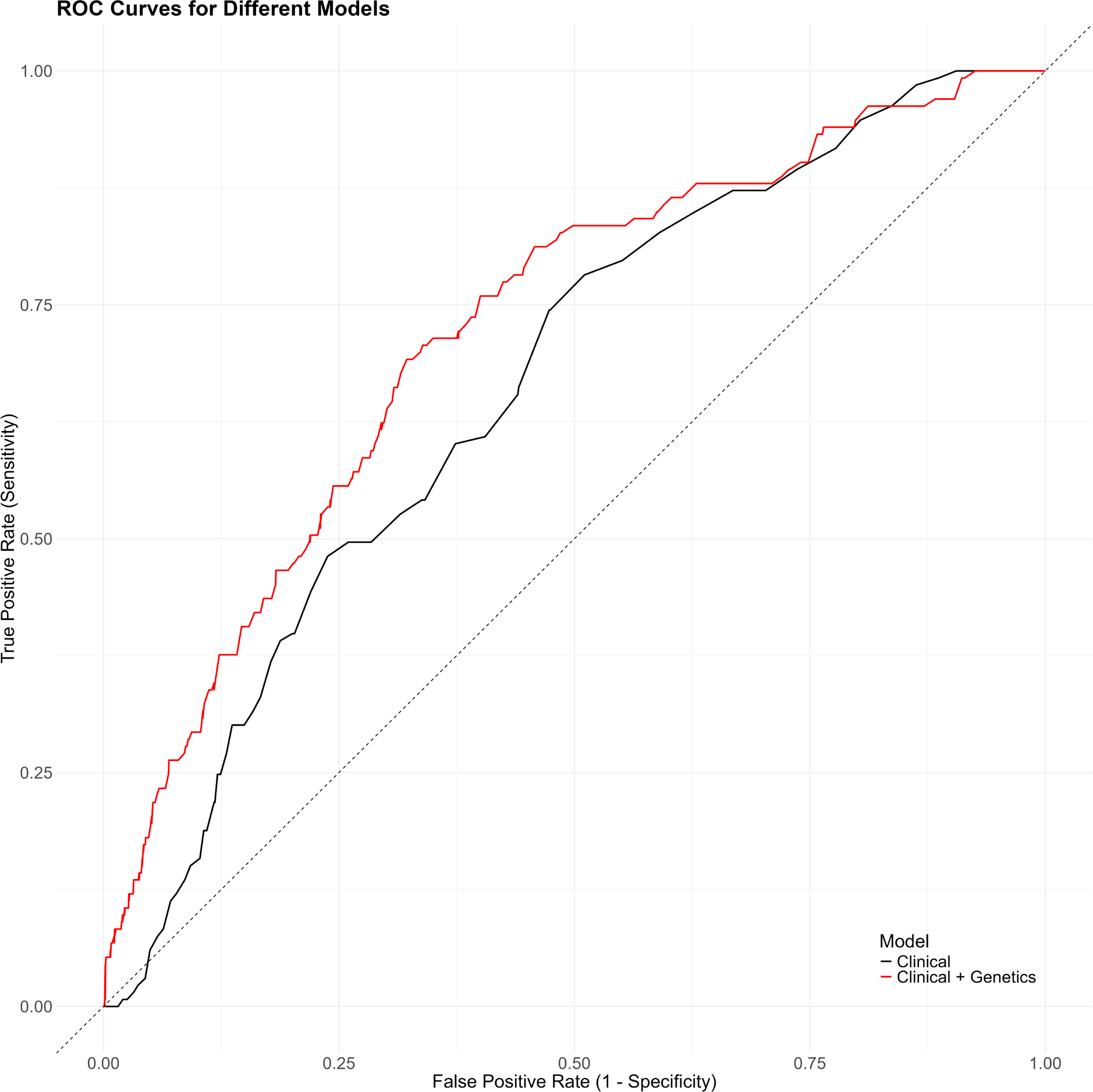
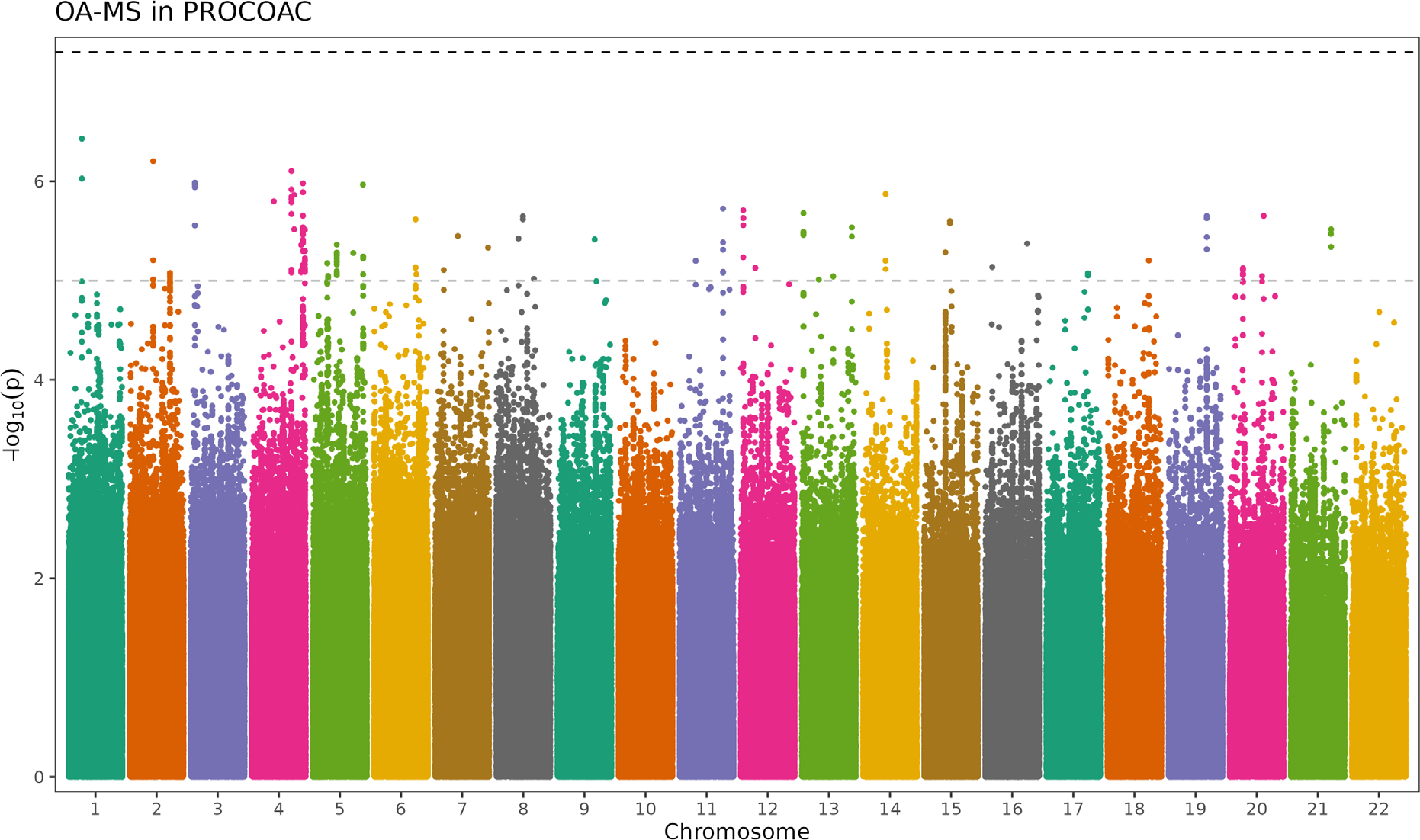
Results: Of the seven mtDNA variants found during the discovery phase, one SNP (m.146C) was confirmed in the complete cohort to be significantly linked to MetS-KOA (pval: 0.041). In the meantime, GWAS produced multiple suggestive nuclear loci; following rigorous filtering and LD-based selection, three SNPs (rs1323826 at the DAB1 gene, rs4851685 at LOC124908051, and rs1648136 at the RPSAP50 gene) were selected for modeling. The addition of these genetic markers to the longitudinal GEE model enhanced predictive ability. The Clinical + Genetics model reached an AUC of 0.72, while the clinical-only model scored 0.66, demonstrating notably enhanced discrimination. This enhancement was additionally validated by bootstrapping, which calculated a median AUC difference of 0.031 (95% CI: 0.0058–0.0567) between the Clinical + Genetics models and the clinical-only models, alongside the internal cross-validation outcomes.
Conclusions: This research uncovers a confirmed mtDNA variant and three nuclear SNPs linked to the simultaneous presence of metabolic syndrome and radiographic knee osteoarthritis in the Spanish population. Incorporating these variant data with clinical information greatly enhances the prediction of MetS-KOA. These results emphasize the possible advantage of integrated genetic-clinical models for improving risk assessment and facilitating personalized care in individuals with knee osteoarthritis and accompanying metabolic syndrome.
Roc curve for the Clinical and the Clinical+Genetics models
Manhattan Plot for the GWAS in OA-MetS within the PROCOAC cohort
REFERENCES: NIL.
Acknowledgments: NIL.
Disclosure of Interests: None declared.