INTERVENTIONS AIMED AT ADVANCING GENDER EQUITY IN RHEUMATOLOGY: INSIGHTS FROM THE COALITION FOR HEALTH AND GENDER EQUITY (CHANGE) SURVEY
Keywords: Diversity, Equity, And Inclusion (DEI), Women’s Health
T. Talreja1, L. Minikumari Rahulan2, P. V. Ovseiko3, M. Sarkar4, L. Gossec5,6, J. Day7,8,9, L. Traboco10,11, A. M. Russel12,13,14, S. A. Haq15, C. Hill16,17, D. Dey18, N. Hassan19,20, A. M. Babini21, A. M. Arredondo-González22, C. E. Toro-Gutierrez23, C. Duftner24, D. Alpizar-Rodriguez25, H. M. Badsha26, E. Nikiphorou27,28, G. Harifi29,30, I. Hmamouchi31, J. Von Feldt32, J. Boechat Farani33, A. Ali Kalla34, L. Andreoli35,36,37, M. Peixoto38, L. S. Tam39, P. Esther Palominos40, R. Nakashima41, Y. Tanaka42, W. Bautista-Molano43,44,45, V. Agarwal46, N. Ziade47, G. Wright48, L. C. Coates49, L. Gupta50,51,52
1Seth GS Medical and KEM Hospital, Mumbai, India
2Sanjay Gandhi Postgraduate Institute of Medical Sciences, Department of Clinical Immunology and Rheumatology, Lucknow, India
3University of Oxford, Radcliffe Department of Medicine, Oxford, United Kingdom
4Sir H.N. Reliance Foundation Hospital and Research Centre, Mumbai, India
5Sorbonne Université, INSERM, Institut Pierre Louis d’Epidémiologie et de Santé Publique, Team Pepites, Paris, France
6AP-HP, Pitié-Salpêtrière Hospital, Rheumatology Department, Paris, France
7Royal Melbourne Hospital, Parkville, Australia
8Walter and Eliza Hall Institute of Medical Research, Parkville, Australia
9University of Melbourne, Department of Medical Biology, Parkville, Australia
10St. Luke’s Medical Center, Global City, Philippines
11University of the Philippines, Manila, Philippines
12College of Medicine and Health, University of Birmingham, Birmingham, United Kingdom
13ILD Specialist Regional Service Birmingham Chest Clinic University Hospitals Birmingham NHS Foundation Trust, Birmingham, United Kingdom
14University of Adelaide, Adelaide, Australia
15Green Life Center for Rheumatic Care and Research, Dhaka, Bangladesh
16The University of Adelaide, Adelaide, Australia
17The Queen Elizabeth Hospital, Woodville South, Australia
18University of Ghana Medical School, College of Health Sciences, Accra, Ghana
19Bristol Medical School, University of Bristol, Musculoskeletal Research Unit, Bristol, United Kingdom
20Royal National Hospital for Rheumatic Diseases, Royal United Hospitals Bath NHS Foundation Trust, Bath, United Kingdom
21Hospital Italiano de Cordoba, Rheumatology Unit, Cordoba, Argentina
22Fundación Universitaria de Ciencias de la Salud, Bogota, Colombia
23Pontifica Universidad Javeriana Cali, Rheumatology and Dermatology, Cali, Colombia
24Medical University of Innsbruck, Tirol, Austria
25Instituto Nacional de Rehabilitación “Luis Guillermo Ibarra Ibarra”, Mexico City, Mexico
26Dr Humeira Badsha Medical Center, Dubai, United Arab Emirates
27Centre for Rheumatic Diseases and Centre for Education, Faculty of Life Sciences & Medicine, King’s College London, London, United Kingdom
28King’s College Hospital, Rheumatology, London, United Kingdom
29King’s College Hospital, Dubai, United Arab Emirates
30Mohammed Bin Rashid University of Medicine and Health Sciences (MBRU), Dubai, United Arab Emirates
31Health Sciences Research Center (CReSS), Faculty of Medicine, International University of Rabat (UIR), Rabat, Morocco
32University of Pennsylvania, Philadelphia, United States of America
33Pontifícia Universidade Católica do Rio Grande do Sul, Porto Alegre, Brazil
34Chief of Rheumatology Unit, Groote Schuur Hospital, Cape Town, South Africa
35Rheumatology and Clinical Immunology Unit, ASST Spedali, Civili and University of Brescia, Brescia, Italy
36The Danish Centre for Expertise in Rheumatology (CeViG), Danish Hospital for Rheumatic Diseases, University Hospital of Southern Denmark, Sønderborg, Denmark
37Department of Regional Health Research, University of Southern Denmark, Odense, Denmark
38Post Graduate Program in Sciences Applied to Adult Health Care, Federal University of Minas Gerais, Av. Prof. Alfredo Balena, 190 - Santa Efigênia, Belo Horizonte, Minas Gerais, Brazil
39The Chinese University of Hong Kong, Department of Medicine and Therapeutics, Hong Kong, Hong Kong, China
40Hospital Lifeplus Litoral Norte. Rua Elias João de Medeiros, Rio Grande do Sul, Brazil
41Department of Rheumatology and Clinical Immunology, Graduate School of Medicine, Kyoto University, Kyoto, Japan
42The First Department of Internal Medicine, School of Medicine, University of Occupational and Environmental Health, Kitakyushu, Japan
43Clinical Immunology Group, Universidad Militar Nueva Granada, Bogota, Colombia
44Cellular and Molecular Immunology Group (InmuBo), Universidad El Bosque, Bogota, Colombia
45Hospital Universitario Fundación Santa Fe de Bogotá, Rheumatology, Bogota, Colombia
46Sanjay Gandhi Postgraduate Institute of Medical Sciences, Department of Clinical Immunology and Rheumatology, Lucknow, India
47Hôtel-Dieu de France Hospital, Saint Joseph’s University, Rheumatology Department, Beirut, Lebanon
48Association of Women in Rheumatology, GRACE C WRIGHT MD PC, 345 E 37th Street, Suite 303C, New York, United States of America
49University of Oxford, Nuffield Department of Orthopaedics, Rheumatology and Musculoskeletal Sciences, Oxford, United Kingdom
50Royal Wolverhampton Hospitals NHS Trust, Department of Rheumatology, Wolverhampton, United Kingdom
51College of Medicine and Health, University of Birmingham, School of Infection, Inflammation and Immunology, Birmingham, United Kingdom
52Francis Crick Institute, London, United Kingdom
Background: Gender disparities in rheumatology persist despite increasing female representation. While recent global assessments have documented these inequities, evidence regarding stakeholder preferences for interventions to address them remains limited.
Objectives: This comprehensive global survey, conducted by the Coalition for Health and Gender Equity (CHANGE) group, examined preferences for gender equity interventions among rheumatology professionals worldwide and explored how these preferences vary by gender, national development indicators, professional role, and caregiving responsibilities.
Methods: A cross-sectional, self-administered online survey of rheumatologists and allied health professionals was conducted between January 2023 and May 2024. The 38-item survey was translated into eight languages and disseminated through professional organisations, mailing lists and social media channels in 105 countries. Respondents evaluated preferences for interventions spanning four domains: conference-based, organizational, skills training, and work-based strategies. Data analysis included descriptive statistics and comparative tests, with gender differences evaluated after adjustment for years of work experience. Subgroup analyses included the Human Development Index (HDI) and Gender Inequality Index (GII) of each respondent’s country, as well as professional roles and caregiving responsibilities. Statistical significance set at p<0.05, with multiple comparisons adjusted using Benjamini- Hochberg correction for false discovery rate.
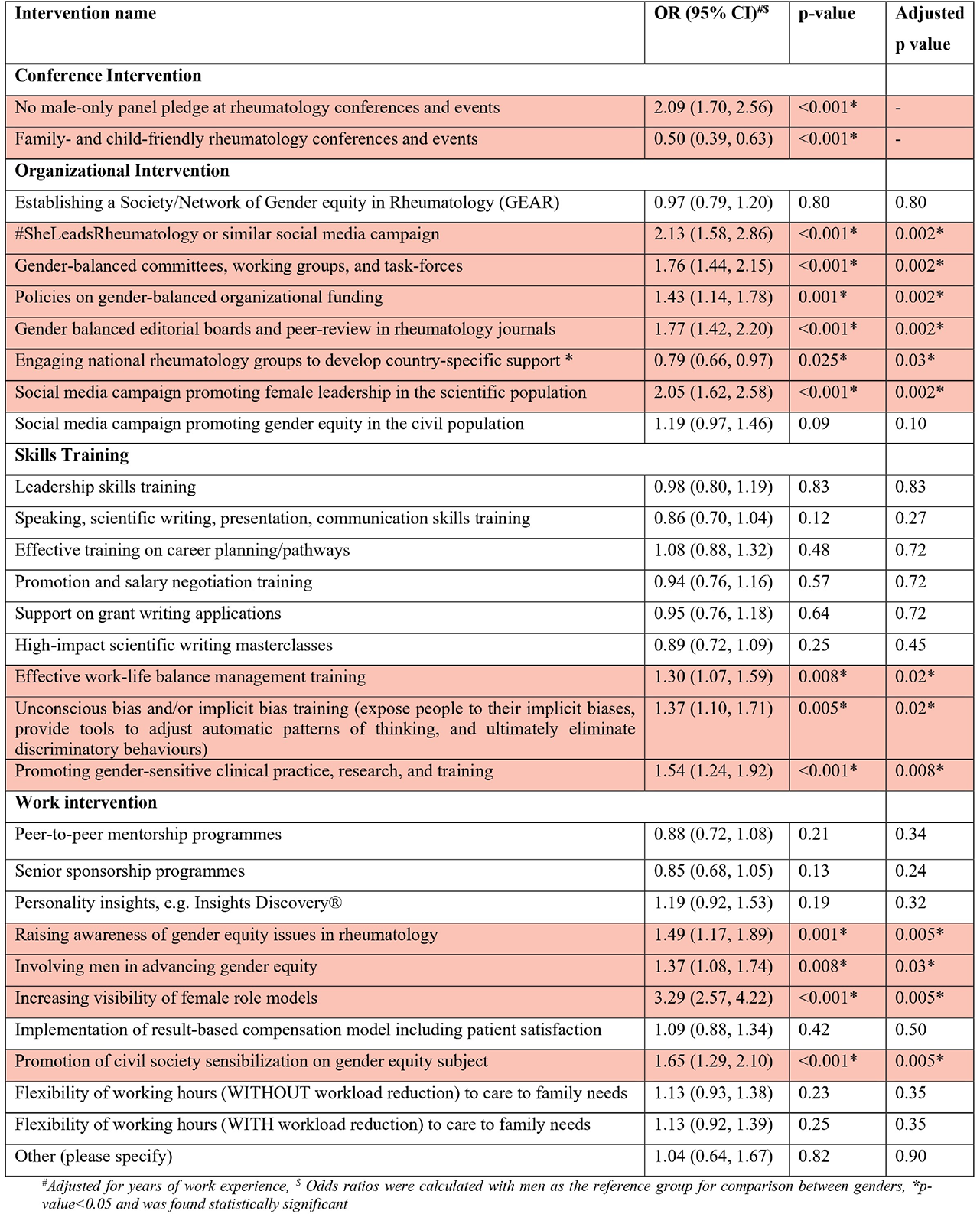
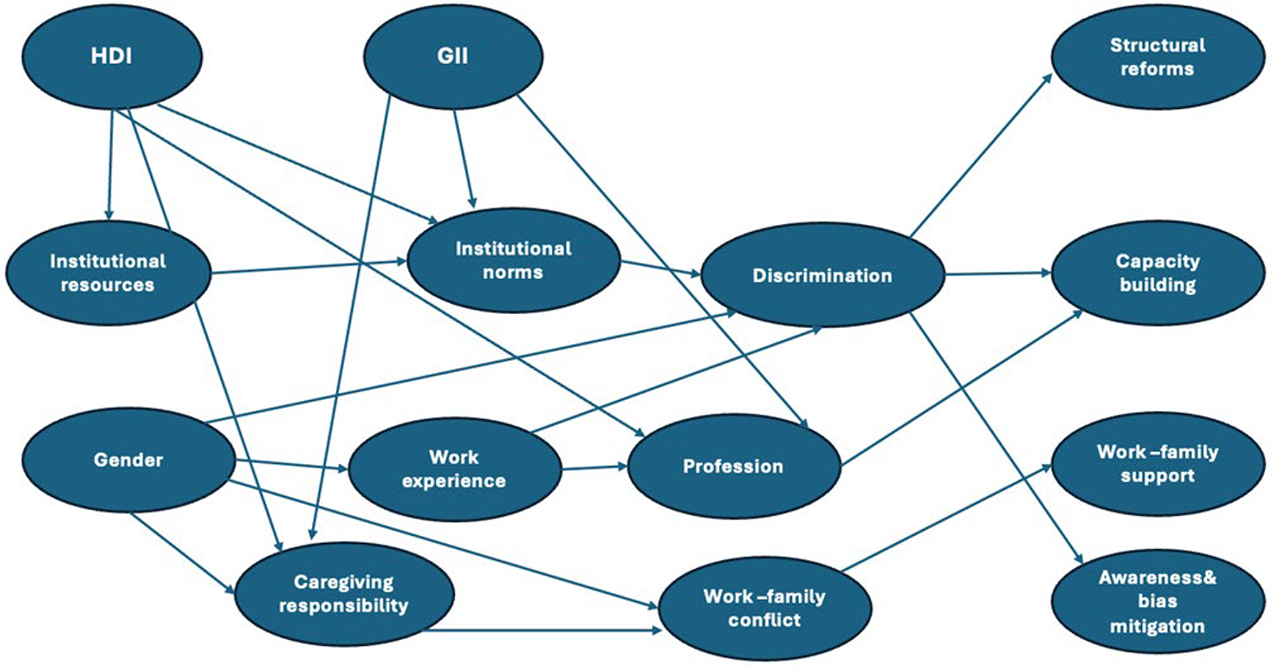
Results: Out of 1,945 respondents, women (66.4% of the sample) demonstrated significantly stronger support for interventions including establishing gender-balanced committees (17.7% vs 16%, OR=1.76, p<0.01), implementing gender-sensitive editorial board policies (12.7% vs 10.7%, OR=1.77, p<0.01), promoting social media campaigns for female leadership (11.8% vs 8.5%, OR=2.05, p<0.01), increasing visibility of female role models (11.9% vs 5.8%, OR=3.29, p<0.01) and abolishing male-only panels (44.1% vs 32.3%, OR=2.09, p<0.01) (Figure 1). Respondents from higher-GII countries prioritized capacity-building interventions including scientific writing masterclasses (OR=4.58, p<0.05) and career planning training (OR=3.90, p<0.05), but showed lower endorsement of unconscious bias training (OR=0.48, p<0.05), male allyship programmes (OR=0.42, p<0.05), and workplace flexibility with workload reduction (OR=0.27, p<0.05). Among women, those in low/middle-HDI countries more frequently selected grant writing support (40.3% vs 26.4%, p<0.01) and scientific writing masterclasses (45.0% vs 33.0%, p=0.03), while those in high/very-high-HDI countries endorsed unconscious bias training (32.6% vs 22.5%, p=0.06). Professional role shaped preferences, with physicians showing higher support for gender-balanced committees (59.3% vs 49.5%, p=0.05) and grant writing assistance (39.0% vs 25.5%, p<0.01) than non-physician respondents. Among male respondents, those early in their careers (<5 years post-graduation) showed markedly higher support for “no male-only panel” pledges (58.8% vs 36.3%, p=0.01) and gender equity awareness initiatives (47.1% vs 18.0%, p<0.001) compared to senior colleagues. The directed acyclic graph (DAG) summarises the multilevel pathways shaping preferences for gender equity interventions within the rheumatology workforce (Figure 2).
Conclusions: Gender equity intervention preferences vary systematically across contexts, reflecting distinct barriers and priorities across different settings. Effective intervention strategies require adaptive, multilevel approaches that combine universal structural reforms with context-specific capacity-building rather than one-size-fits-all solutions. These findings provide empirical foundations for developing culturally responsive, evidence-informed intervention frameworks to advance gender equity in rheumatology.
Adjusted interventions analysis for promotions of gender equity among sexes
Conceptual framework illustrating multilevel determinants of gender equity intervention preferences among rheumatology professionals.
REFERENCES: NIL.
Acknowledgments: NIL.
Disclosure of Interests: None declared.
DOI: annrheumdis-2026-eular.A.1046
Keywords: Diversity, Equity, And Inclusion (DEI), Women’s Health
Citation: , volume 85, supplement 1, year 2026, page s1428
Session: Basic and Translational - Other topics
(Publication Only)