fetching data ... 
Background: Animal models reproducing the chronological sequence of psoriatic disease, where psoriasis induction precedes and drives the development of arthritis, are still lacking. Capturing this temporal relationship is critical to dissect the early immunological mechanisms underlying psoriatic arthritis (PsA) and to explore potential strategies for PsA interception. Given that ZAP-70 mutant BALB/c (SKG) mice are prone to develop spondyloarthritis upon curdlan stimulation, we hypothesized that induction of psoriasis alone might be sufficient to trigger arthritis in SKG mice.
Objectives: Given that ZAP-70 mutant BALB/c (SKG) mice are prone to develop spondyloarthritis upon curdlan stimulation, we hypothesized that induction of psoriasis alone might be sufficient to trigger arthritis in SKG mice.
Methods: Psoriasis was induced by daily topical application of 62.5 mg of imiquimod (IMQ), a Toll-like receptor 7 (TLR7) agonist, to the dorsal skin for five consecutive days at baseline (day 0), week 4, and week 9 in BALB/c (n=10) and SKG mice (n=10). The severity of psorasis was evaluated using the modified Psoriasis Area and Severity Index (mPASI). Joint measurements were recorded weekly with a digital caliper. Structural damage of the ankle joints was assessed by micro–computed tomography (micro-CT) at the end of the experiment. Spleens were harvested, and immune cell populations were analyzed by flow cytometry. Serum levels of rheumatoid factor (RF) and anti–double-stranded DNA (anti-dsDNA) antibodies were quantified by ELISA at the end of the experiment.
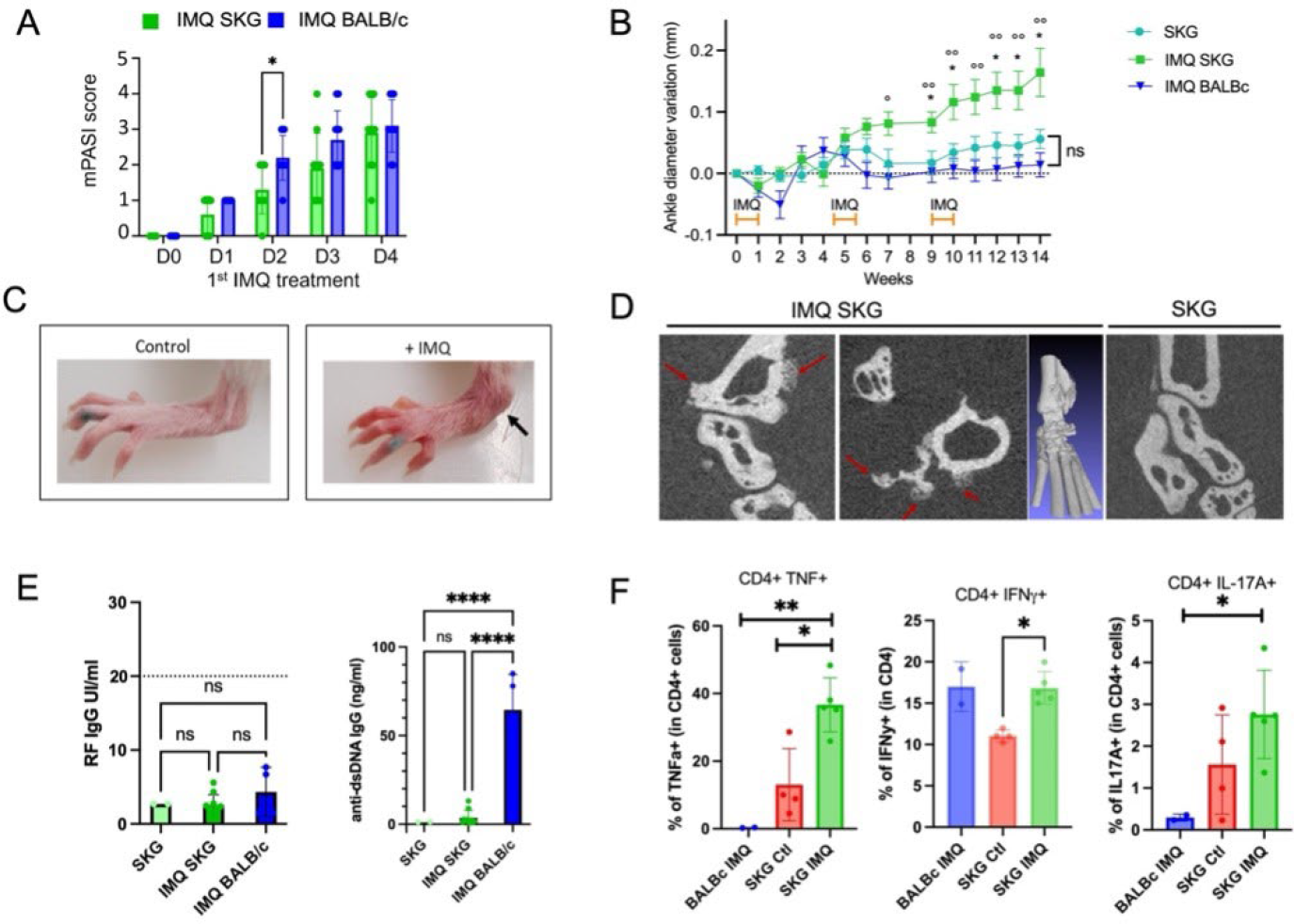
Results: SKG and BALB/c mice developed clinically comparable psoriasis-like skin disease, as assessed by mPASI scores, after 5 days of IMQ application and throughout the three psoriasis induction phases (weeks 0, 4, and 9). A complete resolution of cutaneous inflammation was observed in all mice within one week after IMQ withdrawal. Following two psoriasis inductions, ankle arthritis developed in 5/10 SKG mice, whereas no arthritis was observed in BALB/c mice. A significant increase in ankle diameter was detected exclusively in IMQ-treated SKG mice. Micro–computed tomography analysis revealed new bone formation at the distal tibia only in IMQ-treated SKG mice with clinical arthritis. No significant levels of rheumatoid factor were detected in either SKG or IMQ-treated SKG mice. In contrast, IMQ-treated BALB/c mice developed anti–dsDNA antibodies, which were not observed in SKG mice. Finally, at week 14 after the first IMQ application and 4 weeks after resolution of the last psoriasis flare, a persistent splenic expansion of CD4 + IL-17A + and CD4 + TNF + T cells was observed in IMQ-SKG mice.
Conclusions: This study demonstrates that imiquimod-induced psoriasis in SKG mice is sufficient to trigger the development of arthritis with structural damage and a sustained systemic immune response, characterized by splenic expansion of TNF- and IL-17A–producing CD4 + T cells, two key cytokines in PsA. This novel PsA model directly demonstrates that cutaneous inflammation is sufficient to initiate joint disease, providing a robust tool to dissect the causal skin–joint immune axis and the early mechanisms driving PsA.
REFERENCES: NIL.
Acknowledgments: NIL.
Disclosure of Interests: XAVIER ROMAND Lilly and Novartis, Lauriane Vacher: None declared, Marie-Hélène Paclet: None declared, Dalil HANNANI: None declared, Bertrand Favier: None declared, Athan Baillet: None declared.