fetching data ... 
Background: Global scientific production remains unevenly distributed, with high-income countries (HICs) dominating scholarly output across disciplines [1], including rheumatology [2]. Despite the growing burden of autoimmune and inflammatory rheumatic diseases in low- and middle-income countries [3] (LMICs), their representation in high-impact rheumatology literature remains unclear. Equitable participation in research is essential not only for scientific diversity but also for ensuring that findings reflect global patient populations and healthcare contexts. While open-access initiatives and international collaborations have expanded opportunities for LMICs researchers, structural barriers, such as limited funding, high article processing charges (APCs), and institutional constraints, may still hinder meaningful engagement [4]. This study aims to quantify and compare the contributions of HICs and LMICs to top-tier rheumatology journals, evaluating patterns in publication volume, citation impact, and potential systemic inequities in scholarly visibility.
Objectives: To assess and contrast the scientific contributions of HICs and LMICs to Q1 rheumatology journals over the past three years, with a focus on publication frequency, citation metrics, and financial barriers.
Methods: We analyzed all Q1 journals listed in the 2024 Journal Citation Reports. We examined the top 10 contributing countries for each journal over the past three years, and they were classified as HICs or LMICs according to the World Bank Group Ranking. Research metrics: impact factor (IF), total citations per journal, number of papers associated with each top contributing country, and article processing charges (APCs) were retrieved. Descriptive statistics described trends in publishing. The analysis focused on identifying patterns in publication volume, citation impact, and barriers that may limit representation of LMICs in global rheumatology publishing.
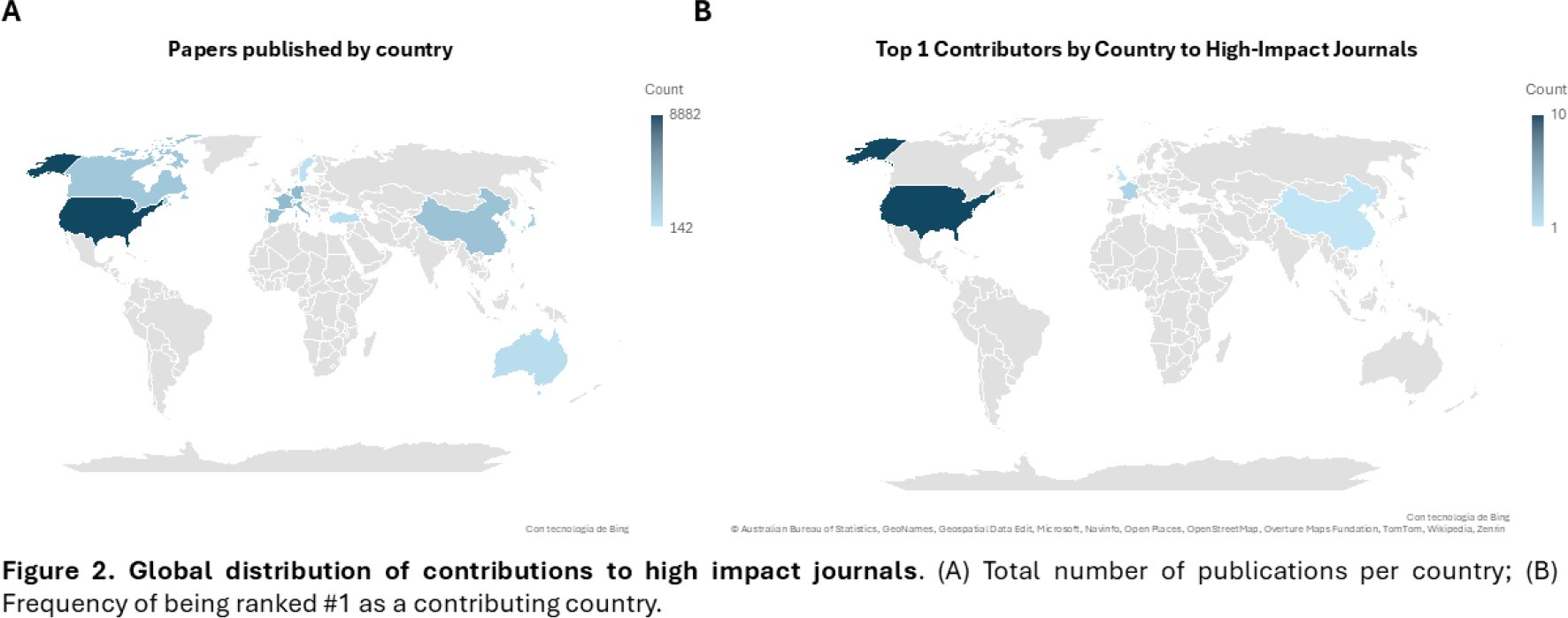
Results: 15 Q1 journals were screened, with a median IF 4.4 (IQR: 4.1 – 10.9); a median total citation count of 5977 (IQR: 4322 – 21036); and median APCs of 4196 (IQR: 3155 - 4881.2). Table 1 shows complete overall characteristics and trends. Geographic distribution of contributions to high impact journals was markedly imbalanced. Journals received contributions from a median of 9 HICs (IQR: 8 – 9), compared to 1 LMIC (IQR: 1 – 2). Self-citation was prevalent, as 6 journals (40%) cited more frequently their own published papers. Additionally, all of them were the most cited in journals based on HICs. On the other hand, HICs contributed a median of 621 (IQR: 246 – 2827) papers compared to 51 (IQR: 15 – 245) from LMICs. The United States dominates both in total frequency as a contributor and as number 1 contributor to high-impact journals (Figure 1a and 1b).
Conclusions: This study reveals a pronounced disparity in the contribution of LMICs to high-impact rheumatology research, with HICs, particularly the United States. exerting overwhelming dominance in both volume and leadership of publications. The marginal presence of LMICs, despite their significant disease burden, underscores persistent inequities in global academic visibility. High APCs, limited research infrastructure, and citation practices favoring HIC-based institutions likely reinforce this gap. These findings call for targeted interventions, such as fee waivers, equitable co-authorship policies, and capacity-building partnerships, to foster inclusive knowledge production. Without deliberate efforts to amplify LMIC voices, rheumatology risks developing guidelines and therapeutics that lack global applicability. Promoting equitable representation is not only a matter of fairness but a scientific imperative for relevance and impact worldwide.
Overall Journal Characteristics
| Median impact factor | 4.4 (IQR: 4.1 - 10.9) |
|---|---|
| Median total citations | 5977 (IQR: 4322 - 21036) |
| Median APCs in USD* | 4196 (3155 - 4881.2) |
| Median number of HICs contributors per journal | 9 (IQR: 8 - 9) |
| Median number of LMICs contributors per journal | 1 (IQR: 1 - 2) |
| Most cited journal is the same journal n (%) | 6 (40) |
| Median number of papers contributed by the top-ranked country | 176 (98 - 893) |
| Median number of papers contributed by the remaining 9 countries | 523 (202 - 2178) |
| Median number of papers contributed by HICs | 621 (246 - 2827) |
| Median number of papers contributed by LMICs | 51 (15 - 245) |
| Article processing charges for n = 14 journals; 1 journal does not charge APCs. | |
REFERENCES: [1] Palser, E.R., Lazerwitz, M. & Fotopoulou, A. Gender and geographical disparity in editorial boards of journals in psychology and neuroscience.
Nat Neurosci
25
, 272–279 (2022).
[2] Barajas-Ochoa, A., Peláez-Ballestas, I., Ramirez-Trejo, M. et al. Gender representation in rheumatology journals: an assessment of editors, editorial boards, and authors. Rheumatol Int 43, 1811–1819 (2023).
[3] Ramírez, L A et al. “Burden of illness of rheumatoid arthritis in Latin America: a regional perspective.” Clinical rheumatology vol. 34 Suppl 1,Suppl 1 (2015): S9-15. doi:10.1007/s10067-015-3012-0
[4] Strydom, Adéle, et al. “Open access and its potential impact on public health–A South African perspective.” Frontiers in research metrics and analytics 7 (2022): 975109.
Acknowledgments: NIL.
Disclosure of Interests: None declared.