fetching data ... 
Background: Global disparities in scientific research are well documented, with high income countries (HICs) contributing disproportionately to the authorship of publications compared to low- and middle-income countries (LMICs) [1]. The geographic distribution and diversity of published authors in rheumatology has not been systematically assessed. Understanding authorship patterns is important for evaluating diversity, equity and inclusion in the field. Although rheumatic diseases impose a significant global burden, structural and economic barriers commonly hinder researchers based on LMICs from publishing in high-impact journals [2]. Additionally, diversity of researchers from different backgrounds, especially those based on LMICs, is important for evaluating the inclusivity and generalizability of evidence [3]. In this pilot study we assess the representation of author affiliations based on LMICs in high-impact rheumatology publications to inform future efforts towards more equitable scholar participation.
Objectives: To assess the worldwide contributions to papers published in the top three highest-impact rheumatology journals.
Methods: The top 3 journals in rheumatology were screened from Journal Citation Reports (JCR) based on quartile, impact factor, h-index, and citations/year, to identify those with the highest readership and impact on the field. All the articles published in 2025 were screened and included in the analysis if their content concerned any significant issue in rheumatology related to basic/translational, clinical or epidemiological research (e.g. original research, narrative or systematic reviews, consensus statement, clinical guidelines, viewpoints, commentaries, correspondence, etc.). Articles addressing historical events, or profiles, or whose content was anecdotical were excluded. For each publication, two independent reviewers retrieved the type of article (original research, review, clinical trial, correspondence, commentary, viewpoint, etc.), the number of authors, country of the authors’ affiliation; and income and development classification as per the World Bank Group, Human Development Index (HDI) during 2025, as well as region. If an author held more than one affiliation, both were recorded to avoid bias. Descriptive statistics frequencies and percentages were used to present the data. We report the types of articles published, the total number of authors, the top ten most common countries of affiliation, the representation of LMICs in rheumatology’s high impact publications, and the percentage of HDI classifications.
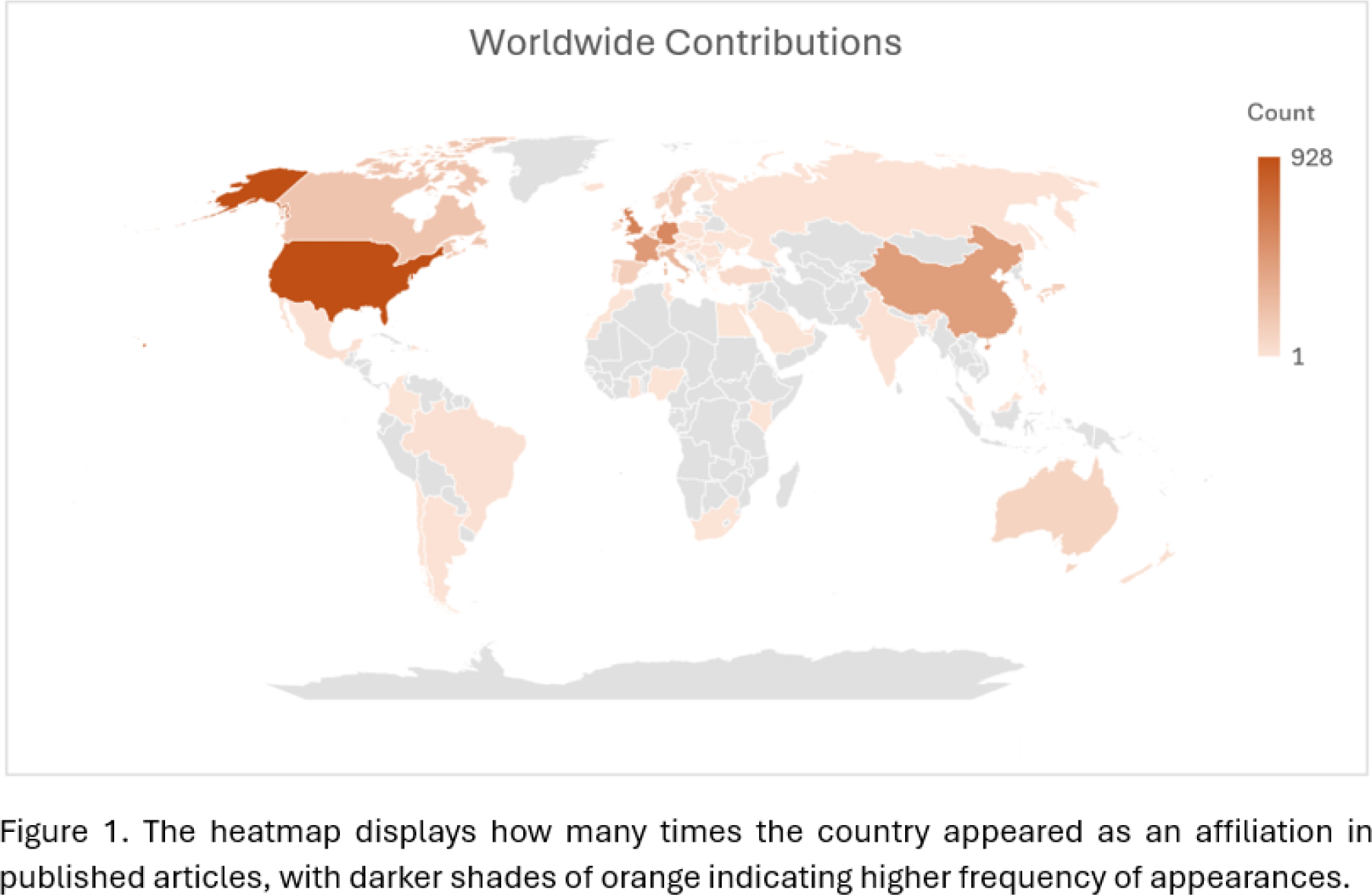
Results: 457 articles were included in the analysis; original research articles (145; 31.7%) being the most common, followed by correspondence (56; 12.3%), commentaries (48; 10.5%), narrative reviews (45; 9.8%), and clinical trials (34; 7.4%). On the other hand, 5,153 author affiliations were retrieved. The top ten most common countries of affiliation were United States (928; 18.0%), United Kingdom (611; 11.9%), Germany (568; 11.0%), France (457; 8.9%), China (433; 8.4%), Italy (285; 5.5%), Netherlands (247; 4.8%), Canada (195, 3.8%), Sweden (133; 2.6%), and Spain (132; 2.6%). Figure 1 depicts the number of times a country appeared as an affiliation. The cumulative percentage of these countries represents 77.4% of worldwide contributions to scientific articles. 584 authors were affiliated with institutions in LMICs (11.3%), while 9 were not represented in the WBG database (0.2%). 4,560 (88.5%) were based on HICs. Table 1 shows the complete breakdown in worldwide regions and income classifications. These findings are further supported by 21 authors (0.4%) based on countries with medium HDI; 494 authors (9.6%) on countries with high HDI; and 4620 authors (89.7%) on countries with very high HDI. 18 were not represented in the HDI classification (0.3%).
Conclusions: This year-in-review analysis of authorship affiliations in the three highest-impact rheumatology journals reveals that HICs-based researchers dominate publishing in these networks, with limited representation of LMICs-based researchers. While these findings reflect publishing patterns in a select group of high-impact venues, rather than the broader rheumatology literature, they suggest that researchers from LMICs may face barriers to visibility in the most widely read journals on the field. Given the unique epidemiological and clinical contexts of rheumatic diseases in resource-limited settings, greater inclusion of researchers from LMICs in high-impact publishing could enhance the global relevance and applicability of rheumatology research.
Global author distribution across WBG income classification and regions
| Region | HIC | UMIC | LMIC | NA |
|---|---|---|---|---|
| East Asia & Pacific | 345 | 436 | 6 | 0 |
| Europe & Central Asia | 3049 | 62 | 0 | 0 |
| Latin America & Caribbean | 3 | 50 | 0 | 0 |
| Middle East, North Africa, Afghanistan & Pakistan | 41 | 0 | 8 | 0 |
| North America | 1123 | 0 | 0 | 0 |
| South Asia | 0 | 0 | 16 | 0 |
| Sub-Saharan Africa | 0 | 1 | 5 | 0 |
| NA | 0 | 0 | 0 | 8 |
WBG: World Bank Group; HIC: high income countries; UMIC: upper middle income countries; LMIC: lower middle income countries; NA: not available.
REFERENCES: [1] Annalingam, Anupama et al. “Determinants of the citation rate of medical research publications from a developing country.” SpringerPlus vol. 3 140. 14 Mar. 2014, doi:10.1186/2193-1801-3-140
[2] Anane-Binfoh, Nana Anyimadua et al. “Barriers to Decolonizing Global Health: Identification of Research Challenges Facing Investigators Residing in Low- and Middle-[3] Income Countries.” Global health, science and practice vol. 12,1 e2300269. 28 Feb. 2024, doi:10.9745/GHSP-D-23-00269
[3] El Boghdady, Michael. “Equality and diversity in research: building an inclusive future.” BMC research notes vol. 18,1 14. 14 Jan. 2025, doi:10.1186/s13104-025-07096-4
Acknowledgments: NIL.
Disclosure of Interests: None declared.