fetching data ... 
Background: Rheumatoid arthritis (RA) is a prototypical autoimmune disease characterized by autoantibody-driven joint destruction. RA-specific autoantibodies are produced by germinal center (GC) B cells, whose differentiation and function are tightly regulated by follicular helper T (Tfh) cells and follicular regulatory T (Tfr) cells. Disruption of the Tfh/Tfr balance is a key determinant of aberrant autoantibody production. Thus, restoration of Tfh/Tfr homeostasis and suppression of GC responses may represent a promising therapeutic strategy for limiting pathogenic autoantibody generation in RA.
Objectives: This study aimed to investigate whether rapamycin can restore Tfh/Tfr imbalance and suppress GC B-cell responses in a mouse model of collagen-induced arthritis (CIA).
Methods: CIA was induced in DBA/1 mice. One week after the secondary collagen immunization (day 28), mice received intraperitoneal injections of rapamycin (1 mg/ kg) every other day for 28 days. Body weight and arthritis scores were monitored longitudinally. At the experimental endpoint, ankle joints were collected for histopathological assessment using haematoxylin and eosin (H&E) and Safranin O–Fast Green staining. Serum anti–type II collagen antibody levels were measured. In addition, spleen, mesenteric lymph nodes (mLNs), and Peyer’s patches (PPs) were harvested to analyze Tfh cells, Tfr cells, and GC-B cells by flow cytometry.
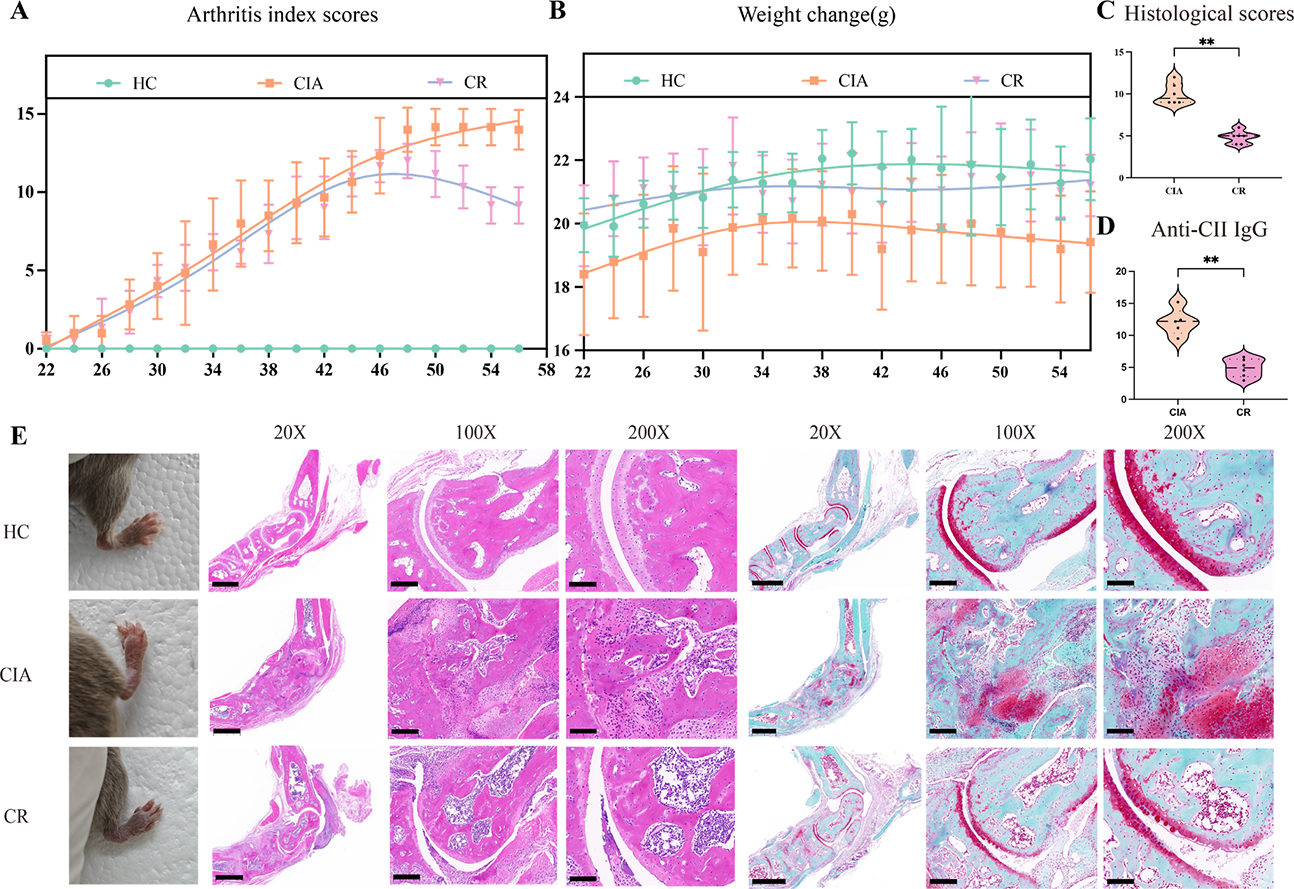
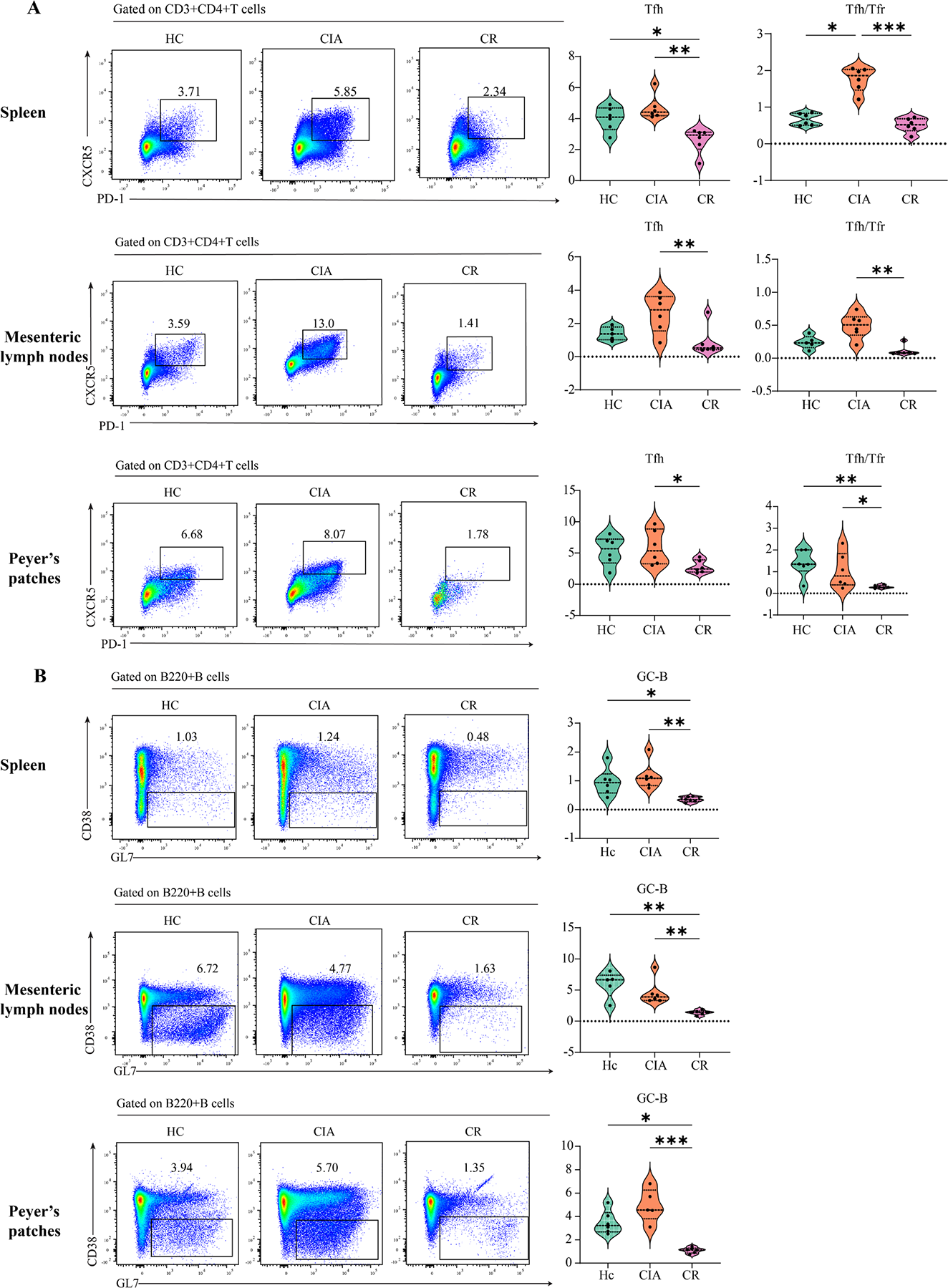
Results: (1) Rapamycin treatment significantly ameliorated clinical arthritis in CIA mice, as evidenced by increased body weight, reduced arthritis scores, and markedly attenuated cartilage and bone destruction, accompanied by lower histopathological scores (Figure 1A–C, E). (2) Serum levels of anti–type II collagen antibodies were significantly reduced following rapamycin treatment (Figure 1D). (3) CIA mice exhibited a pronounced imbalance in the Tfh/Tfr axis. Rapamycin treatment increased Tfr cell frequencies in the spleen and mLNs, while reducing Tfh cell proportions in the spleen, mLNs, and PPs, thereby restoring Tfh/Tfr homeostasis (Figure 2A). (4) Rapamycin treatment significantly decreased GC-B cell frequencies in these lymphoid tissues (Figure 2B).
Conclusions: Rapamycin markedly ameliorates arthritis severity and joint pathology in CIA mice, likely by restoring Tfh/Tfr balance and suppressing GC-B cell-mediated autoantibody responses.
Evaluation of joint damage–related parameters in each group of mice
(A ) Arthritis index scores over the course of the experiment. (B) Body weight changes during the treatment period. (C ) Arthritis histopathological scores of ankle joints. (D ) Serum levels of anti–type II collagen antibodies in each group. (E ) Histopathological assessment of ankle joints using H&E and Safranin O–Fast Green staining. (*P < 0.05, **P < 0.01, ***P < 0.001).
Frequencies of Tfh cells, and GC B cells in the spleen, mLNs, and PPs across experimental groups
(A ) Frequencies of Tfh cells (CD3+CD4+CXCR5+PD-1+) in the spleen, mLNs, and PPs across experimental groups. (B ) Frequencies of GC-B cells (B220+CD38-GL7+) in the spleen, mLNs, and PPs across groups. (*P < 0.05, **P < 0.01, ***P < 0.001).
REFERENCES: NIL.
Acknowledgments: NIL.
Disclosure of Interests: None declared.