fetching data ... 
Background: The induction of robust, long-lasting, and antigen-specific immune tolerance represents a critical unmet need in the management of autoimmune diseases, allergies, organ transplantation, and gene therapy. Nanoparticle-based strategies have emerged as promising tools to achieve antigen-specific tolerance by modulating immune responses. We previously demonstrated the therapeutic potential of plant-derived virus nanoparticles displaying disease-associated peptides in preclinical models of rheumatoid arthritis (RA) and autoimmune diabetes (T1D; Zampieri et al. 2020). These nanoparticles showed to act as both peptide scaffolds and adjuvants, enabling a peptide-specific mechanism of tolerance induction.
Objectives: To evaluate the potential of TBSV.pLip for tolerance induction in RA animal models by characterizing the Liprin-1 peptide and the specific response to intra-venous injection of TBSV.pLip.
Methods: We genetically engineered Tomato Bushy Stunt Virus (TBSV) nanoparticles to display the immunodominant Liprin-1 peptide previously described (Bason et al., 2021) using Nicotiana benthamiana as plant platform for its manufacturing. Eight-week-old male mice were intradermally immunized with Liprin-1 peptide and chicken type-II collagen emulsified in CFA, followed by a booster on day 21. We compared arthritis induction using collagen versus the Liprin peptide, evaluating clinical and histological scores, Treg induction by FACS analysis, and the pro-inflammatory cytokine profile (MCP-1, IL-6, TNF-α, IL-1β, IFN-γ) by ELISA. Then, we assessed whether tolerance could be induced through four intravenous injections of TBSV.pLip nanoparticles, compared to TBSV wild-type (lacking peptide exposure). Following arthritis induction, mice were monitored for 60 days, with biweekly scoring of limb redness and swelling (clinical score 1–4). At study completion, paws were collected for hematoxylin and eosin staining (H&E) and histological evaluation.
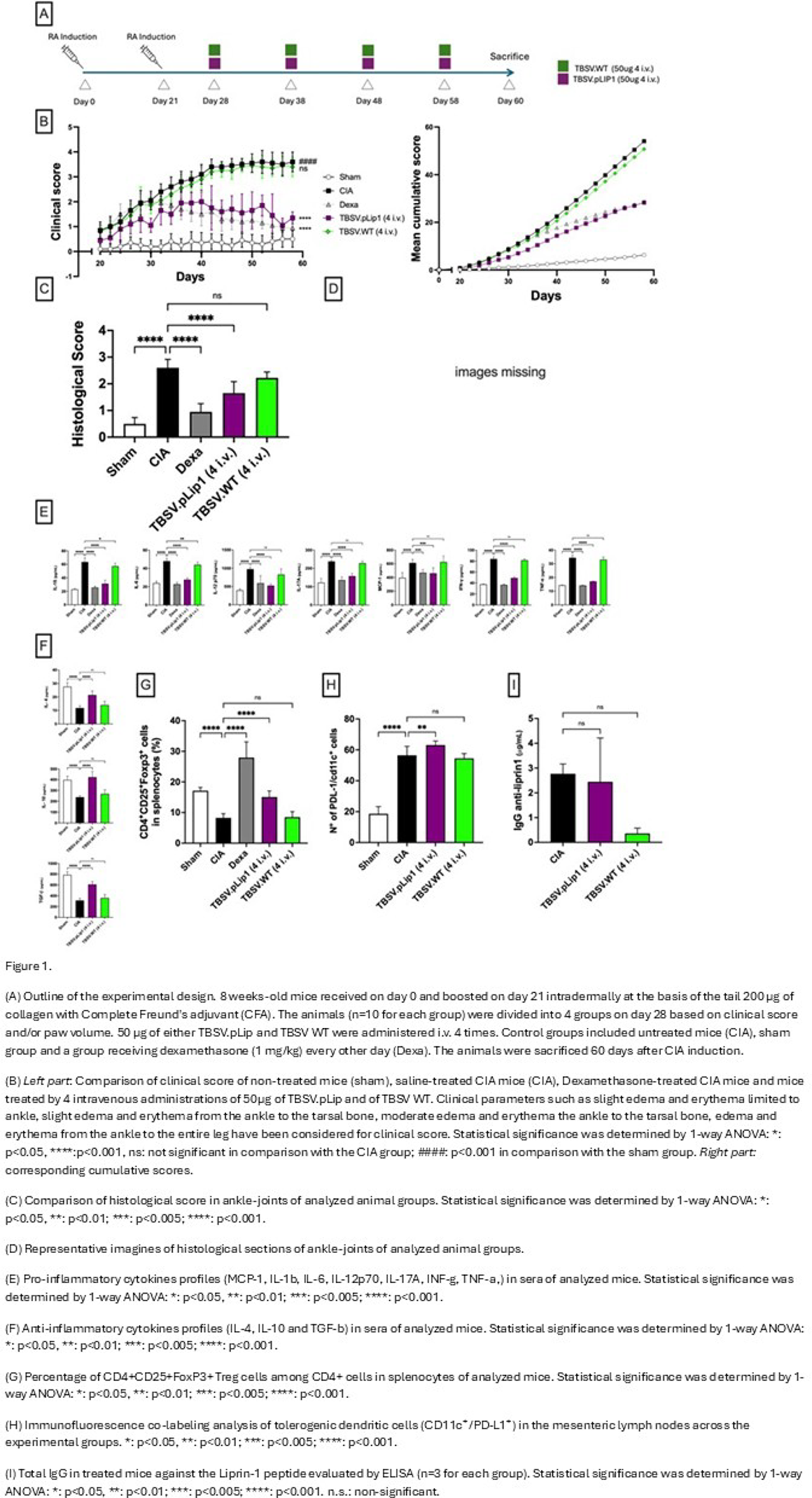
Results: Rheumatoid arthritis (RA) patients, irrespective of RF status, produce autoantibodies against the Liprin-1 peptide. To investigate its pathogenic potential, we assessed whether immunization with the Liprin-1 peptide, which shares complete homology with human and murine isoforms, induces arthritis in DBA/1J mice. Within one week post-boost, mice developed progressive inflammatory arthritis with clinical scores comparable to collagen-induced arthritis (CIA). At day 60, both Liprin-1-induced arthritis (LIA) and CIA groups exhibited marked synovial inflammation, cartilage degradation, and bone erosion versus sham controls. Serum analysis revealed significant elevation of pro-inflammatory cytokines (MCP-1, IL-17, IL-1β, IL-6, IL-12p60), with IL-17 and MCP-1 being predominant, alongside a reduction in Treg cell populations. These findings suggest that Liprin-1 peptide immunization can trigger arthritis and promote a strong pro-inflammatory milieu similar to CIA. To evaluate the tolerogenic potential of TBSV.pLip, we compared four intravenous administrations (every 10 days) of TBSV.pLip nanoparticles with TBSV WT (lacking peptide display), in an experimental design showed in Figure 1A. TBSV.pLip treatment significantly improved clinical scores compared to CIA controls, while TBSV WT showed no benefit (Figure 1B). Histological analysis confirmed reduced joint damage in the TBSV.pLip group (Figure 1C–D). Pro-inflammatory cytokines were markedly decreased following TBSV.pLip treatment, unlike TBSV WT (Figure 1E). Anti-inflammatory cytokines (IL-4, IL-10, TGF-β) were significantly elevated in TBSV.pLip-treated mice, with the strongest effect for TGF-β and IL-4 (Figure 1F). Flow cytometry revealed restoration of CD4 + CD25 + Foxp3 + Treg cells in the TBSV.pLip group (Figure 1G), and immunofluorescence showed increased tolerogenic dendritic cells (CD11c + /PD-L1 + ) compared to CIA and TBSV WT (Figure 1H). No differences in anti-Liprin-1 antibody reactivity were observed among groups (Figure 1I).
Conclusions: Our findings indicate that the Liprin-1 peptide exhibits key features of an autoantigen involved in disease onset, making it an optimal target for antigen-specific immunotherapy in RA. TBSV nanoparticles displaying the Liprin-1 peptide provided specific protection against RA development, unlike WT TBSV, which showed no impact on cytokine profiles or induction of tolDC and Treg. Repeated, controlled presentation of Liprin-1 by TBSV particles promoted tolerogenic dendritic cells and regulatory T cells, likely through clonal anergy and metabolic modulation involving IL-10, TGF-β, and IL-4. These results highlight TBSV.pLip as a promising platform for antigen-specific immunotherapy in RA.
REFERENCES: [1] Zampieri, R. et al. Prevention and treatment of autoimmune diseases with plant virus nanoparticles. Sci. Adv. 6, eaaz0295 (2020).
[2] Bason C., Barbieri A, Martinelli N, Olivieri B, Argentino G, Bartoloni E, Beri R, Jadav G[3] Puccetti A, Tinazzi E and Lunardi C (2021) Identi cation of a Novel Serological Marker in Seronegative Rheumatoid Arthritis Using the Peptide Library Approach. Front. Immunol. 12:753400. doi: 10.3389/fimmu.2021.753400
Acknowledgments: NIL.
Disclosure of Interests: None declared.