fetching data ... 
Background: Rheumatoid arthritis fibroblast-like synoviocytes (RA-FLS) acquire an apoptosis-resistant, invasive phenotype that drives synovial inflammation and joint destruction. Persistent endoplasmic reticulum stress with activation of the IRE1/phospho-JNK arm of the unfolded protein response coexists with altered ferroptosis susceptibility in RA-FLS, but the mechanisms underlying ferroptosis resistance remain unclear.
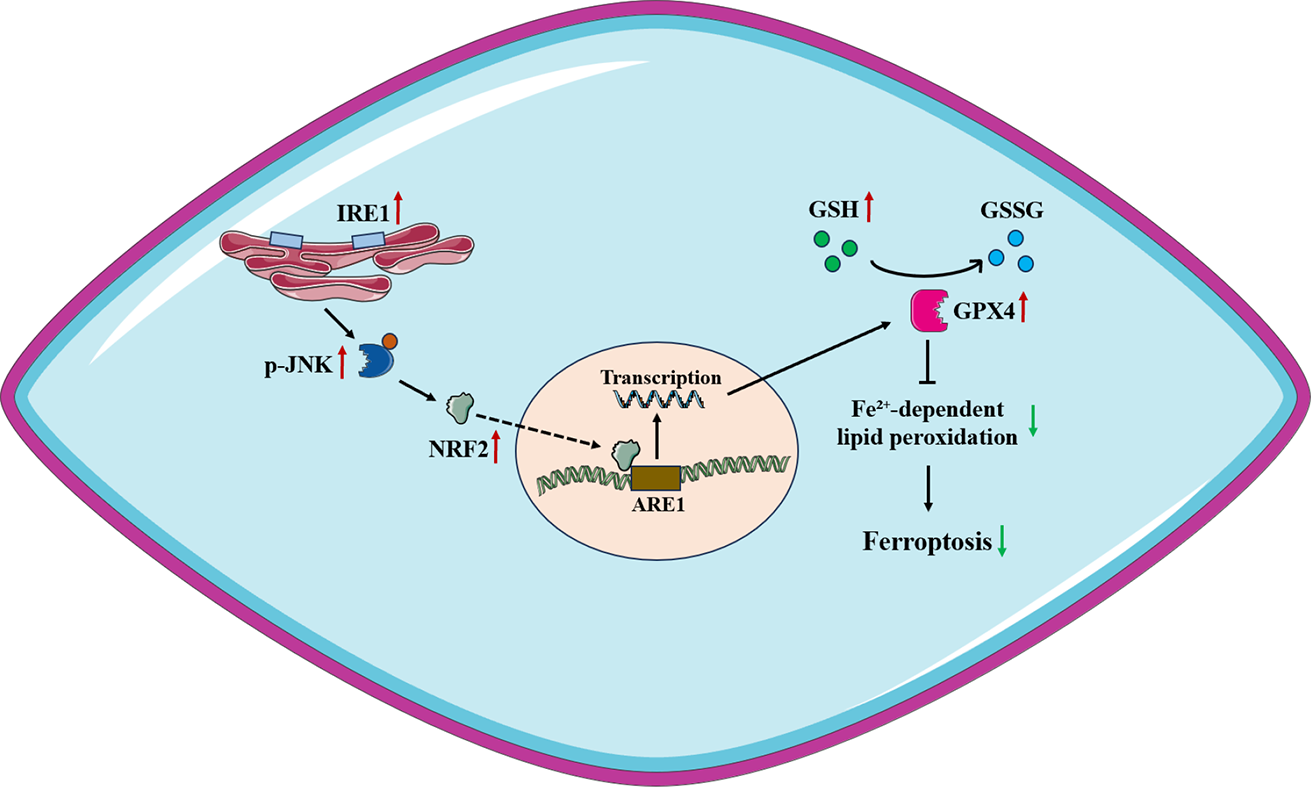
Objectives: To determine whether sustained IRE1/p-JNK signaling activates NRF2 to upregulate GPX4 and thereby confers ferroptosis resistance in rheumatoid arthritis fibroblast-like synoviocytes, and to evaluate whether inhibiting this axis restores ferroptotic sensitivity and mitigates arthritis in vivo.
Methods: A total of 21 patients who underwent joint replacement were included (rheumatoid arthritis n=11; osteoarthritis n=10). FLS (n≥3 per group) from rheumatoid arthritis and osteoarthritis patients were analyzed by RT-qPCR and western blotting for IRE1, p-JNK, NRF2 and GPX4. Signaling was modulated with siRNA or inhibitors against ERN1 or NRF2. Ferroptosis was assessed by transmission electron microscopy, lipid peroxidation, Fe 2+ and glutathione depletion; cell phenotypes were measured by invasion, wound-healing and CCK-8 assays. In vivo (n≥4 per group), a collagen-induced arthritis rat model received IRE1 inhibitor 4μ8c; micro-CT, joint pathology and biochemical markers were evaluated.
Results: Rheumatoid arthritis fibroblast-like synoviocytes showed elevated IRE1/p-JNK, increased total and nuclear NRF2, and higher GPX4 versus osteoarthritis arthritis fibroblast-like synoviocytes. Rheumatoid arthritis fibroblast-like synoviocytes were more resistant to ferroptosis. ERN1 knockdown reduced p-JNK, NRF2, and GPX4. Furthermore, it increased lipid peroxidation, iron accumulation, glutathione loss and ferroptosis. NRF2 inhibition also sensitized rheumatoid arthritis fibroblast-like synoviocytes to ferroptosis. In CIA rats, IRE1 inhibition partially attenuates bone destruction, lowers serum IL-1β/MMP9, and reduces synovial GPX4.
Conclusions: Sustained IRE1/p-JNK/NRF2 signaling upregulates GPX4, linking ER stress to ferroptosis resistance in RA-FLS. Targeting IRE1 lowers GPX4 and restores ferroptotic sensitivity, suggesting a potential therapeutic strategy for rheumatoid arthritis.
IRE1/p-JNK/NRF2 axis-mediated GPX4 upregulation underlies ferroptosis resistance in rheumatoid arthritis fibroblast-like synoviocytes
REFERENCES: NIL.
Acknowledgments: NIL.
Disclosure of Interests: None declared.