fetching data ... 
Background: Rheumatoid arthritis (RA) is a chronic autoimmune disease characterized by episodic flares that lead to joint inflammation and progressive damage. RA is heterogeneous and thus treatment responses vary widely among patients[1,2], highlighting the need for new predictive biomarkers to guide personalized therapies.
Objectives: In this study, we integrate single‐cell RNA sequencing (scRNAseq) of peripheral blood mononuclear cells (PBMCs) collected at diagnosis with clinical follow‐up data to investigate novel biomarkers associated with treatment outcomes.
Methods: Our analysis includes 22 patients with newly diagnosed RA, prior to treatment, and 22 age‐ and sex‐matched controls. The scRNAseq data are first corrected for batch effects using the Scanorama [3] algorithm, and low‐quality cells and background noise are removed through standard filtering. Cell identities were annotated based on known marker genes via the CellTypist [4] human immune cell model. After integrating clinical data from diagnosis with follow‐up parameters such as erosiveness and treatment response, differential abundance between conditions was assessed using the milo [5] algorithm, while differential gene expression and gene set enrichment analyses were performed afterwards on the cell subset.
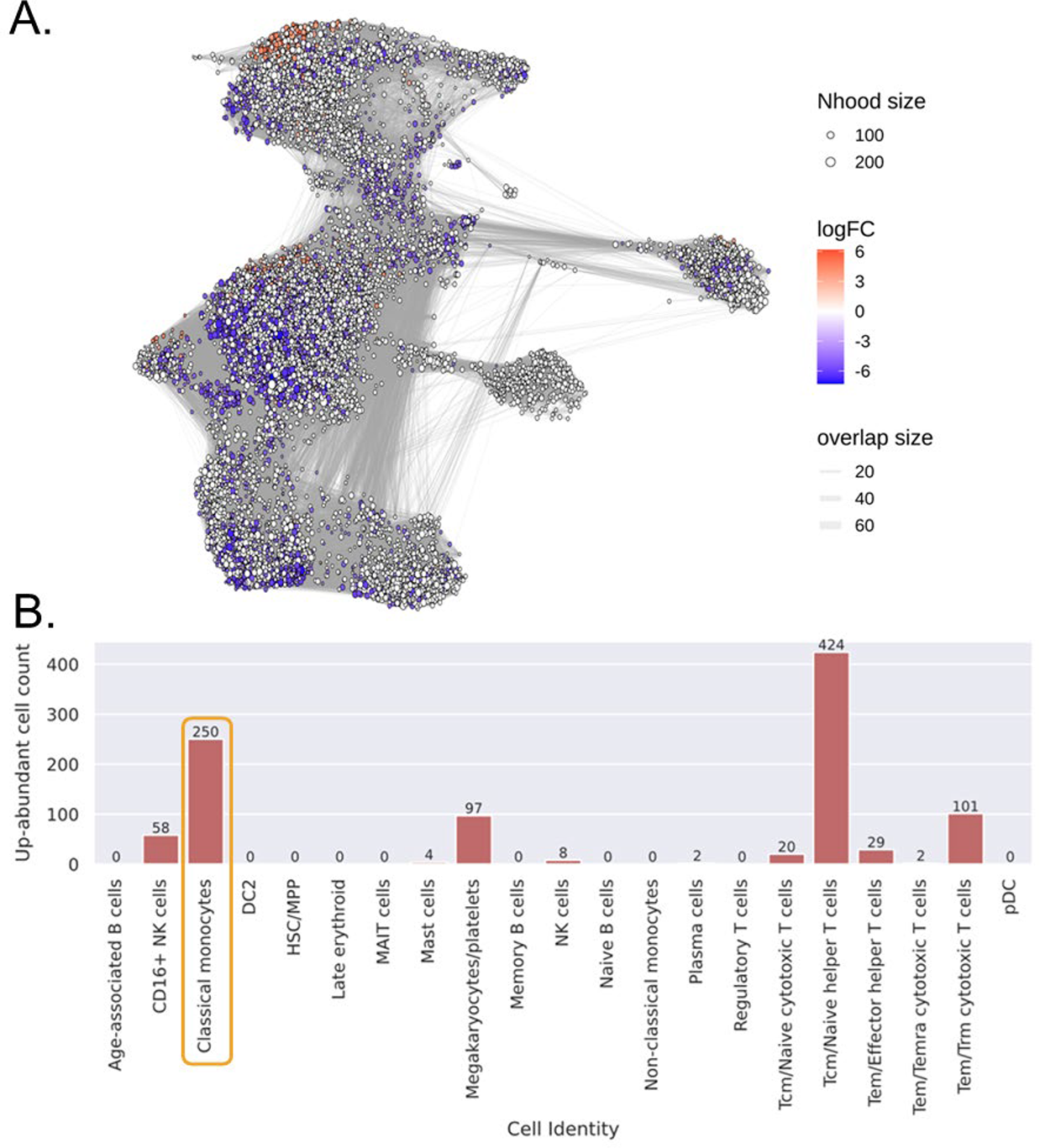
Results: Focusing on a subset of 22 rheumatoid arthritis (RA) patients and 22 matched controls, we identified transcriptomic and compositional alterations associated with therapeutic outcomes. Among RA patients, those who later required biologic therapy exhibited an over-abundance of classical monocytes at diagnosis. These cells displayed distinct transcriptional profiles characterized by the downregulation of inflammatory and osteoclast-related pathways, suggesting an altered activation state potentially linked to suboptimal response to conventional treatment. In exploratory analyses of patients with prolonged follow-up (>30 months), a separate monocyte subpopulation was enriched in individuals with erosive disease, indicating that discrete monocyte programs may contribute to pathogenic mechanisms driving joint damage.
Conclusions: By linking distinct classical monocyte subpopulations to both MTX treatment resistance and an erosive disease trajectory, our study presents a promising strategy for identifying potential new biomarkers predictive of treatment outcomes in RA. Together, these findings underscore the potential of single‐cell transcriptomic profiling to reveal clinically relevant immune signatures present at diagnosis, paving the way for future functional investigations and, ultimately, personalized treatment strategies in rheumatoid arthritis.
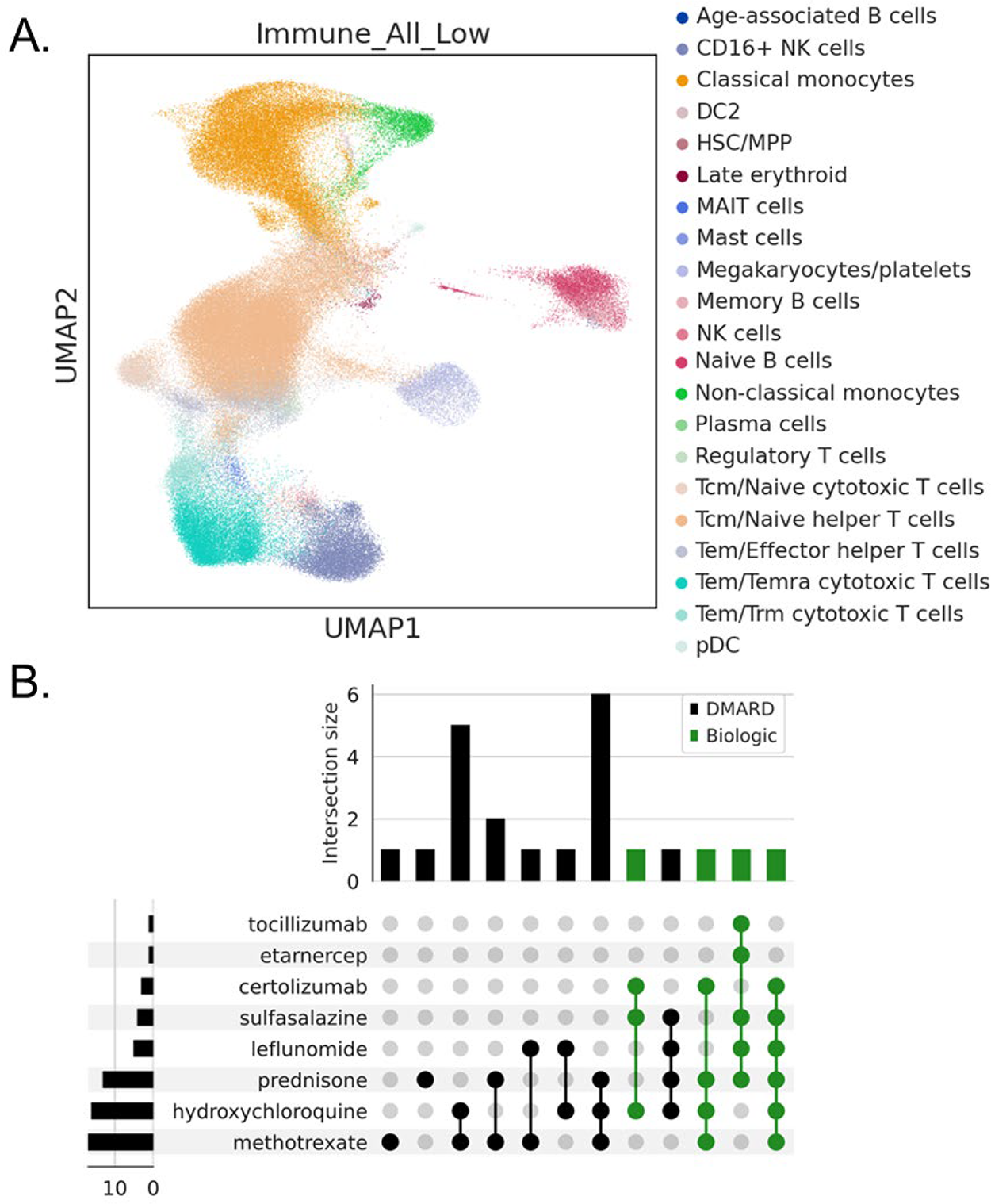
PBMC immune landscape at diagnosis and patients’ treatment trajectories. (A) UMAP of the data with cell identities annotation from Celltypist. (B) Upset plot of the patient treatment trajectories.
Immune cell subpopulations enriched in RA patients requiring biologic therapy. (A) UMAP of the differential abundance analysis graph from miloR. (B) Up-abundant cell count in patients requiring biologic therapy by cell identity.
REFERENCES: [1] Nagy G, Roodenrijs NMT, Welsing PMJ, et al. EULAR points to consider for the management of difficult-to-treat rheumatoid arthritis. Annals of the Rheumatic Diseases. 2021;81(1):20-33. doi:10.1136/annrheumdis-2021-220973 [2] Fraenkel L, Bathon JM, England BR, et al. 2021 American College of Rheumatology Guideline for the Treatment of Rheumatoid Arthritis. Arthritis Care & Research. 2021;73(7):924-939. doi:10.1002/acr.24596 [3] Hie B, Bryson B, Berger B. Efficient integration of heterogeneous single-cell transcriptomes using Scanorama. Nature Biotechnology. 2019;37(6):685-691. doi:10.1038/s41587-019-0113-3 [4] Conde CD, Xu C, Jarvis LB, et al. Cross-tissue immune cell analysis reveals tissue-specific features in humans. Science. 2022;376(6594). doi:10.1126/science.abl5197 [5] Dann E, Henderson NC, Teichmann SA, Morgan MD, Marioni JC. Differential abundance testing on single-cell data using k-nearest neighbor graphs. Nature Biotechnology. 2021;40(2):245-253. doi:10.1038/s41587-021-01033-z
Acknowledgments: NIL.
Disclosure of Interests: Jean Vencic: None declared, Sophie Roux Kyowa Kirin, Amgen, Kyowa Kirin, Apotex, Kyowa Kirin, Insmed, Michelle Scott: None declared, Hugues Allard-Chamard Abbvie, Amgen, AstraZeneca, BMS, Celltrion, Eli Lilly, Hoffmann-La Roche, Fresenius Kabi, GSK, Janssen, Novartis, Otsuka, Mantra Pharma, Pfizer, Sandoz, Sobi., Abbvie, Amgen, AstraZeneca, Celltrion, Eli Lilly, GSK, Hoffmann-La Roche, Janssen, Fresenius Kabi, Novartis, Pfizer, Sandoz, Sobi., AstraZeneca, Eli Lilly, Fresenius Kabi, Pfizer.