fetching data ... 
Background: A significant proportion (up to 20%) of patients with rheumatoid arthritis (RA) have treatment-resistant disease. EULAR recently defined ‘Difficult to treat’ (D2T) RA as failure of 2 or more classes of biological or targeted synthetic DMARDs. This is an area of high unmet need, where novel therapeutic approaches are urgently required. In D2T RA, there’s often a shift towards which opens chromatin and increases expression of pro-inflammatory genes (like IL-1β, IL-6, IL-8) in immune cells and synovial tissue, driving synovitis and joint destruction. BRD4 is an epigenetic regulator that appears to play a major role in establishing the hyperacetylated state in D2T patients through its BD2 chromatin binding domain. This hyperacetylated state leads to increased expression of pro-inflammatory genes, including the major chemoattractant CCL2. DC-9476 is a novel, selective third-generation BET inhibitor that targets only the BD2 domain of BRD4, not the other family members or any BD1 domains. It was developed using Deepcure’s proprietary AI-driven drug discovery platform. DC-9476 offers a unique solution to the limitations of previous BRD4 inhibitors by reducing hematopoietic toxicity while still effectively inhibiting BRD4-driven transcription.
Objectives: We aimed to determine the in vitro effectiveness of the BRD4 inhibitor DC9476 in D2T RA and relate it to in vivo efficacy in the CIA animal model.
Methods: PBMCs from patients with RA and at risk of RA (CCP+ at risk =5, D2T JAKi naïve=10, D2T JAKi exposed=5, MTXIR=5) treated with DC9476 (0.3µM, 1.2µM) or Tofacitinib (200nM) for 24 hours. Supernatant and RNA were collected and assessed CCL2 via ELISA and gene expression (CCL2, IL-6, TNF-α, MX1 and IFIT1 qPCR) changes by qPCR. Ultrasound guided synovial biopsies were treated ex vivo . In the collagen-induced arthritis (CIA) model, mice were treated with DC-9476 (p.o., 15 or 150 mg/kg, BD), etanercept (i.p., 10 mg/kg, QD) or tofacitinib (p.o., 25 mg/kg, BD). Joints were analysed by X-rays for bone and cartilage distraction and for immune infiltrate by histopathology.
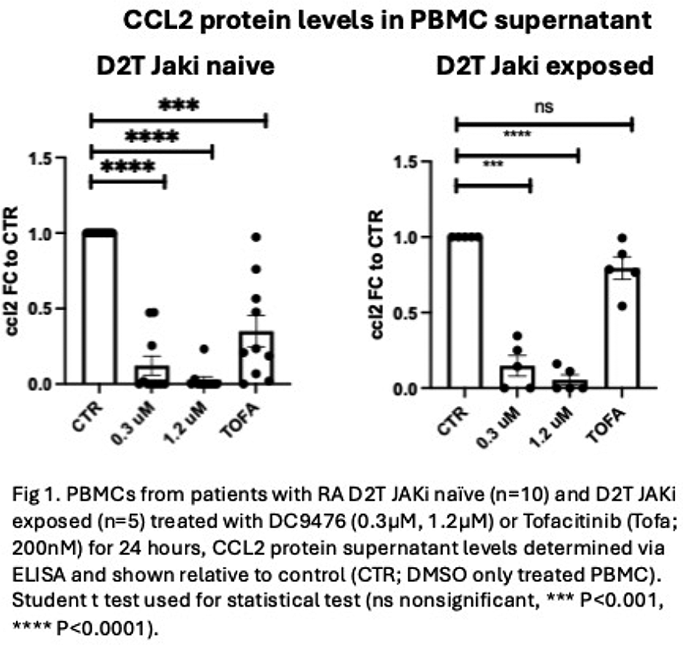
Results: DC9476 reduced CCL2 expression in PBMCs from all patient subtypes by over 90%, whereas D2T JAKi exposed subgroup were resistant to Tofacitinib (Figure 1). DC9476 showed significant reduction of TNF-α levels in PBMCs from all disease subtypes by 50%, with Tofacitinib having no effect within the D2T group. Analysis of Interferon stimulated genes (MX1 and IFIT1) revealed DC9476 had no impact on expression levels in RA PBMCs. Treatment of D2T RA synovial biopsies ex vivo , revealed DC9476 reduced CCL2 gene expression levels by 85%.
In the CIA model, oral treatment with DC-9476 led to dose-dependent reduction of arthritis score. This was concurrent with substantial decrease in joint damage as shown by X-ray image analysis, which is associated with an almost complete reduction in immune-infiltration in the joint. In this model, DC-9476 demonstrated significantly better activity compared to Etanercept and Tofacitinib.
Conclusions: DC9476 dramatically reduced CCL2 expression in PBMCs from patients across the RA disease continuum, including D2T patients unresponsive to JAK inhibition. The effect seen in patient PBMC align with the activity shown by DC-9476 in reducing damage and immune infiltration in the joint of CIA mice.
Given the role of CCL2 in immune cell recruitment and its strong association with disease activity, this suggests DC9476 could hold therapeutic potential in people with treatment-resistant RA.
REFERENCES: NIL.
Acknowledgments: NIL.
Disclosure of Interests: Christopher W Wasson: None declared, Fareeha Tariq: None declared, Michal Segal-Salto Deepcure, Deepcure, Panji Mulipa: None declared, Georg Duenstl Deepcure, Deepcure, Sana Sharrack: None declared, Helen-Jayne Sugden: None declared, Andrea Di Matteo: None declared, Paul Emery: None declared, Lesley-Anne Bissell: None declared, Ai Lyn Tan: None declared, Francesco Del Galdo: None declared, Kfir Schreiber Deepcure, Deepcure, Luca Rasteli Deepcure, Deepcure, Kulveer Mankia Abbvie, ALLin Bio, Alchemab Thertapeutics, Astra Zeneca, Engitix, UCB, Lilly, Galapagos, Serac Healthcare, Zura Bio, Deepcure, Ventus Therapeutics, Gilead, Lilly, Serac Healthcare, Astra Zeneca, Deepcure, Alfa-Sigma, Rebecca Ross AstraZeneca, Ventus therapeutics, Deepcure, Mitsubishi, Abbvie, Calluna Pharma.