fetching data ... 
Background: Rheumatoid arthritis (RA) is a chronic systemic autoimmune disease characterised by persistent synovial inflammation, progressive joint destruction, and substantial interindividual heterogeneity in disease course and therapeutic response. Despite the expanding availability of targeted therapies, including biologic and targeted synthetic disease-modifying antirheumatic drugs (DMARDs), treatment selection in routine clinical practice largely relies on empirical trial-and-error strategies. This approach often leads to prolonged exposure to ineffective therapies, during which irreversible structural damage may occur. Interleukin-6 (IL-6) is a central cytokine in RA pathogenesis, exerting pleiotropic effects on both innate and adaptive immune responses. IL-6 signalling is predominantly mediated via the Janus kinase–signal transducer and activator of transcription (JAK–STAT) pathway, particularly through STAT3 phosphorylation. Dysregulated IL-6–JAK–STAT signalling contributes to sustained inflammation, T-cell polarisation, and autoantibody production, making this pathway a major therapeutic target. However, the functional activity of this signalling axis and its pharmacological inhibition vary considerably between patients and immune cell subsets, underscoring the need for functional biomarkers that capture patient-specific signalling behaviour.
Objectives: To functionally characterise IL-6–induced STAT3 phosphorylation (pSTAT3) across major peripheral immune cell subsets in RA and to assess interindividual and cell-type-specific heterogeneity in JAK–STAT pathway activation and inhibition, with the overarching aim of supporting future personalised therapeutic decision-making.
Methods: Peripheral whole-blood samples were obtained from healthy controls (HC), RA patients with moderate to high disease activity prior to escalation from conventional synthetic DMARD therapy (csDMARD-IR), and RA patients switching therapy following inadequate response to tumour necrosis factor-α inhibitors (TNF-IR). Samples were pre-incubated ex vivo with the JAK inhibitors tofacitinib, baricitinib, upadacitinib, or filgotinib (10 µM, 30 min), followed by IL-6 stimulation (100 ng/mL, 15 min). STAT3 phosphorylation was quantified by multiparameter flow cytometry in T cells, monocytes, and B cells and expressed as the proportion of pSTAT3-positive cells. Non-parametric statistical analyses were performed using Kruskal–Wallis testing with Dunn’s post-hoc correction. Clinical characteristics were retrieved from electronic health records.
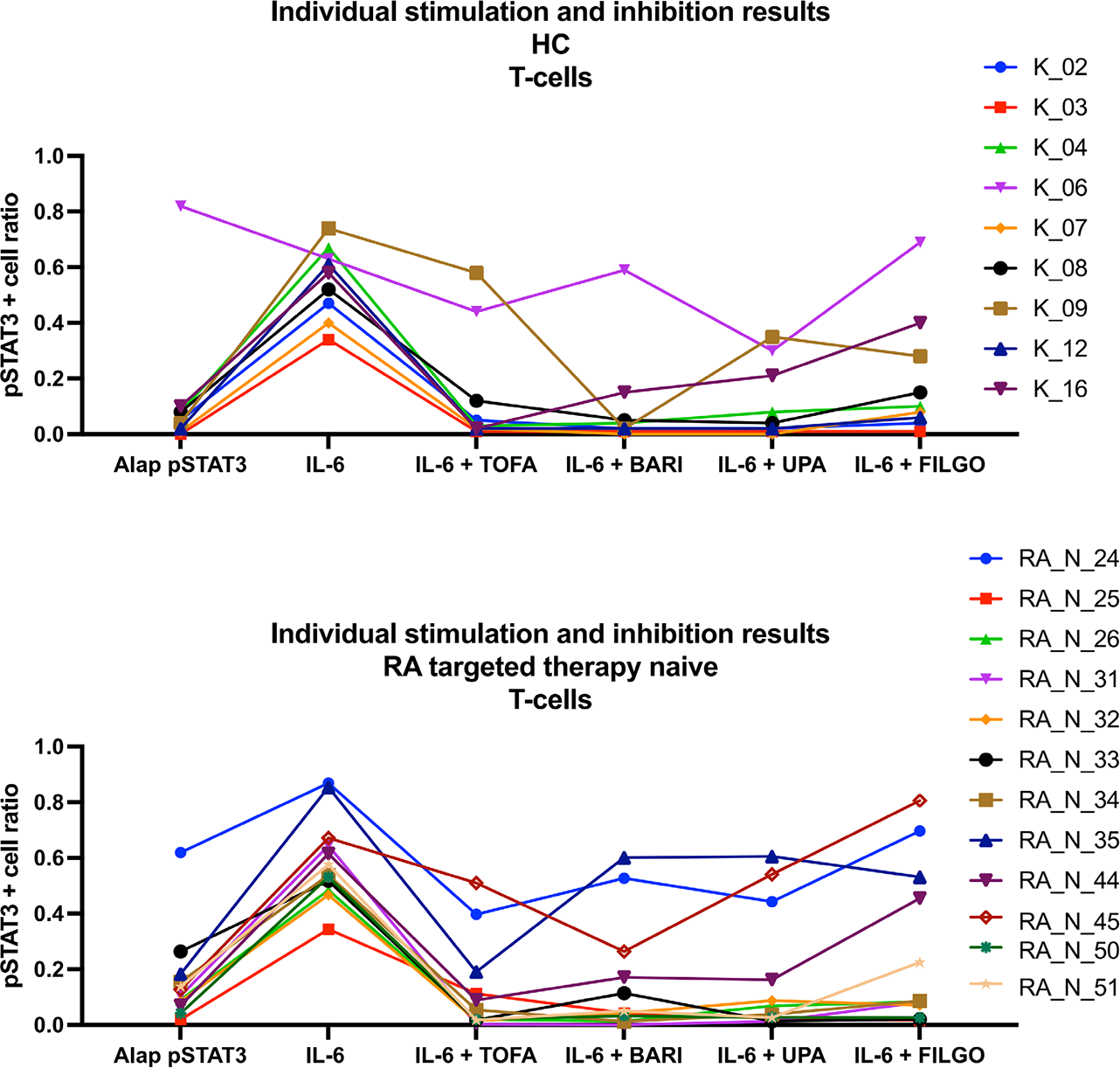
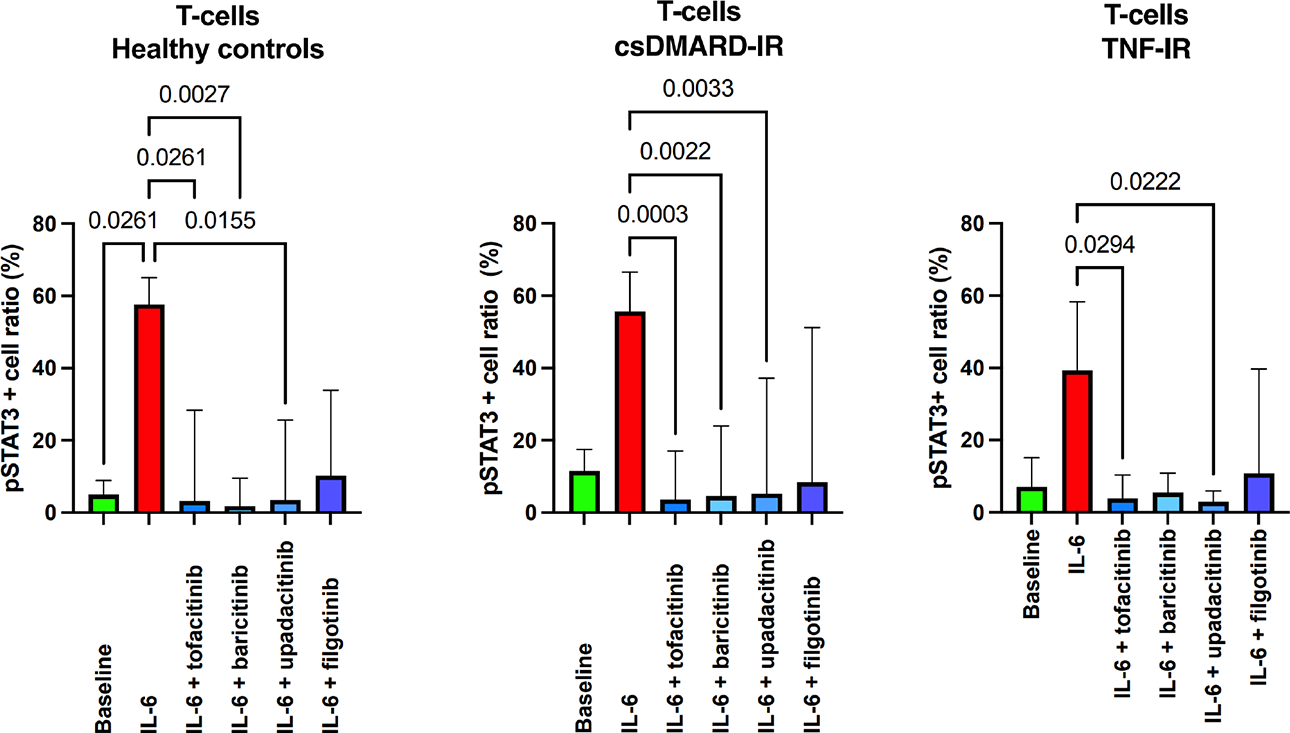
Results: IL-6 stimulation induced robust pSTAT3 activation across all analysed immune cell subsets in both RA patients and healthy controls. However, RA samples displayed marked interindividual variability in both the magnitude of IL-6–induced signalling and the degree of pharmacological inhibition. This heterogeneity was most pronounced in csDMARD-IR patients. T cells showed the most consistent and statistically significant inhibition of IL-6–induced pSTAT3 following JAK inhibitor exposure (p = 0.0003–0.0033), whereas monocytes demonstrated significant but less uniform suppression (p < 0.01). B-cell responses were more variable and less consistently inhibited. Importantly, individual csDMARD-IR patients exhibited distinct in vitro signalling phenotypes, resembling responder-like or non-responder-like patterns at the level of T-cell JAK–STAT activation. TNF-IR patients displayed similar but more heterogeneous profiles, while healthy controls showed comparatively homogeneous signalling and inhibition patterns.
Conclusions: This study demonstrates substantial immune cell-specific and interindividual heterogeneity in IL-6–driven JAK–STAT signalling in RA, with the most robust and discriminatory patterns observed in T cells. These findings support the concept that functional ex vivo pathway assessment can reveal biologically meaningful patient-specific signalling signatures beyond conventional clinical parameters. Ongoing work aims to correlate these in vitro profiles with longitudinal treatment outcomes. If validated, functional JAK–STAT profiling may represent a valuable step toward precision medicine approaches in rheumatoid arthritis.
Individual T-cell pSTAT3 responses to IL-6 stimulation and JAK pathway inhibition in HCs and csDMARD-IR RA patients
IL-6–induced pSTAT3 activation and JAK inhibitor–mediated inhibition in T cells from HCs, csDMARD-IR and TNF-IR RA patients (median) (IQR)
REFERENCES: [1] Smolen JS, Landewé RBM, Bergstra SA, et al. EULAR recommendations for the management of rheumatoid arthritis with synthetic and biological disease-modifying antirheumatic drugs: 2022 update. Ann Rheum Dis. 2023;82:3–18. doi:10.1136/ard-2022-223356
[2] Morris R, Kershaw NJ, Babon JJ. The molecular details of cytokine signaling via the JAK/STAT pathway. Protein Sci. 2018;27:1984–2009. doi:10.1002/pro.3519
Malemud CJ. The role of the JAK/STAT signal pathway in rheumatoid arthritis. Ther Adv Musculoskelet Dis. 2018;10:117–127. doi:10.1177/1759720X18776224
[3] Hu X, Li J, Fu M, Zhao X, Wang W. The JAK/STAT signaling pathway: from bench to clinic. Signal Transduct Target Ther. 2021;6:402. doi:10.1038/s41392-021-00791-1
[4] Cacciapaglia F, Perniola S, Stano S, et al. Modulation of IL-6 receptor/STAT3 downstream signaling in rheumatoid arthritis patients. Exp Mol Pathol. 2025;141:104951. doi:10.1016/j.yexmp.2024.104951
Acknowledgments: NIL.
Disclosure of Interests: None declared.