fetching data ... 
Background: Immune dysregulation mediated by the imbalanced follicular helper T (Tfh) cells and reduced follicular regulatory T (Tfr) cells resluting in the over-production of abnormal antibodies is the main pathogenesis of rheumatoid arthritis (RA) [1]. Tryptophan metabolism is known to modulate immune response and manipulating tryptophan metabolism is a new therapeutic strategy for RA [2]. It has been reported that the supplement tryptophan helped to alleviate RA [3]. However, weather tryptophan could restore Tfh/Tfr imbalance in RA remains unclear.
Objectives: To investigate the effects of dietary tryptophan on imbalanced Tfh/Tfr cells and arthritis in collagen-induced arthritis (CIA) mice.
Methods: 30 male 6-week-old DBA/1J mice (SPF grade) were acclimatized and fed with standard diet for 7 days. 6 mice were randomly selected as control group and maintained on a standard diet containing 0.36% tryptophan. The remaining were randomly divided into CIA with standard diet, CIA with high-tryptophan diet (1.5% tryptophan, HT-CIA) and CIA with low-tryptophan diet (0.10% tryptophan, LT-CIA). After 7 days, these mice were prepared to establish CIA model via initial immunization on day 0 and booster immunization on day 21. After booster immunization, the mice were evaluated for arthritis index score, and mice with score ≥ 4 were considered to induce arthritis successfully. At the end of the experiment (day 56), the numbers of surviving arthritic mice in the CIA, HT-CIA and LT-CIA groups were 6, 6 and 7 respectively. Blood, Peyer’s patch and joint tissue were collected from these mice. The level of anti-type II collagen (CII) and cytokines (including IL-4, IL-6, IL-10, IL-21 and TNF-α) in blood as well as the expression of Tfr cells, Tfh cells and B cells subsets (including memory B cells and plasma cells) in Peyer’s patch were detected.
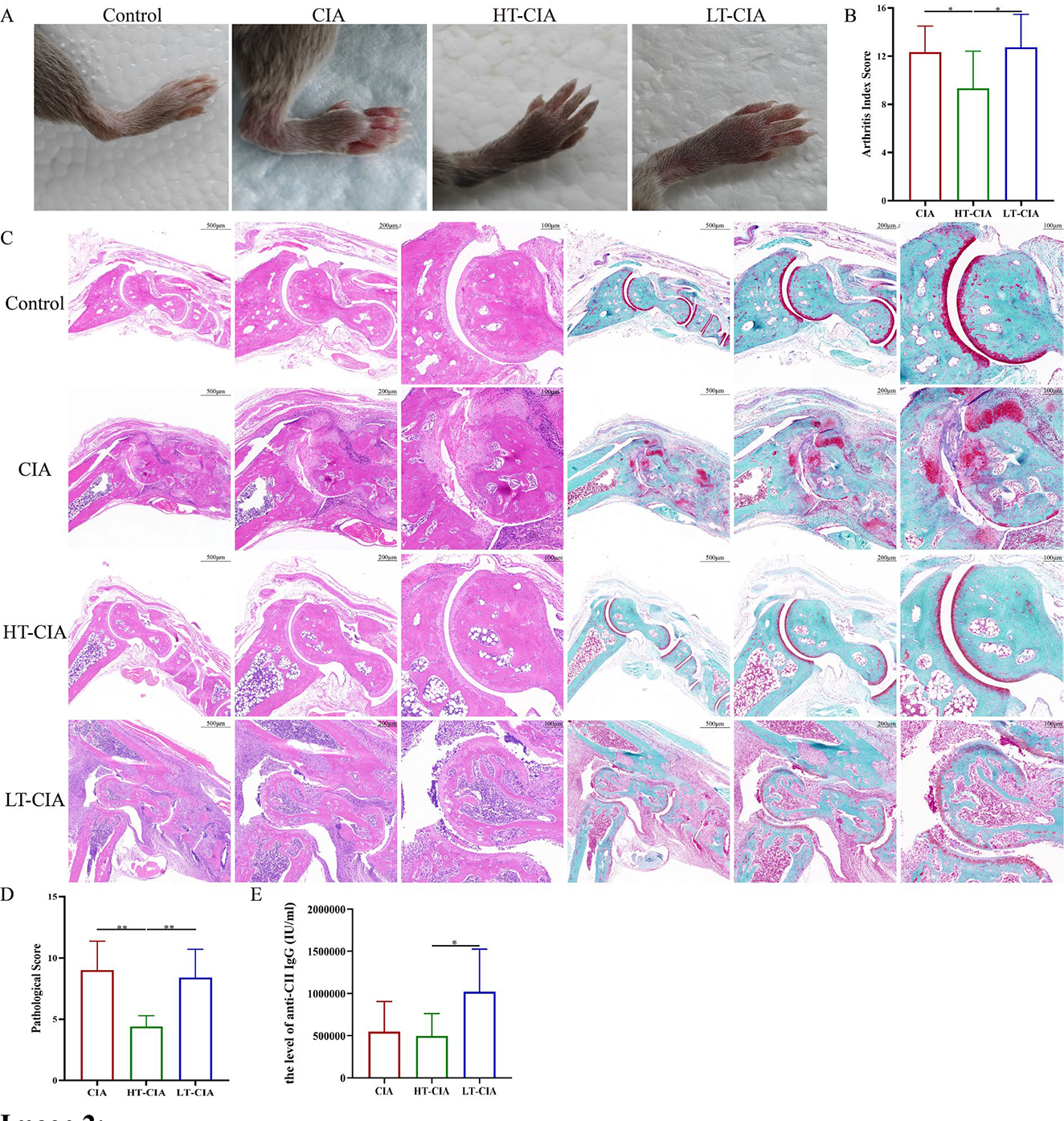
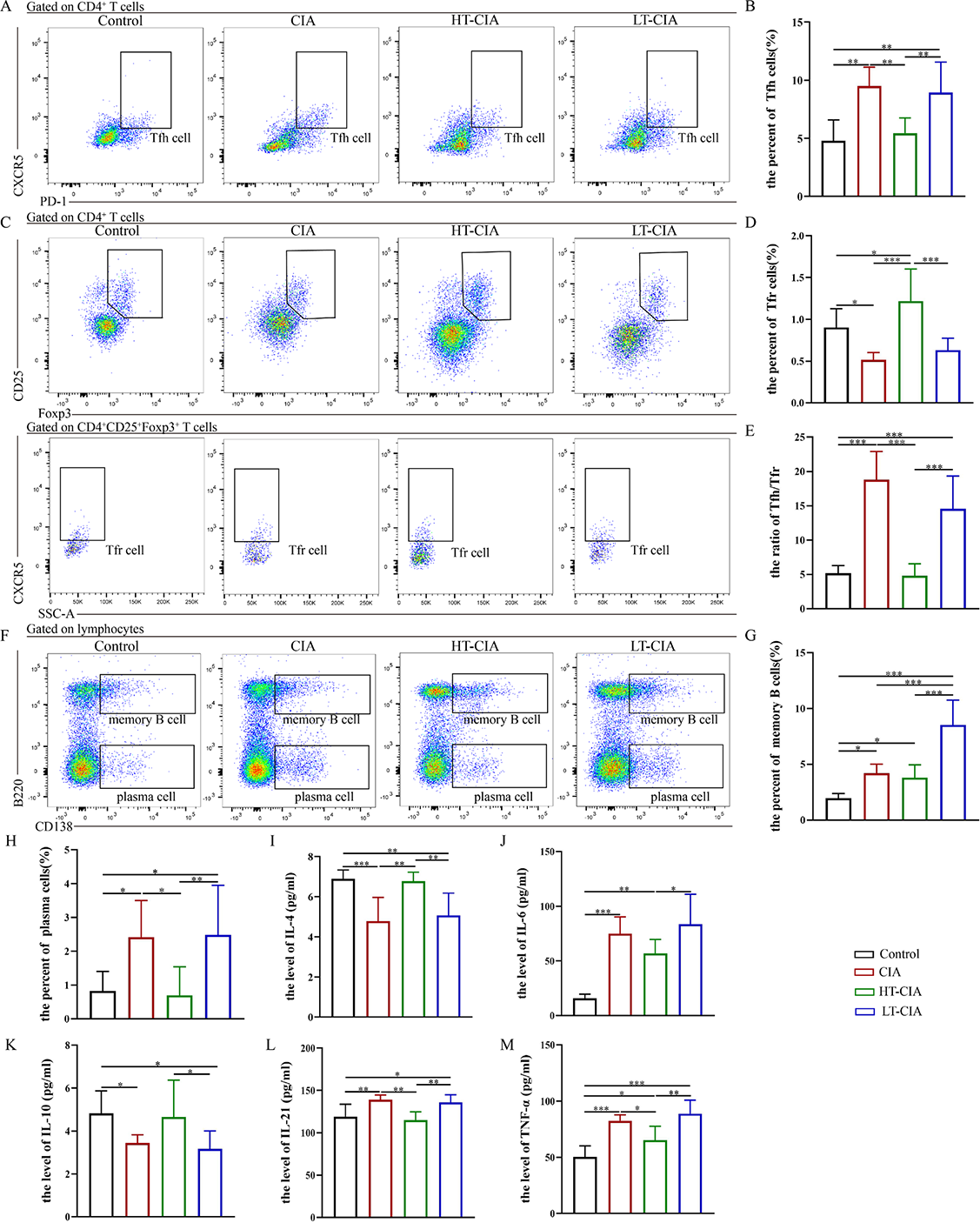
Results: The HT-CIA mice had the significantly reduced swollen joint counts and lower arthritis scores (Figure 1A-B). The histological examination showed that CIA and LT-CIA mice exhibited severe infiltration of inflammatory cells and destruction of cartilage and bone. While the HT-CIA mice showed only minimal inflammatory cell infiltration and mild cartilage compromise (Figure 1C). Consistently, pathological scores for the joints in HT-CIA mice were significantly lower (Figure 1D). Additionally, the level of anti-CII was significantly elevated in LT-CIA group (Figure 1E). The CIA mice exhibited immune dysregulation manifesting as immune imbalance (including increased Tfh cells, memory B cells and plasma cells, but reduced Tfr cells) and pro-inflammatory phenotype (including the higher IL-6, IL-21 and TNF-α, but the lower IL-4 and IL-10) (Figure 2). Compared to the CIA and LT-CIA mice, the HT-CIA mice showed the significantly reduced Tfh cells but increased Tfr cells to restore the balanced of Tfh/Tfr cells (Figure 2A-E). The LT-CIA mice had higher memory B cells but HT-CIA mice had lower plasma cells. A downward trend in memory B cells was also observed in HT-CIA mice, but it did not reach statistical significance (Figure 2F–H). The cytokine levels were also altered in the HT-CIA and LT-CIA mice. The HT-CIA mice demonstrated a significant increase in IL-4 but notable reduces in IL-21 and TNF-α. HT-CIA mice had a higher IL-10 but lower IL-6 level than LT-CIA mice (Figure 2I-M).
Conclusions: CIA mice exhibited immune dysregulation. High dietary tryptopha effectively restored immune homeostasis and ameliorated arthritis, highlighting the potential of tryptophan as an immunomodulatory agent for the treatment of RA.
The joint lesions and antibody levels of mice. (A) The appearance of joint. (B) The arthritis score of all the model mice. (C) The histological manifestation of mice. (D) The pathological score of all the model mice. (E) The level of anti-CII of all the model mice.
The immune phenotypes and cytokines of mice. (A-B) The comparison of Tfh cells. (C-D) The comparison of Tfr cells. (E) The comparison of Tfh/Tfr ratio. (F-H) The comparison of memory B cells and plasma cells. (I-M) The comparison of cytokines.
REFERENCES: [1] Gao A, Wu R, Mu Y, Jin R, Jiang S, Gao C, et al. Restoring immune tolerance in pre-RA: immunometabolic dialogue between gut microbiota and regulatory T cells. Front Immunol. 2025; 16(1565133).
[2] Phillips R. Manipulating tryptophan metabolism in arthritis. Nat Rev Rheumatol. 2024; 20(2):67.
[3] Jian C, Zhu J, Wu J, Zhang Y, Chen J, Wang H, et al. Multiomics Analyses Reveal an Essential Role of Tryptophan in Treatment of csDMARDs in Rheumatoid Arthritis. Adv Sci (Weinh). 2025:e13170.
Acknowledgments: NIL.
Disclosure of Interests: None declared.