fetching data ... 
Background: Rheumatoid arthritis (RA) can be classified according to the presence or absence of anti-citrullinated protein antibodies (ACPA). Although ACPA-positive RA has been extensively characterised, the pathological pathways underpinning ACPA-negative RA remain incompletely understood. Synovial biopsy-based stratification may provide insights into disease biology beyond conventional clinical and serological classification and enable more targeted therapeutic approaches.
Objectives: To compare clinical, histological and molecular features between ACPA-positive and ACPA-negative patients with RA.
Methods: We performed an in-depth analysis of the Pathobiology of Early Arthritis Cohort (PEAC), which includes treatment-naïve patients with early RA who underwent ultrasound-guided synovial biopsy of the most inflamed accessible joint prior to treatment initiation. In total, 215 patients with RA were recruited between 2009 and April 2024 and were included in analysis of clinical data. 190 patients had adequate synovial tissue from biopsies and underwent histological analysis. Of these, analysis was applied to 73 samples that had RNA-sequencing data available. Clinical assessments were recorded at baseline and at three-monthly intervals for one year. Synovial tissue was histologically classified into lympho-myeloid, diffuse-myeloid, and pauci-immune pathotypes according to established criteria [1]. Clinical and histological features were compared according to ACPA status. Differential gene expression, pathway enrichment and unsupervised clustering analyses were applied to synovial tissue bulk RNA-sequencing data to identify molecular subgroups.
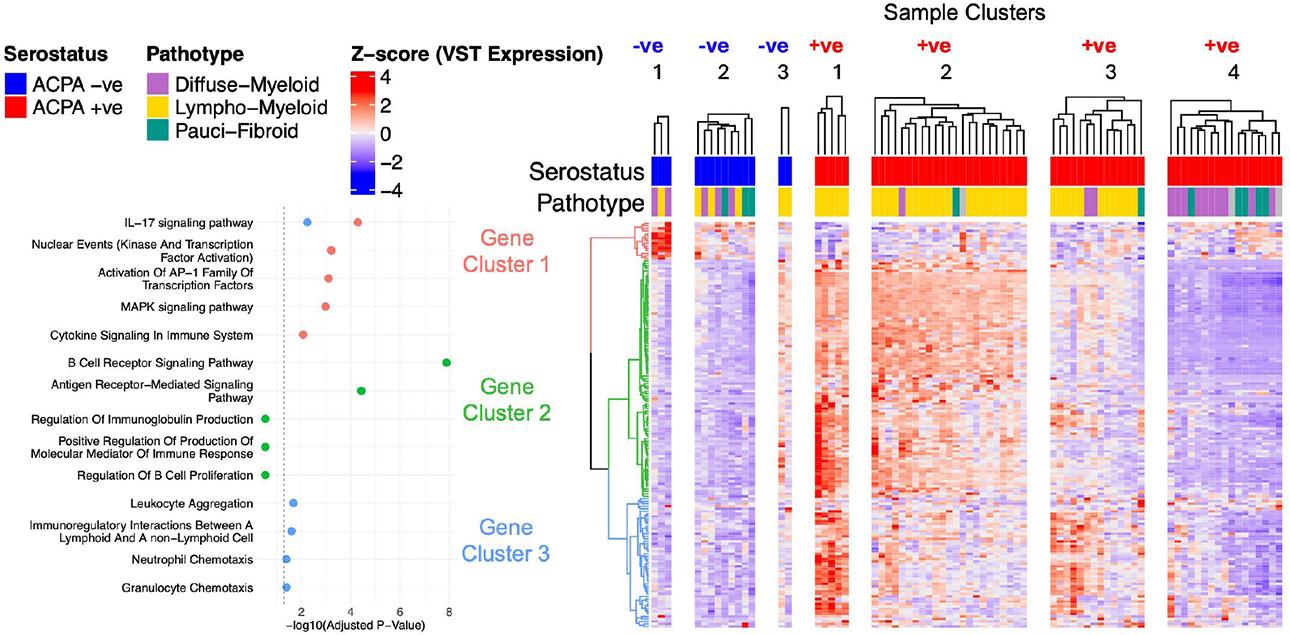
Results: Clinically, ACPA-negative patients (n=76) presented with higher swollen and tender joint counts at diagnosis compared to ACPA-positive patients (n= 139). This pattern persisted after stratification by synovial pathotype, although differences did not reach statistical significance. The distribution of synovial histological pathotypes did not differ significantly between ACPA-positive (n=125) and ACPA-negative patients (n=65). Differential gene expression analysis of synovial bulk RNA-sequencing identified 146 genes significantly upregulated in ACPA-positive RA (n=59) and 16 genes upregulated in ACPA-negative RA (n=14). Functional enrichment analysis demonstrated enrichment of B-cell Receptor and antigen receptor-mediated signalling pathways in ACPA-positive synovium. In contrast, ACPA-negative patients showed enrichment of IL-17 signalling, activation of AP-1 family transcription factors and MAPK signalling pathways. Hierarchical clustering of differentially expressed genes identified three major gene clusters associated with distinct immune pathways. Stratification of patients by ACPA-status revealed molecular heterogeneity within both groups, with three subgroups among ACPA-negative and four among ACPA-positive patients (see Figure 1).
Conclusions: Transcriptomic-based clustering reveals distinct immune pathways and molecular subgroups in ACPA-negative and ACPA-positive RA that are not captured by clinical or histological features. Synovial molecular endotype-driven patient stratification may facilitate the optimization of targeted therapies.
Synovial transcriptomic clustering reveals subgroups within ACPA-negative and ACPA-positive rheumatoid arthritis. Differentially expressed genes define pathway-associated patterns across disease categories.
REFERENCES: [1] Humby F, Lewis M, Ramamoorthi N, Hackney JA, Barnes MR, Bombardieri M, et al. Synovial cellular and molecular signatures stratify clinical response to csDMARD therapy and predict radiographic progression in early rheumatoid arthritis patients. Ann Rheum Dis. 2019 June;78(6):761–72.
Acknowledgments: NIL.
Disclosure of Interests: None declared.