fetching data ... 
Background: Rheumatoid arthritis (RA) is an autoimmune disease mainly defined by persistent synovial inflammation. Despite various treatment strategies of high effectivity, such as biologic (b) and targeted synthetic (ts) disease-modifying antirheumatic drugs (DMARDs), about 5-15% of RA patients do not achieve predefined therapeutic goals and remain symptomatic. This can lead to progressive joint destruction as well as systemic inflammation. These patients are then considered ’difficult-to-treat RA’ (D2T RA)[1].
Objectives: Our aim was to profile the plasma proteome in RA patients and identify candidate protein markers associated with D2T RA in patients.
Methods: The proteome-profiling cohort consisted of 99 RA patients treated with b/ts DMARDs, out of which 52 fulfilled the EULAR criteria for D2T RA and 47 were in sustained remission. Plasma samples were obtained from the biobank at the Institute of Rheumatology, Prague. We quantified 270 proteins in patient plasma samples collected at baseline (on average 2.2 years before fulfilling D2T criteria or at least 12 weeks after entering sustained remission) using liquid chromatography coupled with mass-spectrometry (LC-MS). Linear regression models were employed to evaluate the association between quantified plasma proteins and the D2T status as well as their predictive potential. Four candidate markers were chosen and validated using ELISA on a cohort of 106 patients (51 with D2T RA and 55 in sustained remission). The association with D2T RA development and predictive potential of the validated proteins were assessed.
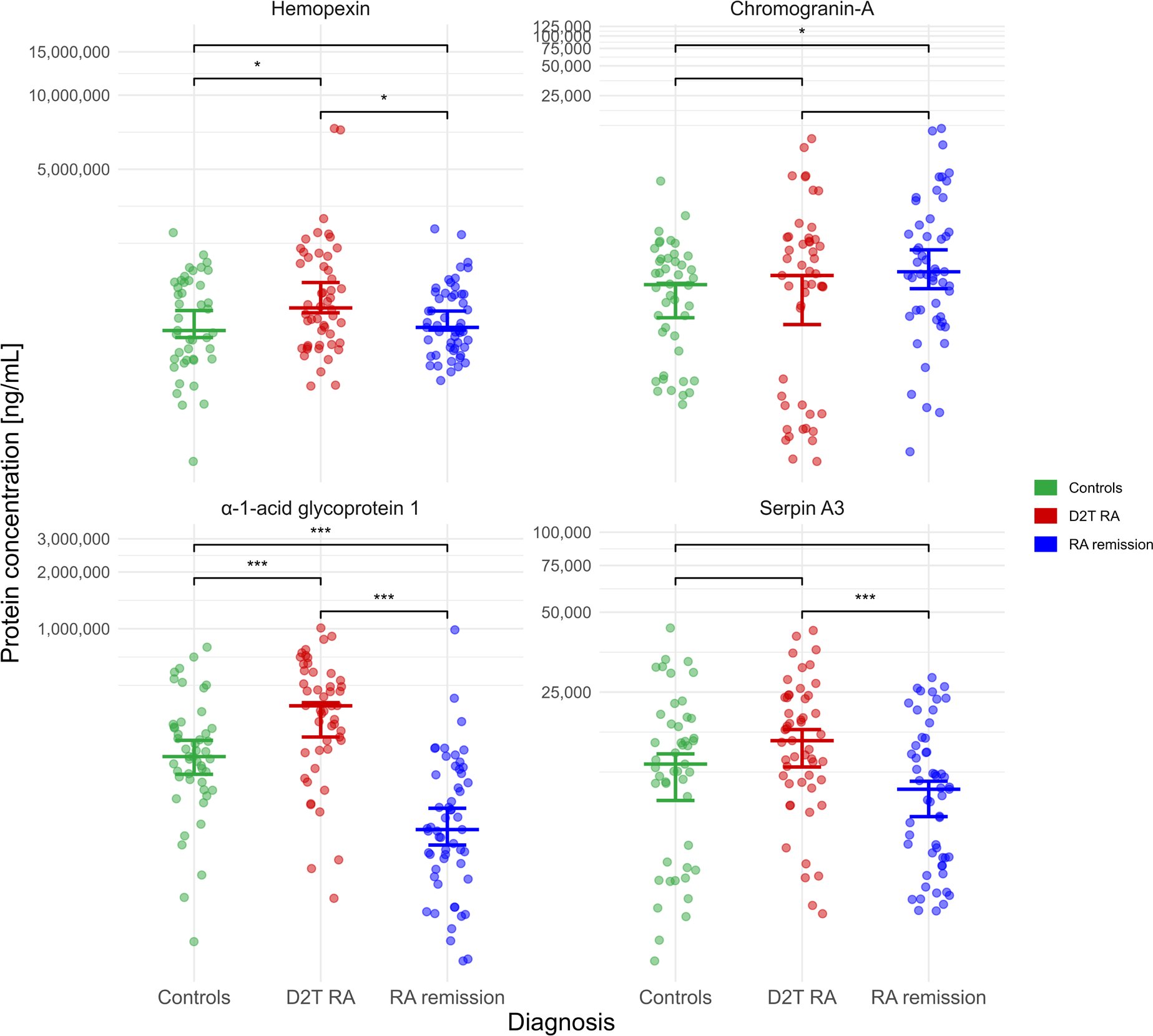
Results: The proteomic profiling showed a total of 222 detectable proteins and indicated 12 candidates associated with D2T RA in patients (p-value < 0.05, omega2 > 0.06). We chose four of them for validation and confirmed the association for three, which were all upregulated in D2T RA compared to remission: α-1-acid glycoprotein (3.25-fold), hemopexin (1.45-fold), and serpin A3 (1.51-fold). All of them have been previously linked to RA or D2T RA [2-7].
Conclusions: We profiled the plasma proteome of patients before they fulfilled D2T criteria or achieved sustained remission. Thanks to this profile, we identified and validated three candidate plasma markers associated with the D2T RA in patients and with potential predictive ability for D2T RA development.
Four validated candidate biomarkers associated with the development of D2T RA in patients. The error bars represent 95% confidence intervals with the median calculated by the bootstrap method with 50,000 simulations for patients with the D2T status or in sustained remission.
REFERENCES: [1] Nagy G, Roodenrijs NMT, Welsing PMJ, et al. EULAR definition of difficult-to-treat rheumatoid arthritis. Ann Rheum Dis . 2021;80(1):31-35. doi:10.1136/ANNRHEUMDIS-2020-217344
[2] Masood A, Benabdelkamel H, Alfadda AA, Alarfaj AS, Fallata A, Joy SS, Al Mogren M, Rahman AMA, Siaj M. Proteomic Profiling Reveals Novel Molecular Insights into Dysregulated Proteins in Established Cases of Rheumatoid Arthritis. Proteomes. 2025 Jul 4;13(3):32. doi: 10.3390/proteomes13030032.
[3] Sidiras P, Lechanteur J, Imbault V, Sokolova T, Durez P, Gangji V, Communi D, Rasschaert J. Human carbamylome description identifies carbamylated α2-macroglobulin and hemopexin as two novel autoantigens in early rheumatoid arthritis. Rheumatology (Oxford). 2022 Jul 6;61(7):2826-2834. doi: 10.1093/rheumatology/keab838.
[4] Di Comite G, Rossi CM, Marinosci A, Lolmede K, Baldissera E, Aiello P, Mueller RB, Herrmann M, Voll RE, Rovere-Querini P, Sabbadini MG, Corti A, Manfredi AA. Circulating chromogranin A reveals extra-articular involvement in patients with rheumatoid arthritis and curbs TNF-alpha-elicited endothelial activation. J Leukoc Biol. 2009 Jan;85(1):81-7. doi: 10.1189/jlb.0608358.
[5] Khulood Alotaibi, Alaa Mufawwaz, Mona Alharbi, Jehan Alrahimi, Fatemah Basingab and Safiah Alhazmi (2022) “The Role of Alpha-1-acid Glycoprotein 2 Protein and the Underlying Orosomucoid 2 Gene in Different Diseases”, Journal of Pharmaceutical Research International, 34(20A), pp. 15–29. doi: 10.9734/jpri/2022/v34i20A35821.
[6] Hrycaj P, Sobieska M, Mackiewicz S, Müller W. Microheterogeneity of alpha 1 acid glycoprotein in rheumatoid arthritis: dependent on disease duration? Ann Rheum Dis. 1993 Feb;52(2):138-41. doi: 10.1136/ard.52.2.138.
[7] Kosaka S, Tazawa M. Alpha1-antichymotrypsin in rheumatoid arthritis. Tohoku J Exp Med. 1976 Aug;119(4):369-75. doi: 10.1620/tjem.119.369.
Acknowledgments: NIL.
Disclosure of Interests: None declared.