fetching data ... 
Background: RA patients often experience persistent pain despite adequate control of inflammation, indicating a contribution of central sensitization and impaired descending inhibitory pathways. Transcranial direct current stimulation (tDCS) is a non-invasive neuromodulation technique that modulates central and peripheral mechanisms involved in nociceptive processing.
Objectives: Evaluate the effects of tDCS on nociceptive and neuroinflammatory outcomes in mice with collagen-induced arthritis (CIA) model.
Methods: Thirty male DBA/1J mice were randomized into four groups (n=6/8): control(CO), CIA+sham tDCS(CIAS), CIA+active tDCS(CIAT), and CIA+anesthesia (CIAA). Arthritis was induced by injecting bovine type II collagen (CII) and CFA on day zero, followed by a booster 18 days later using CII and IFA. Animals received either treatment with sham or active tDCS (0.5 mA, 1 Hz), daily from day 30 to day 40 post-arthritis induction, for 15 minutes, under 2% vaporized isoflurane anesthesia. Body weight, clinical arthritis score, locomotor activity, rearing and jumping behaviors (Open Field Test-OFT), and mechanical nociceptive threshold (Von Frey test-VFT) were assessed repeatedly throughout 45 days. Data were analyzed using repeated-measures ANOVA, Tukey’s post hoc test, and Spearman correlation (p<0.05). Approved by the animal ethics committee (nº2023.0484).
Results: CIAS animals exhibited a significant reduction in body weight compared with the CO at D40 (p=0.018). CIA animals exhibited higher arthritis scores throughout the experiment (p=0.0001). When treatment groups were analyzed, increased arthritis scores were observed in CIAT vs CO at D35 (p=0.036) and D40 (p=0.026), and CIAS vs CO at D40 (p=0.030) and D45(p=0.025). Mechanical nociceptive thresholds were similar at baseline and progressively worsened with disease progression, were significantly reduced in CIAA animals at D35 (p=0.012) and D42 (p=0.010) compared with CO, while CIAS animals also exhibited reduced thresholds at D42 (p=0.010). Lower mechanical nociceptive threshold represents increased nociceptive response. Significant negative correlations were identified between arthritis scores and mechanical nociceptive thresholds at multiple time points (Table 1). VFT at D42 correlated with rearing (rho=0.493, p=0.012) and jumping behaviors (rho=0.541,p=0.005) at D40. Serum TNF-α levels correlated with arthritis scores at D45.
Conclusions: This partial data study demonstrates that tDCS, when applied during the early stages of the disease, does not influence the arthritis score and might have some impact on the hypernociceptive severity in these animals.
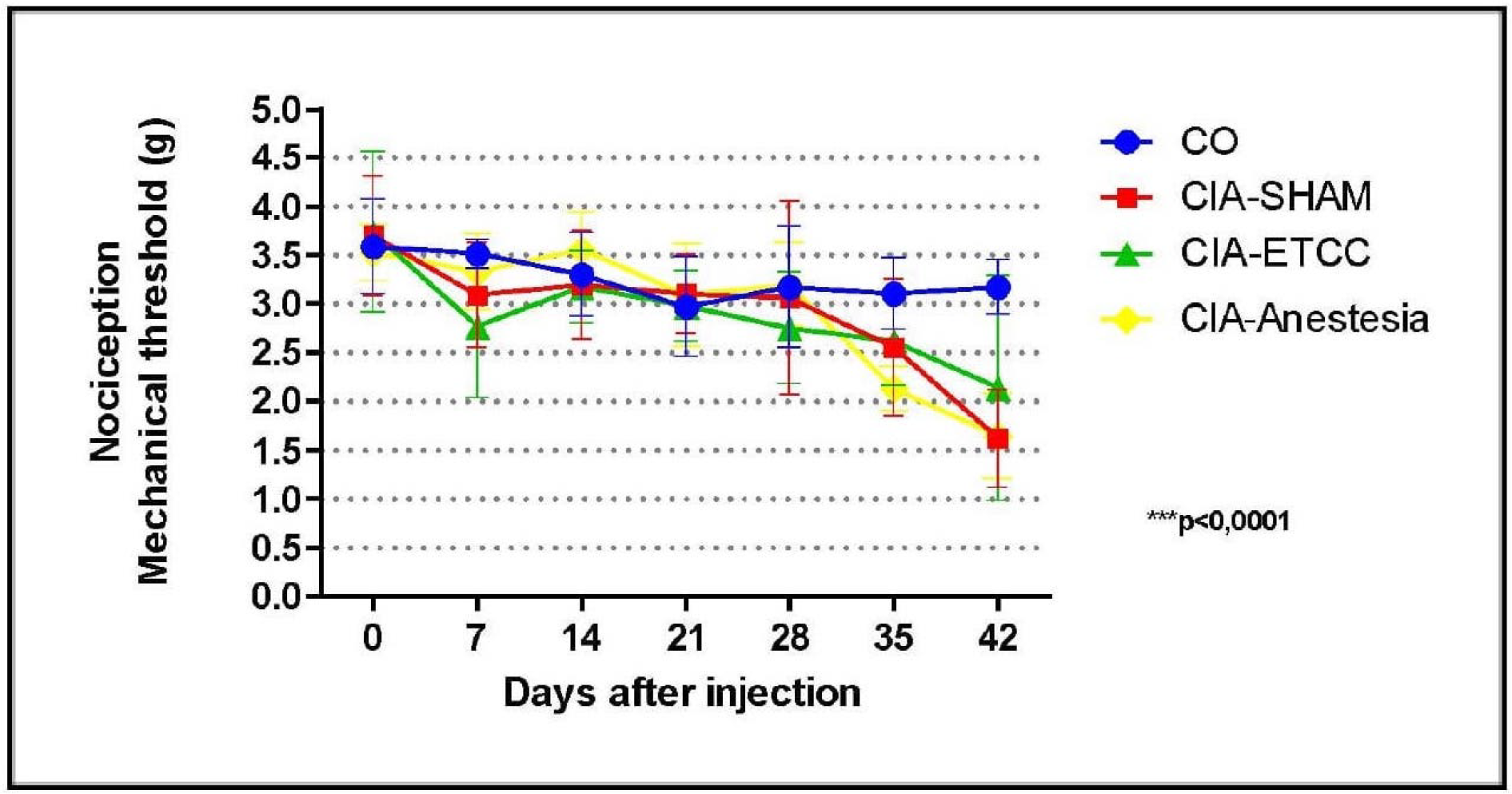
Correlations between arthritis clinical score, mechanical nociceptive threshold (Von Frey Test), and behavioral parameters.
| Variable 1 (Day) | Variable 2 (Day) | Spearman’s rho (ρ) | p value |
|---|---|---|---|
| Arthritis score (D25) | Von Frey Test (D21) | −0.481 | 0.008 |
| Arthritis score (D30) | Von Frey Test (D28) | −0.457 | 0.013 |
| Arthritis score (D35) | Von Frey Test (D35) | −0.513 | 0.009 |
| Arthritis score (D40) | Von Frey Test (D35) | −0.473 | 0.017 |
| Arthritis score (D40) | Von Frey Test (D42) | −0.628 | 0.001 |
| Arthritis score (D45) | Von Frey Test (D42) | −0.641 | 0.001 |
| Von Frey Test (D42) | Rearings (D40) | 0.493 | 0.012 |
| Von Frey Test (D42) | Jumps (D40) | 0.541 | 0.005 |
| Serum TNF-α (D45) | Arthritis score (D45) | 0.412 | 0.046 |
REFERENCES: NIL.
Acknowledgments: NIL.
Disclosure of Interests: None declared.