fetching data ... 
Background: Rheumatoid arthritis (RA) is genetically complex and clinically heterogeneous. Although RA susceptibility arises from multiple biological pathways, it remains unclear to what extent RA shares genetic architecture with related traits such as body mass index (BMI), C-reactive protein (CRP), and osteoarthritis (OA). These traits reflect key biological axes—metabolic status, systemic inflammation, and joint structure—that are likely to influence variation in RA disease manifestations. Identifying shared genetic architecture across these phenotypes could therefore help decompose RA risk into biologically meaningful components, offering insight into mechanisms underlying disease heterogeneity. However, this hypothesis has not been systematically explored.
Objectives: To characterize shared genetic architecture between RA and BMI, CRP, and OA using linkage disequilibrium (LD)-based overlap analysis, and to define biologically informed genetic partitions that highlight distinct RA-relevant mechanisms.
Methods: We examined 122 autosomal genome-wide significant RA loci and assessed linkage disequilibrium (LD; r 2 > 0.1) between RA index variants and suggestive variants from large-scale BMI, CRP, and OA genome-wide association studies. GWAS summary statistics were derived from the largest and most recent studies available at the time of analysis. For each RA index variant, overlapping variants in LD were aggregated into locus-level LD blocks, which served as the unit of analysis. RA loci were classified as RA-only or as overlapping with BMI, CRP, OA, or multiple traits, and overlap patterns were summarized at the LD-block level. For biological interpretation, candidate genes were assigned based on reported annotations from the original RA GWAS and established locus definitions. Pathway and functional labels were derived using an integrative approach combining curated literature review and established gene annotation resources, including Gene Ontology, Reactome, and KEGG. In addition, exploratory functional and tissue enrichment analyses using Functional Mapping and Annotation of Genome-Wide Association Studies (FUMA) were performed to assess consistency with known biological themes. Together, these complementary sources were used to support the most plausible and relevant biological pathways within each genetic partition, while acknowledging the exploratory nature of pathway assignment.
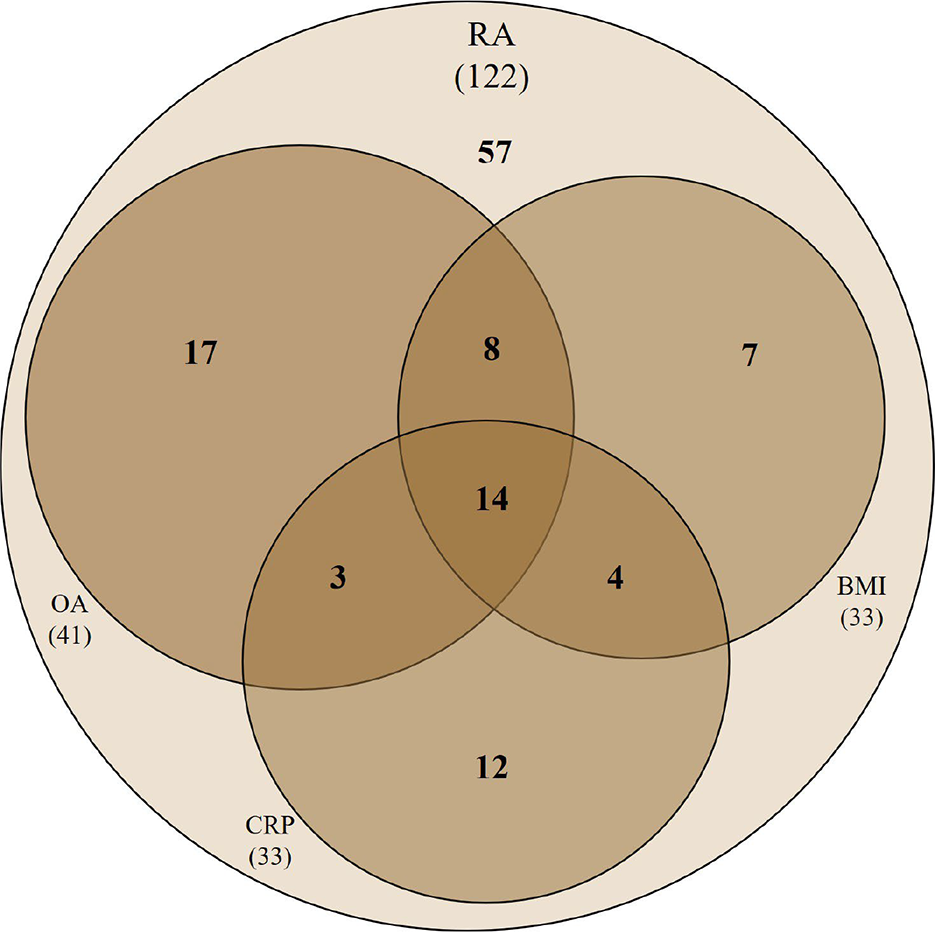
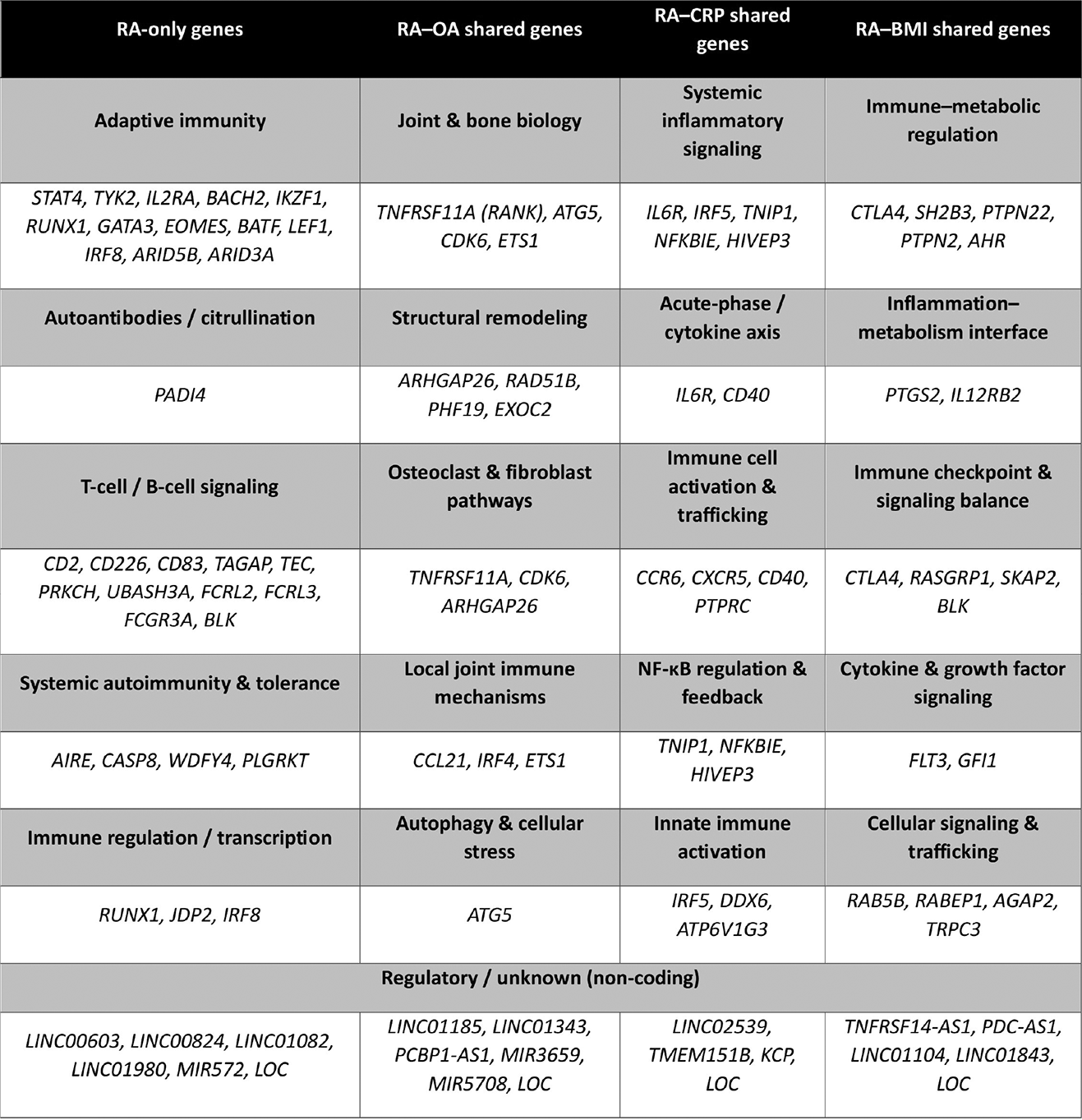
Results: Across 122 RA LD blocks, 57 were RA-only, 7 overlapped with BMI, 12 with CRP, 17 with OA, and 29 overlapped with two or more traits. RA-only loci were enriched for canonical autoimmune pathways, including antigen presentation, T-cell differentiation, and immune tolerance (e.g. PADI4, STAT4, TYK2, IL2RA), consistent with core RA autoimmunity. RA–CRP overlapping loci showed coherent enrichment for systemic inflammatory signalling, including the IL-6/acute-phase axis and NF-κB regulatory pathways (e.g. IL6R, TNIP1, NFKBIE, IRF5), alongside genes involved in immune cell activation and trafficking (e.g. CCR6, CXCR5, CD40), consistent with genetic contributions to inflammatory burden. RA–BMI shared loci highlighted immune–metabolic regulatory pathways (e.g. CTLA4, PTPN22, SH2B3, AHR). Importantly, a subset of RA–OA overlapping loci showed no concurrent overlap with BMI or CRP and included genes implicated in bone remodelling, osteoclast biology, and joint-specific immune–stromal interactions (e.g. TNFRSF11A, CCL21, ATG5
Conclusions: LD-based partitioning of RA genetic architecture reveals biologically distinct components corresponding to autoimmune susceptibility, systemic inflammatory burden, immune–metabolic regulation, and joint-specific structural mechanisms. In particular, the RA–CRP genetic component is enriched for pathways related to inflammatory signalling and immune cell mobilisation, whereas RA–OA shared loci highlight genetic regions linked to joint-focused structural biology. By systematically mapping LD-based overlap between RA loci and related phenotypes, this study provides a biologically informed, descriptive framework that highlights patterns consistent with distinct genetic contributions to RA heterogeneity. These genetic partitions offer a foundation for future analyses integrating patient-level data to test whether pathway-informed risk stratification can help distinguish RA disease profiles.
Overlap of rheumatoid arthritis (RA)–associated LD blocks with BMI, osteoarthritis (OA), and C-reactive protein (CRP). The Venn diagram shows the number of RA LD blocks overlapping loci associated with BMI, OA, and CRP, individually or in combination. Numbers represent RA LD blocks overlapping a given trait or shared between traits. A total of 14 RA LD blocks overlap all three phenotypes, while additional blocks show pairwise or single-trait overlap, highlighting distinct patterns of shared genetic architecture.
Genes are grouped according to their dominant reported biological roles based on prior functional and genetic studies. Assignment reflects primary pathways rather than exclusive functions. Several loci, particularly non-coding regions, remain incompletely characterised and are labelled as regulatory or unknown.
REFERENCES: NIL.
Acknowledgments: NIL.
Disclosure of Interests: None declared.