fetching data ... 
Background: Herpes zoster is a common adverse event in rheumatoid arthritis (RA) patients treated with Janus kinase (JAK) inhibitors, particularly in Japanese populations. Although the adjuvanted recombinant zoster vaccine (RZV) is effective in older adults, its immunogenicity and safety in RA patients treated with upadacitinib remain unclear.
Objectives: This study aimed to evaluate the immunogenicity and safety of RZV in Japanese patients with RA treated with methotrexate (MTX), upadacitinib, or their combination.
Methods: In this single-center, prospective, parallel triple-arm study, a total of 69 patients (23 per group) aged ≥50 years were enrolled. All patients had been receiving a stable dose of either methotrexate (MTX) monotherapy (6–12 mg/week; Group 1), upadacitinib monotherapy (15 mg/day; Group 2), or a combination of MTX and upadacitinib (Group 3) for at least one month prior to study entry. Each participant received two doses of RZV administered at 8-week intervals. The primary endpoint was the proportion of patients who achieved a ≥4-fold increase in anti-glycoprotein E (gE) antibody titers four weeks after the second dose. Secondary endpoints included changes in gE-specific CD4 + T cell responses, the incidence of RA flares, RA disease activity, and adverse events. The clinical characteristics of patients were compared using the Kruskal–Wallis non-parametric test for continuous variables and Pearson’s Chi-squared test or Fisher’s exact test for categorical variables as appropriate.
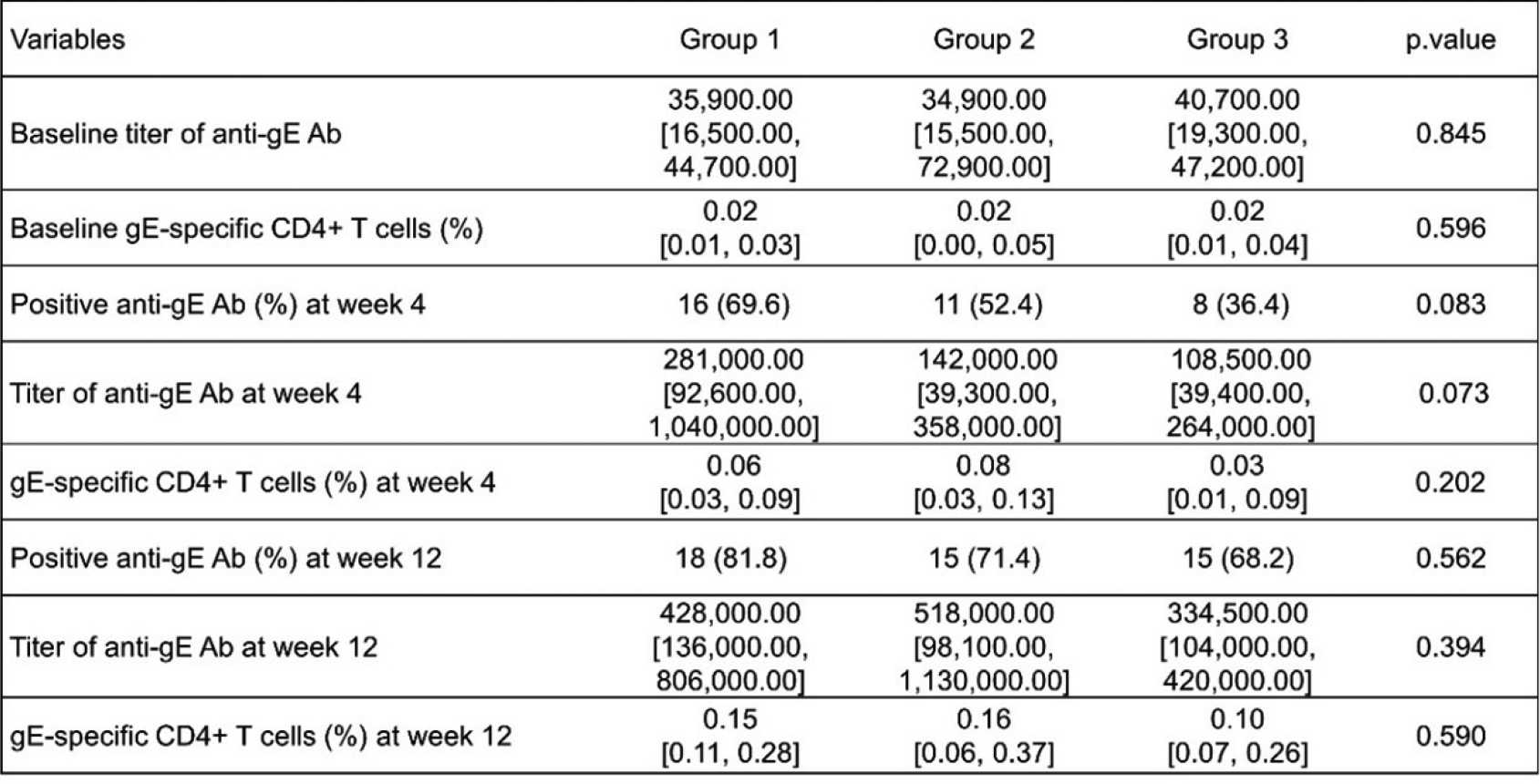
Results: Age, sex, disease duration, and seropositivity were balanced across the three groups (Table 1). Baseline levels of anti-gE antibodies and gE-specific CD4 + T cells were also comparable (Table 2). At Week 4 following the first RZV dose, the proportion of patients with a positive anti-gE antibody response was numerically lower in Group 3 compared with Groups 1 and 2 (69.6% in Group 1, 52.4% in Group 2, and 36.4% in Group 3; p =0.083). By Week 4 after the second dose, response rates increased to 81.8%, 71.4%, and 68.2% in Groups 1, 2, and 3, respectively ( p =0.56). Parallel increases in gE-specific CD4 + T cells were observed at both time points, with no significant differences between groups (p=0.20, p=0.59, respectively). RA flares occurred in 6 patients (26.1%) in Group 1 and in 2 patients (8.7%) each in Groups 2 and 3 ( p =0.19). Despite these flares, RA disease activity, as measured by DAS28-CRP, remained stable throughout the study in all groups, with no significant between-group differences at any assessed time point. Adverse events occurred in 15 patients (65.2%) in Group 1, 7 patients (30.4%) in Group 2, and 14 patients (60.9%) in Group 3 ( p =0.036).
Conclusions: Two doses of RZV induced robust humoral and cellular immune responses in Japanese RA patients receiving MTX, upadacitinib, or their combination. No unexpected safety signals were observed. These findings support the use of RZV in RA patients treated with upadacitinib in Japan.
Table 1. Demographics of enrolled patients in each group.
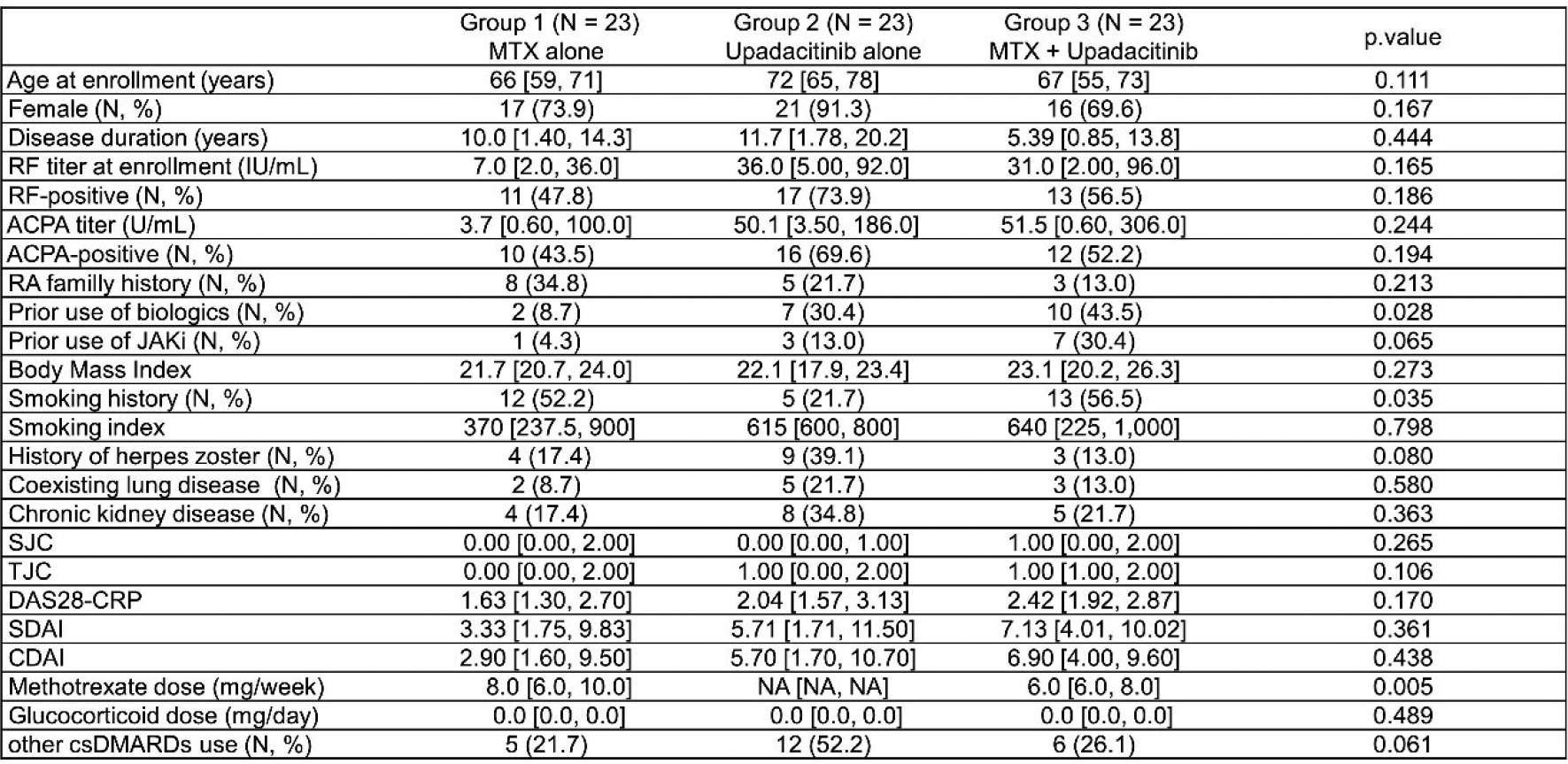
Table 2. Immunogenicity tests.
REFERENCES: [1] Lal H, et al. N Engl J Med. 2015;372:2087-2096.
[2] Cunningham AL, et al. N Engl J Med. 2016;375:1019-1032.
[3] Winthrop KL, et al. Ann Rheum Dis.2022;81:206-213.
[4] Winthrop KL, et al. RMD Open 2025;11:e005521.
[5] Kojima S, et al. RMD Open 2024;10:e003902.
[6] Watanabe R, et al. J Clin Med. 2024 Dec 2;13:7321.
[7] Ishihara R, et al. Biomolecules 2024;14:739.
Acknowledgments: NIL.
Disclosure of Interests: Ryu Watanabe AbbVie GK and GlaxoSmithKline, AbbVie GK, Tadashi Okano AbbVie GK, Shinsuke Yamada: None declared, Ryota Kawai: None declared, Hisako Yoshida: None declared, Hisako Fujii: None declared, Yuki Furusawa an employee of AbbVie GK and may own stocks or options relevant to the company, Ryuhei Ishihara: None declared, Masao Katsushima: None declared, Kazuo Fukumoto: None declared, Yutaro Yamada: None declared, Kenji Mamoto: None declared, Motomu Hashimoto Mitsubishi Tanabe Pharma Corporation.