fetching data ... 
Background: Rheumatoid Arthritis (RA) is characterized by variable clinical manifestations and responses to therapies. Accordingly, a non-negligible proportion of patients experience refractory disease, while others achieve sustained remission with first-line biological Disease-Modifying Anti-Rheumatic Drug (bDMARD) therapy, typically an anti-Tumor Necrosis Factor (anti-TNF). However, the molecular mechanisms underlying RA pathogenesis and therapeutic response still remain unresolved. Nevertheless, such heterogeneities cannot be fully resolved at the mechanistic level by a sole evaluation of clinical features, without being accompanied by in vivo investigations of the gene expression programs’ establishment.
Objectives: To assess the gene expression programs’ establishment and address the commitment of Differentially Expressed Genes (DEGs) in RA-remission or treatment-resistant patients. To characterize the assembly of alternative transcriptomes, apart from those encoded by protein-coding genes, composed of RA-stimulated Differentially Transcribed Transposable Elements (DTTEs). To identify remission- or resistance-specific molecular & cellular signatures.
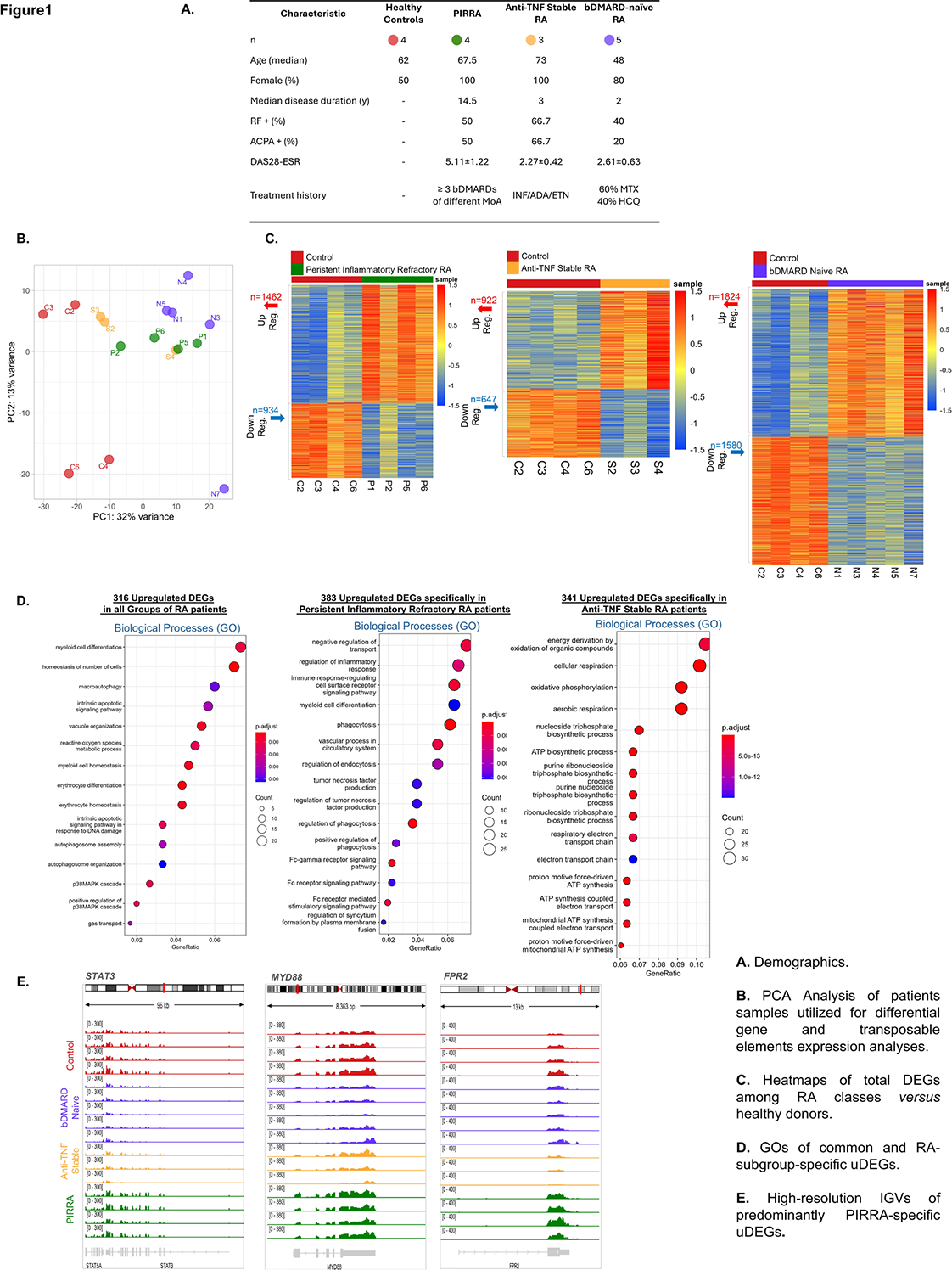
Methods: Study approval:1. Scientific Council of LAIKO General Hospital of Athens 2. Bioethics Committee of the Biomedical Research Foundation, Academy of Athens (BRFAA). Supported by a Research Grant from the Greek Rheumatology Society and the Professional Association of Rheumatologists. 6 mL of peripheral whole blood was collected in EDTA tubes from each of the 16 participants (Figure 1A ). RA-Patients were classified as: P ersistent I nflammatory R efractory RA ( PIRRA , n=4), first Anti - TNF - st able RA (Anti-TNF-st., n=3 ), b DMARD - n aïve RA ( bn RA, n=5). Samples from healthy controls (n=4) were also examined. Whole-blood N ext- G eneration R NA- s equencing (NGS RNA-seq) was performed at BRFAA Greek Genome Center on NovaSeq 6000 Illumina sequencer. The Raw NGS Reads (fastq file) were processed as in [1], PCA using DESEQ2, G ene O ntology enrichment analyse s (GOs ) using the clusterProfiler R package, and DTTEs’ investigation were performed as described in [1]. High-resolution visualization of transcriptomic signals is depicted by Integrative Genomics Viewer analyses (IGVs). Transcriptional changes are illustrated with RNA-seq heatmaps by pheatmap R package. 1
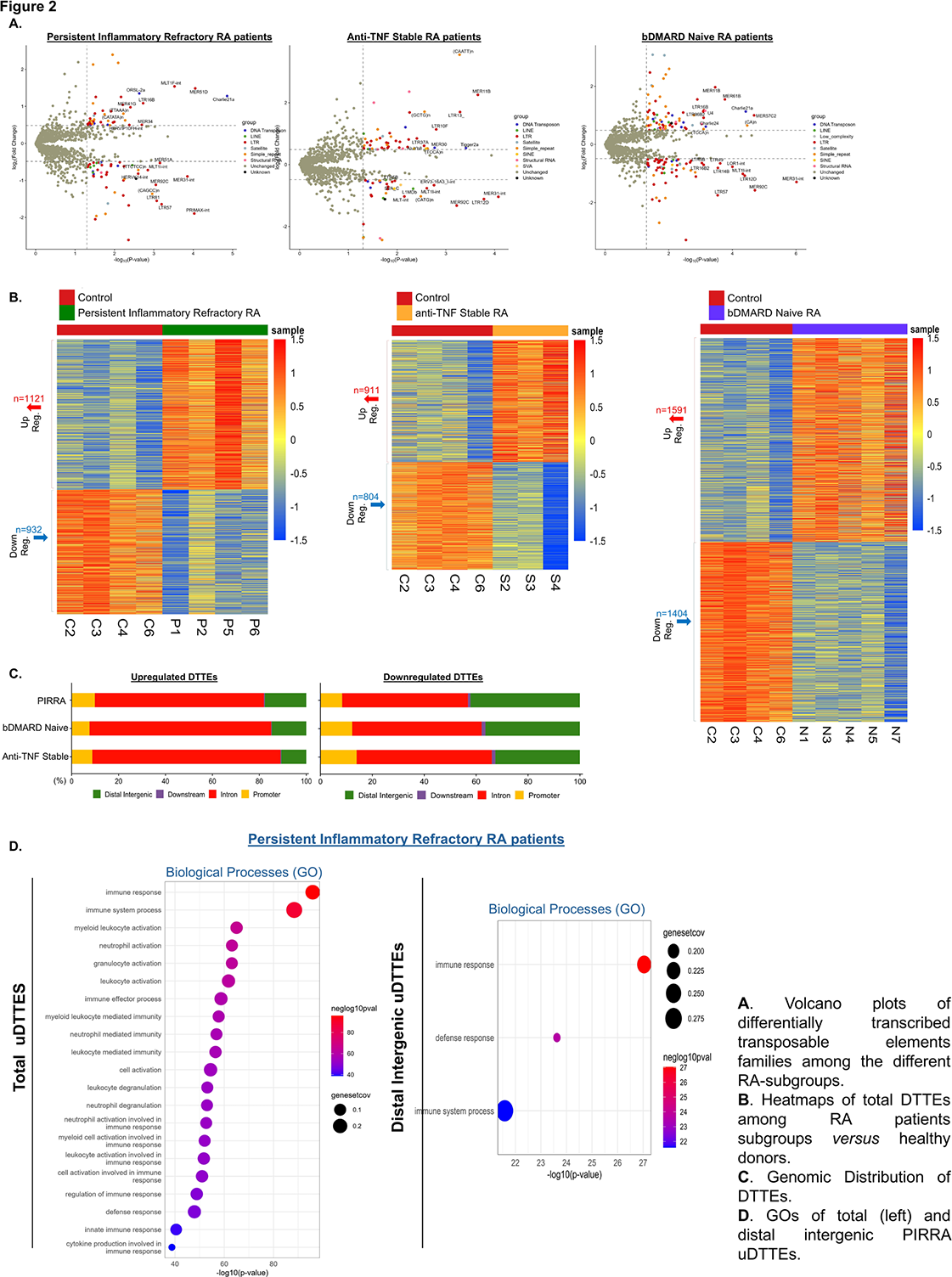
Results: Gene expression programs exchange during the transition from naïve-to-autoimmune cellular states. RNA-seq datasets unveiled alternative gene expression programs establishment during the transition from naïve-to-autoimmune states and they also distinguished a wealth of (↑)up- or (↓)down-regulated genes (uDEGs, dDEGs), compared to controls, amongst RA-patients classes (PIRRA: > 1,400 ↑, > 900↓; Anti-TNF-st. RA: >900↑ and >600↓; bn RA: >1,800↑and 1580↓). Interestingly, >300 uDEGs are common across all classes and according to GOs, among others, exhibit remarkable specificity for myeloid differentiation. In addition, hundreds of uDEGs assemble RA-class-specific profiles. For instance, GOs applied to PIRRA-total-uDEGs highlight innate and adaptive immune responses, while PIRRA-specific-uDEGs are mostly related to cellular pathways engaged with TNF production and Fc-receptor signaling. These findings suggest a PIRRA-characteristic, treatment-resistant inflammatory transcriptional state. In contrast, Anti-TNF-st.-specific-uDEGs are linked to metabolic processes, including cellular respiration, oxidative phosphorylation, and mitochondrial ATP synthesis, while nearly lacking inflammatory pathways; an observation signifying effective remission with anti-TNF. Intriguingly, bn-RA-specific-uDEGs nearly abolish any statistically significant ontologies. Strikingly, mainly in PIRRA patients, uDEGs encoding MYD88, STAT3, and mitochondrial DAMP sensors (NLRP3, FPR1, FPR2) were highly activated, suggesting that mitochondrial stress may cooperate to sustain the refractory state. In addition, Anti-TNF-st.-specific-uDEGs include metabolic hallmarks, such as NDUFA3 (NADH dehydrogenase) and ATP5ME (ATP Synthase Membrane Subunit E). Accordingly, metabolic rewiring/switching is underscored as a new era in RA autoimmunity. These findings (Figure 1B-E) suggest that the divergence in RA phenotypes relies on a distinct gene expression regulatory foundation. Mapping and characterization of DTTEs that shape alternative transcriptomes in RA-patients Given the emerging roles of TEs-composed alternative transcriptomes in homeostasis regulation, disease pathogenesis, and response to exogenous stress (e.g., chemotherapies, viral infections), we identified more than >900 upregulated DTTEs in each class. Regardless of the RA-class, those TEs exhibit remarkable specificity (GOs) for RA-associated immunophenotypes. Of those, ~150 are common between the RA classes and are linked to leukocyte and myeloid activation, immune effector processes, etc. Importantly, analyses exclusively applied to intergenic uDTTEs’ copies (that reside across genomic coordinates far from genes) revealed that they exhibit substantial specificity for immune system processes, only in PIRRA patients, but not in Anti-TNF-st or bn RA patients (Figure 2). This pattern underscores that the evolution of the PIRRA phenotype is hardwired into human DNA, both within and outside genomic loci that host protein-coding genes, and relies on in vivo functional regulatory mechanisms rather than random transcriptional cellular responses. Since PIRRA exhibits the most severe phenotype, these findings open new avenues for investigating RA phenotype variability via TEs function.
Conclusions: Distinct gene-expression programs drive heterogeneity in RA treatment response. PIRRA immunophenotype links to highly specific transcriptomes encoded by genes and TEs, while anti-TNF remission is featured by a unique metabolic rewiring signature, revealing novel determinants of the RA phenotype and potential targets for personalized therapies.
REFERENCES: [1] Koutsi, Pouliou, […], Agelopoulos, Nucleic Acids Res , 2025 Correspondence: magelo@bioacademy.gr, pvlah@med.uoa.gr
Acknowledgments: NIL.
Disclosure of Interests: None declared.