fetching data ... 
Background: The recombinant zoster vaccine (RZV) is effective in preventing herpes zoster, but some patients with rheumatoid arthritis (RA) experience disease flare after vaccination. The End Zoster-J Study was a prospective, parallel, triple-arm trial evaluating the immunogenicity and safety of RZV in RA patients treated with methotrexate (MTX), upadacitinib (UPA), or their combination. In the study, post-RZV RA flares occurred in 14.5% of patients overall and tended to be less frequent in UPA-treated patients (26.1% in MTX group, 8.7% in UPA group, and 8.7% in MTX+UPA group). However, the baseline molecular signatures predisposing to post-RZV flare remain unknown.
Objectives: This study aimed to characterize baseline transcriptomic profiles associated with RA flares after RZV.
Methods: Patients receiving stable MTX (6–12 mg/week, n=17), upadacitinib (15 mg/day, n=16), or their combination (n=16) received two doses of RZV at 8-week intervals. Peripheral blood mononuclear cells (PBMC) were collected before vaccination and after the first and second doses for bulk RNA sequencing. Patients were classified according to RA flare during follow-up (future flare Yes n=6, No n=43). Raw RNA-seq counts were processed in R with edgeR and limma: lowly expressed genes were filtered, libraries were normalized by trimmed mean of M-values, and log 2 counts per million with precision weights were obtained using voom. Gene-level differential expression for future flare was tested with linear models and empirical Bayes moderation, adjusting for treatment group, sex, and age; p values were corrected using the Benjamini–Hochberg false discovery rate (FDR), with FDR<0.05 considered significant and FDR<0.10 exploratory. Pathway-level changes were assessed by preranked gene set enrichment analysis using Hallmark gene sets and gene-wise t statistics as the ranking metric; pathways with FDR<0.10 were retained.
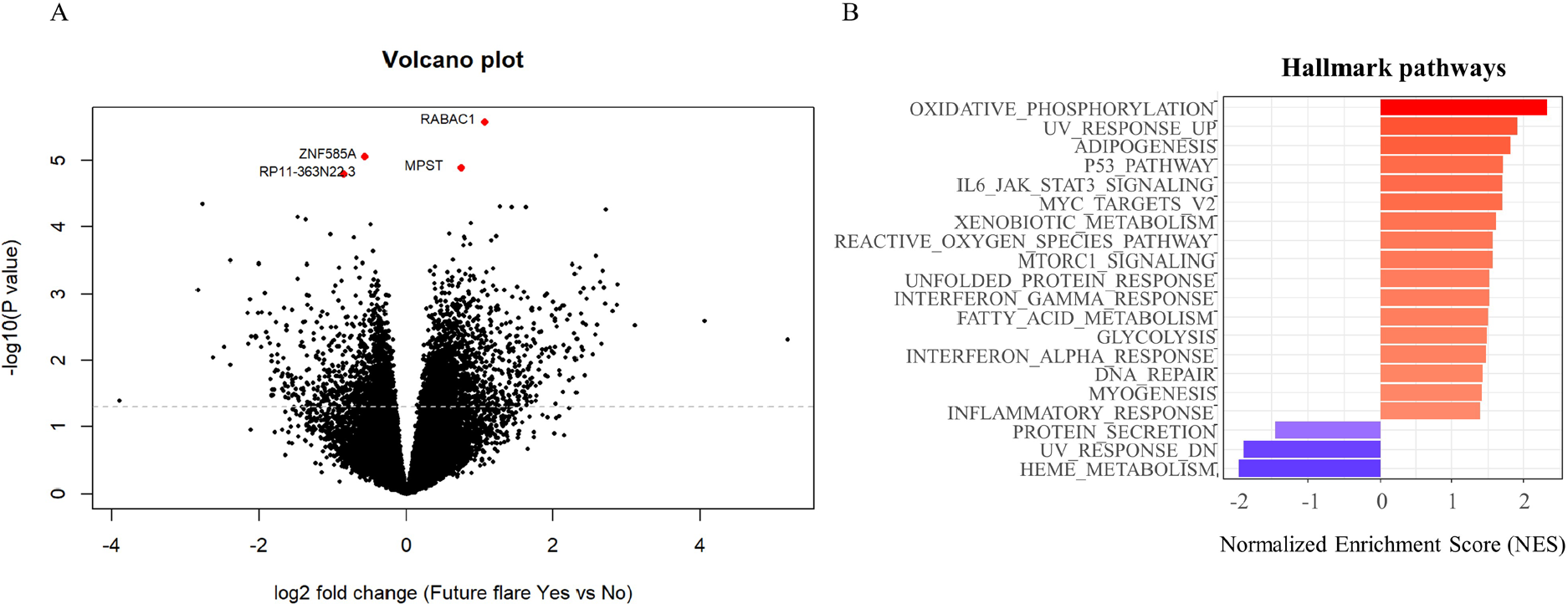
Results: Using an exploratory FDR<0.10 cutoff, four genes showed nominal associations: RABAC1 and MPST were upregulated at baseline in patients who later flared, whereas ZNF585A and the non-coding transcript RP11-363N22.3 were downregulated (Figure 1A). However, no transcript met the FDR<0.05 threshold for differential expression between patients who did and did not experience a future flare. In contrast, Hallmark pathway analysis revealed clearer baseline differences between groups. Patients who subsequently flared showed higher enrichment of IL-6-JAK-STAT3 signaling and interferon α and interferon γ response pathways, together with metabolic and stress-response pathways such as oxidative phosphorylation and reactive oxygen species pathway, while a heme metabolism–related signature was relatively depleted in the future flare group (Figure 1B).
Conclusions: In this transcriptomic study, baseline PBMC RNA-seq did not identify robust individual differentially expressed genes predicting post-vaccination flares. In contrast, Hallmark enrichment showed that patients who later flared already exhibited heightened IL-6/JAK–STAT and interferon signaling, metabolic stress pathways, and relatively lower heme metabolism at baseline. These findings suggest that post-RZV RA flares arise on a primed inflammatory and metabolically active immune background, and that pathway-level rather than single-gene signatures may be more informative for risk stratification.
Baseline PBMC differential expression and Hallmark pathway enrichment associated with future rheumatoid arthritis flare after recombinant zoster vaccination.
REFERENCES: [1] Liu G, et al. Hum Vaccin Immunother. 2025;21(1):2590257.
[2] Watanabe R, et al. J Clin Med. 2024;13(23).
Acknowledgments: NIL.
Disclosure of Interests: Ryuhei Ishihara: None declared, Ryu Watanabe AbbVie GK and GlaxoSmithKline, AbbVie GK, Tadashi Okano AbbVie GK, Shinsuke Yamada: None declared, Takeshi Iwasaki: None declared, Yuki Furusawa AbbVie GK, Masao Katsushima: None declared, Kazuo Fukumoto: None declared, Yutaro Yamada: None declared, Kenji Mamoto: None declared, Motomu Hashimoto Mitsubishi Tanabe Pharma Corporation