fetching data ... 
Background: RA is a chronic autoimmune disease characterized by persistent synovial inflammation and progressive joint damage. Fibroblast-like synoviocytes (FLS) play a central role in RA pathogenesis by sustaining inflammation and producing pro-inflammatory mediators. Interferon-β (IFN-β) displays potent immunomodulatory effects and strategies enabling its local expression in arthritic joints using non-viral gene delivery system might have a therapeutic role.
Objectives: To evaluate IFN-β expression induced by a non-viral vector–based gene delivery approach in RA-FLS in vitro and to investigate the effects of intra-articular IFN-β expression on inflammation and disease severity in the collagen-induced arthritis (CIA) murine model.
Methods: In vitro assays were performed using FLS isolated from synovial fluid of RA patients. Cell viability following treatment with a non-viral CRISPR–Cas9 delivery system was assessed by MTT assay (n=3). IFN-β secretion was quantified in culture supernatants by ELISA at 24 and 48 hours after treatment (n=3). In vivo, CIA was induced in mice by collagen immunization. Animals were assigned to healthy controls and CIA groups treated intra-articularly: control saline (n=4), control non-viral vector (n=3) and non-viral gene delivery system inducing IFN-β expression (n=5). Paw edema and clinical arthritis score were monitored longitudinally. At the experimental endpoint, joint tissues were collected for quantification of IFN-β levels by ELISA. Statistical analysis was performed using one-way ANOVA followed by Dunnett’s multiple comparisons test.
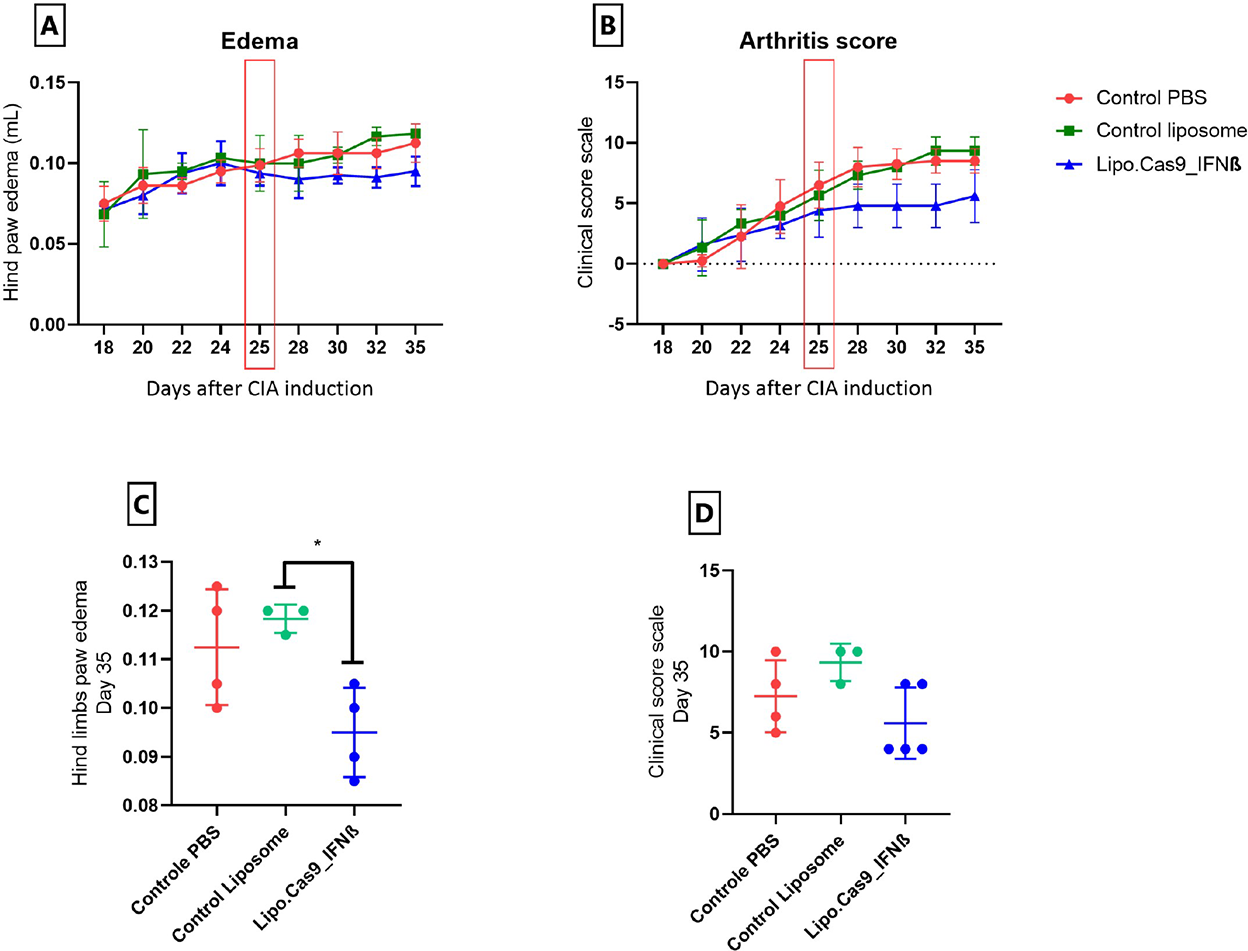
Results: In vitro, treatment with the non-viral vector preserved FLS viability (>70%) at all concentrations used for functional assays. Untreated cells and cells exposed to naked plasmids showed undetectable IFN-β secretion, whereas cells treated with the lipossomal complex exhibited significantly increased IFN-β secretion at 24 h (1.0 ± 0.0 vs 15.42 ± 10.78 pg/mL) and 48 h (1.0 ± 0.0 vs 77.61 ± 28.49 pg/mL), in comparison to the negative controls (p < 0.01). In vivo, CIA control groups displayed progressive increases in paw edema and clinical arthritis score, while mice treated with IFN-β expression showed a decrease in paw edema (0.12 ± 0.00 vs 0.09 ± 0.01, p=0.019) and a trend for improvemen in clinical scores (9.33 ± 1.15 vs 5.6 ± 2.19, p = 0.054) at day 35. Joint cytokine analysis revealed significantly higher IFN-β levels in treated mice compared with saline controls (27.07 ± 15.56 vs 67.26 ± 28.71 pg/mL, p = 0.035).
Conclusions: These findings provide preliminary evidence that a non-viral gene delivery approach can induce IFN-β expression in RA- FLS in vitro, and promote local IFN-β expression in vivo in the CIA model. Further studies with extended follow-up and complementary analyses are therefore required to confirm the therapeutic potential of this approach.
Effects of local IFN-β expression delivered by a non-viral system in collagen-induced arthritis (CIA).
Longitudinal assessment of hind paw edema (A) and clinical arthritis score (B) following CIA induction. Mice received intra-articular injections of PBS (Control PBS), empty liposome (Control liposome), or liposomal Cas9-based system inducing IFN-β expression (Lipo.Cas9_IFNβ) at 25 day post-CIA induction. The red vertical line indicates the time point of intra-articular treatment. Representation of the last experimental time point (day 35) for hind paw edema (C) and clinical arthritis score (D), extracted from the longitudinal curves shown above. Data are presented as individual values with mean ± SEM. Statistical analysis was performed using one-way ANOVA followed by Dunnett’s this multiple comparisons test. *p < 0.05.
REFERENCES: NIL.
Acknowledgments: NIL.
Disclosure of Interests: None declared.